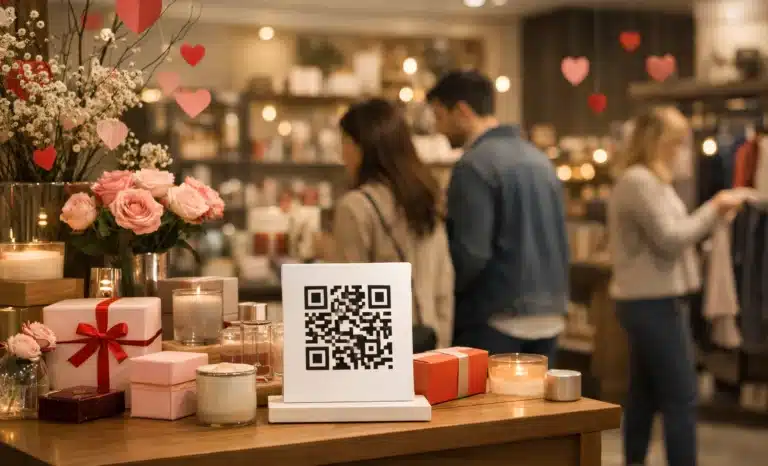
Choosing between website and landing page QR codes for Valentine’s Day campaigns is not a technical decision. It is a marketing one.
Valentine’s Day is emotional, time-sensitive, and deeply personal. People are not just buying products. They are expressing affection, celebrating love, thinking about family members, self love, and meaningful connections. That context changes how QR codes should be used.
This article explores website vs landing page QR codes for Valentine’s Day, explaining how each option works inside QRCodeKIT and how smart brands use them to drive engagement, boost sales, and build lasting relationships without overwhelming customers or relying on generic discounts.
Why Valentine’s Day requires a different QR code mindset
Valentine’s Day campaigns behave differently from standard marketing campaigns.
Consumers spend billions during this period, but spending habits vary widely. Some shoppers plan early and look for curated gift guides. Others are last minute shoppers scanning QR codes in store displays or on greeting cards. Loyal customers expect recognition, early access, or personalized messages rather than one-size-fits-all promotions.
Because of this, adding QR codes to Valentine’s Day marketing campaigns works best when the destination experience matches the emotional state and intent of the person scanning.
This is where the distinction between website QR codes and landing page QR codes becomes critical.
Understanding website QR codes in Valentine’s Day marketing
A website QR code links directly to a website, usually a homepage or a broad category page. In QRCodeKIT, this means the QR code points to an existing web destination without reshaping the experience for a specific campaign.
In Valentine’s Day marketing, website QR codes are typically used to support discovery and exploration.
They work well when shoppers want to browse:
- A full Valentine’s collection
- A general Valentine’s Day gift guide
- Multiple gift ideas across categories like tech gadgets, self care, or streaming services
- Brand stories or seasonal inspiration content
Website QR codes are especially useful in physical contexts where space is limited but curiosity is high. Think in store displays, packaging inserts, greeting cards, or traditional ads where the QR code acts as a doorway rather than a funnel.
Because the destination is broad, website QR codes are better suited for:
- Brand awareness
- Online traffic generation
- New customers who need context
- Campaigns without a single conversion goal
The limitation is focus. Once users land on a website, they decide where to go next. During high-pressure moments like Valentine’s Day, too many choices can reduce momentum.
How landing page QR codes change the campaign dynamic
Landing page QR codes direct users to a dedicated landing page built for a specific purpose. In QRCodeKIT, landing pages are designed to keep the experience simple, focused, and mobile-first.
For Valentine’s Day campaigns, this focus often makes the difference between engagement and distraction.
Landing page QR codes are ideal when the campaign revolves around a clear action, such as:
- Redeeming a unique promo code
- Accessing exclusive discounts
- Viewing a personalized video message
- Discovering a curated Valentine’s Day gift guide
- Joining flash sales or early access offers
- Participating in quizzes, voting, or interactive experiences
Because the landing page is campaign-specific, every element reinforces the same message. There are no unrelated menus, no competing banners, and no unnecessary navigation.
This makes landing page QR codes particularly effective for:
- Paid ads
- Social media ads
- SMS campaigns
- Pop up promotions
- In store QR placements targeting gift buyers
The experience feels intentional, which helps customers feel guided rather than sold to.
Website vs landing page QR codes in real Valentine’s Day scenarios
The difference between website and landing page QR codes becomes clearer when looking at real use cases.
A website QR code makes sense when:
- The QR code appears on reusable promotional materials
- The campaign runs before and after Valentine’s Day
- The goal is inspiration rather than immediate conversion
- The audience includes first-time visitors
- You want customers to explore multiple gift ideas freely
A landing page QR code makes sense when:
- The QR code supports a specific Valentine’s Day campaign
- You want to create urgency with limited-time offers
- The message needs to feel personal and emotionally relevant
- You are running flash sales or exclusive discounts
- You want to measure performance tied to one promotion
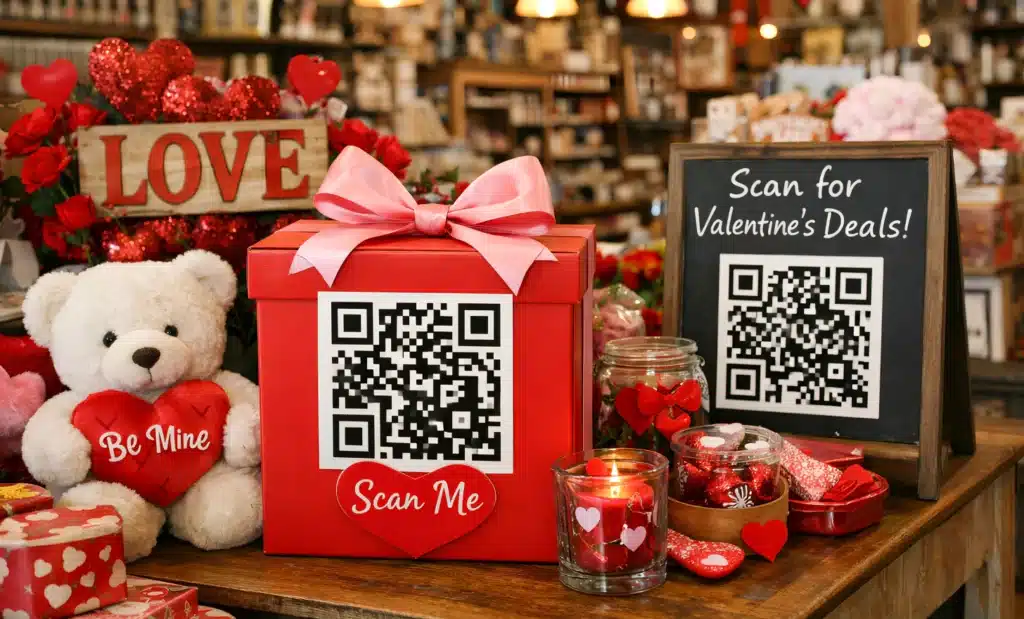
For example, a brand may place a website QR code on a storefront poster to encourage shoppers to buy online later. That same brand might include a landing page QR code inside a gift box linking to a personalized video message or a digital Valentine’s Day card.
Both QR code types can coexist without competing, as long as each serves a distinct purpose.
Personalization beyond generic discounts
One of the biggest missed opportunities in Valentine’s Day marketing is relying too heavily on generic discounts.
QR codes make it easier to offer personalized experiences that feel thoughtful rather than transactional.
Landing page QR codes can support:
- Personalized digital Valentine’s Day cards
- Love letters or greeting cards with hidden messages
- Interactive quizzes suggesting the perfect gift
- Virtual Valentine’s experiences like cooking classes or concerts
- Scavenger hunts that turn gift giving into an experience
- User generated content campaigns encouraging sharing
Website QR codes, on the other hand, work better when personalization already exists on the site itself, such as recommendations based on past purchases or loyalty programs.
The key difference is where the personalization logic lives. Website QR codes rely on existing site structure. Landing page QR codes allow brands to design personalization from scratch for a specific campaign.
The role of dynamic QR codes during Valentine’s Day
Both website and landing page QR codes in QRCodeKIT are dynamic. Conceptually, this means the destination can be updated without changing the printed QR code.
This flexibility matters during Valentine’s Day because campaigns evolve quickly.
Early access offers may turn into last minute deals. Gift guides may need to adapt based on inventory. Messaging may shift from “celebrate love” to “don’t miss out.”
Dynamic QR codes allow brands to adjust without reprinting materials, which is especially valuable for in store displays, promotional materials, and packaging inserts.
QR codes across channels in a Valentine’s Day campaign
Valentine’s Day campaigns rarely live in one channel.
Smart brands use QR codes to connect:
- In store experiences with online content
- Social media posts with curated landing pages
- Paid ads with focused campaign destinations
- SMS campaigns with time-sensitive offers
- Greeting cards with digital experiences
Website QR codes tend to support broader digital marketing strategies and long-term brand engagement. Landing page QR codes are better aligned with short-term conversion goals and campaign-specific messaging.
Understanding this distinction helps avoid mismatched experiences, such as sending a last minute shopper to a generic homepage with no clear next step.
Measuring engagement and learning from campaigns
Another practical difference between website and landing page QR codes is how clearly they support learning.
Landing page QR codes make it easier to understand:
- Which campaigns drive engagement
- Which messages resonate
- How customers interact with specific offers
- What drives returning customers versus new customers
Website QR codes provide value at a higher level, supporting overall online traffic and customer journeys that unfold over time.
Using both strategically helps brands collect data without overwhelming users or relying on assumptions.

Choosing the right QR code for your Valentine’s Day goals
There is no universal answer in the website vs landing page QR codes for Valentine’s Day discussion.
If your priority is discovery, inspiration, and long-term brand loyalty, website QR codes are often the right choice.
If your priority is focus, urgency, and clear action, landing page QR codes usually perform better.
Many successful Valentine’s Day marketing strategies combine both, using each where it naturally fits within the customer journey.
If you want to better understand how different QR code types behave in real campaigns, QRCodeKIT provides a practical environment to explore both approaches and learn what works for your audience—without locking you into a single model.