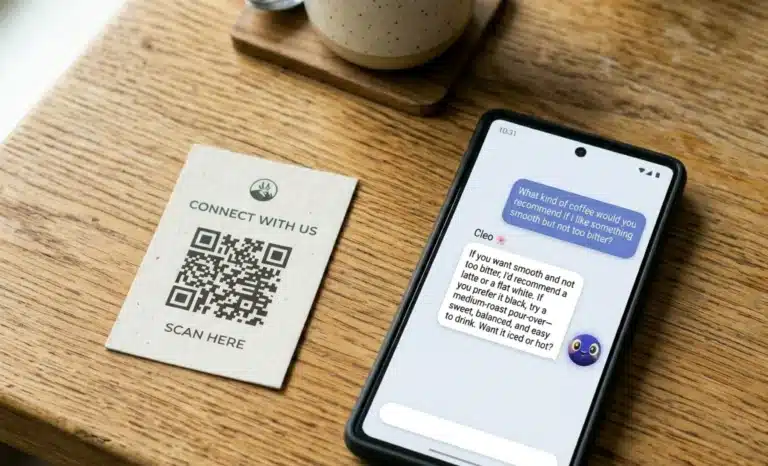
The QR code has quietly become one of the most significant interfaces between the physical and digital worlds. What began as a way to encode a URL into a printable square has evolved into something far more sophisticated. Today, a scan can launch not just a webpage, but a conversation: a real-time, intelligent exchange that adapts to who is asking and what they need. Understanding this evolution is not just interesting history. It is a strategic framework for anyone thinking seriously about how they connect with people in the physical world.
From dynamic QR codes to AI conversations: tracing the shift
To appreciate where QR technology is heading, it helps to understand the breakthrough that made it useful in the first place.
In 2009, a small team working on browser-based augmented reality experiences hit a simple but frustrating problem: every time an AR experience needed to change, the printed marker that launched it had to be reprinted. Their solution was to insert a redirect layer between the printed code and its destination, and that gave birth to the first dynamic QR code. They coined the term and launched a platform to manage these editable codes. That platform eventually became QRCodeKIT.
The insight was deceptively simple: separate the printed object from the digital destination. Once you do that, the physical world becomes flexible. A sticker on a shelf, a poster on a wall, a label on a bottle, none of them need to change. Only the experience they unlock does.
That separation was the foundation for everything that followed. And now, more than fifteen years later, QRCodeKIT finds itself at another frontier: the first platform to bring a conversational AI assistant into the QR code experience itself.
What made dynamic QR codes a genuine business tool
A static link embedded in a QR code is a one-way door. You print it, people scan it, they arrive somewhere. There is no visibility into what happens, no ability to change course if the campaign underperforms, and no recovery if the destination URL becomes outdated.
Dynamic QR codes changed all of that. The destination remains editable after printing, which means a brand can redirect traffic to a seasonal promotion, a localized landing page, or an updated piece of content without touching the physical material.
But the more consequential benefit has always been analytics. Marketers can track how many people scanned a code, when they scanned it, from which city, and on which device. That data turns a printed item into a measurable marketing channel. A flyer is not just a flyer anymore. It is a data point in a campaign.
This ability to test, measure, and iterate, the same feedback loop that powers digital advertising, becomes available in print. A restaurant chain can compare scan rates across locations. A retailer can A/B test two different designs on product packaging. An event organizer can track engagement by poster placement. The intelligence that used to live only online now extends into the physical environment.
How QR codes became interfaces, not just links
For most of their commercial life, QR codes were essentially launchers. They existed to get someone from here, a physical surface, to there, a webpage. The intelligence lived at the destination, not in the journey.
That is starting to shift in a meaningful way.
Brands are increasingly treating the scan not as the end of a process, but as the beginning of one. The question has moved from “where does this code go?” to “what happens when someone scans it?” And the answer is getting more interesting.
A scan can now trigger a personalized experience based on user behavior, location, or device. It can open a product page that looks different depending on whether you are a first-time visitor or a returning customer. It can launch an interactive guide, a loyalty program enrollment, a feedback form, or a conversation.
The QR code has become an interface. A moment of entry that connects the physical world to increasingly intelligent digital systems.
Meet Cleo: the first AI assistant living inside a QR code
Just as QRCodeKIT was the first platform to introduce dynamic QR codes, it is now the first to embed a conversational AI assistant directly into the QR code experience. Her name is Cleo.
Cleo is not a chatbot widget added on top of a webpage. She is the destination itself. When someone scans a QR code powered by Cleo, they open a real-time dialogue in their mobile browser, no app download required, no account needed. They ask a question in natural language and get an accurate, contextual answer immediately.
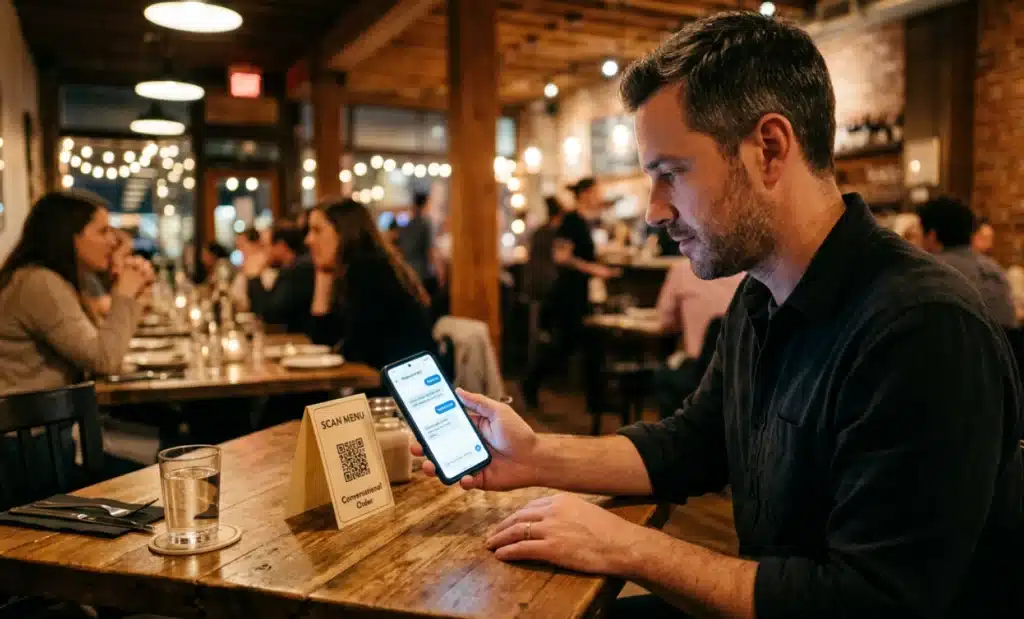
The first place Cleo is available is the QR menu for restaurants. A diner scans the code on the table, asks which dishes are vegan, whether a plate contains nuts, or if they can place an order directly, and Cleo answers with precision. She knows the menu in full. She does not get distracted during a busy Saturday night. She gives the same correct answer at noon on a Tuesday as she does at nine in the evening when the room is packed and the staff are stretched.
For restaurant owners, this means fewer repetitive questions reaching the team, fewer errors around allergens, and a measurably more confident customer at the moment of ordering. For diners, it means getting exactly the information they need without waiting and without guessing.
This is what the transition from dynamic QR codes to AI conversations looks like in practice: a physical code on a table, a scan, and an intelligent assistant ready to help.
A first deployment, with much more to come
The AI menu is where Cleo lives today. But the architecture behind it, a conversational AI layer connected to a dynamic QR code that understands context and guides users toward a specific outcome, is not limited to food and beverage.
QRCodeKIT is expanding Cleo into more use cases progressively. The restaurant is the proof of concept. The logic extends naturally to other physical environments where people have questions and need answers in the moment of the scan.
Consider retail. A QR code on a shelf label or product packaging could open a conversation about materials, compatibility, sizing, or sustainability certifications: exactly the kind of detail that influences purchase decisions but rarely fits on the label itself. In healthcare, a code on a medication package could give patients clear, verified answers about dosage, interactions, or storage without them having to navigate a help center. In hospitality, a code at a hotel check-in kiosk could handle amenity questions, room preferences, and local recommendations without involving staff.
In each scenario the pattern is identical: a physical moment of attention, a scan, and an AI that understands what that person needs in that context. The QR code becomes the access point to intelligence rather than just a shortcut to a URL.
What AI adds to QR code strategy beyond conversation
Conversational AI is the most visible change, but artificial intelligence is also reshaping QR code strategy in other directions simultaneously.
On the design side, AI-powered generators can apply brand colors, integrate logos, and produce visually distinctive codes that blend into product packaging or marketing materials without sacrificing scannability. This matters because visual appeal directly affects whether someone chooses to scan in the first place. A code that looks designed rather than added as an afterthought signals intent and professionalism. QRCodeKIT has offered AI-generated artistic QR codes for some time, allowing brands to create codes that feel like part of the visual identity, not foreign objects on it.
On the analytics side, AI can surface patterns across large volumes of scan data and translate them into actionable insights. If a campaign underperforms in a specific market or time window, the signal appears faster and with more precision. If a particular design or call to action consistently drives higher engagement, that learning becomes transferable across campaigns.
Together, these layers, smarter design, richer data, and now conversational intelligence, are turning the QR code from a passive link into an active part of the customer experience.
The role of design in scan rates and user engagement
Scan rates are directly influenced by visual context. A code that blends into its environment, that looks like it belongs on the packaging or the poster, will consistently outperform one that looks like an afterthought. This is not just aesthetic preference. It is measurable user behavior.
AI has made it genuinely easier to produce QR codes that are both functional and visually intentional. The technical constraint that used to force brands to choose between a distinctive design and reliable scanning is largely gone. High-contrast, artistically styled codes can maintain scanning accuracy while reinforcing brand identity.
The strategic implication is simple: the code itself is part of the experience. If someone is standing in front of your product, your poster, or your packaging, the QR code is the first thing they interact with. It sets an expectation. A well-designed, contextually appropriate code communicates that what follows is worth their time.
Where does the scan take someone and why it matters more than ever?
The destination question is more consequential now that conversations are possible.
For a long time, the default answer was a webpage. Sometimes a landing page, sometimes a product URL, sometimes a PDF. These destinations are passive. They present information, but they do not engage. The user either finds what they need or they do not.
Conversational AI changes the expectation. When someone scans a code and opens a dialogue, they expect the system to understand them. They expect relevant, specific, immediate responses. They are not reading a FAQ. They are asking a question. The bar is higher, and the reward for meeting it is also higher: a user who gets a useful answer in real time is far more likely to convert, return, or trust the brand.
This means the content strategy behind QR codes needs to evolve alongside the technology. It is no longer enough to have a mobile-friendly destination. The destination needs to be designed around a conversation, around the questions people are likely to ask in that specific physical context, and the answers that genuinely help them.

Is this shift relevant to every business using QR codes?
Not every business needs to implement AI conversations through their QR codes right now. The technology is maturing, and the use case needs to fit the context. For a small operation with straightforward product information and limited physical touchpoints, a dynamic QR code pointing to a well-designed mobile landing page may be entirely sufficient.
But for businesses operating at scale, across multiple locations, markets, or product lines, the calculus changes. The ability to update destinations in real time, measure engagement across physical touchpoints, and route users into intelligent experiences rather than static pages becomes a genuine competitive advantage.
The most important strategic question is not whether to use QR codes. Most businesses already are. The question is whether those codes are being used as simple launchers or as active parts of a customer experience system.
What does the next generation of QR actually look like?
The next generation is not a different shape or a new format. It is a different expectation.
The printed square stays the same. What changes is what it connects to. A scan today can initiate a conversation that understands context, responds in the user’s language, handles complex queries, and feeds behavioral data back into the brand’s systems in real time.
Dynamic QR codes were the first major step: making the physical world editable. AI conversations are the second: making the physical world responsive. QRCodeKIT was there for both.
Cleo is already live in the QR menu. The cases she will serve next are already in development. And the pattern that connects them is always the same: a physical moment, a scan, and an intelligent system that knows exactly what to do with it.
Want to go deeper on where dynamic QR codes started? QRCodeKIT published the full story of how the first dynamic QR code was invented in 2009.
All images and visual content in this article were created using RealityMAX.
