Most QR codes still do one thing: open a link. You scan, you land somewhere, the interaction ends. But that model is being replaced by something fundamentally more capable. The ways AI QR codes are changing real businesses in 2026 have less to do with where a code points and everything to do with what happens after the scan. Conversation, personalization, real-time intelligence, and contextual adaptation are now built into the QR code experience itself. This article walks through eight concrete shifts, grounded in what businesses are actually doing today.
1. Restaurant menus that answer questions, not just list dishes
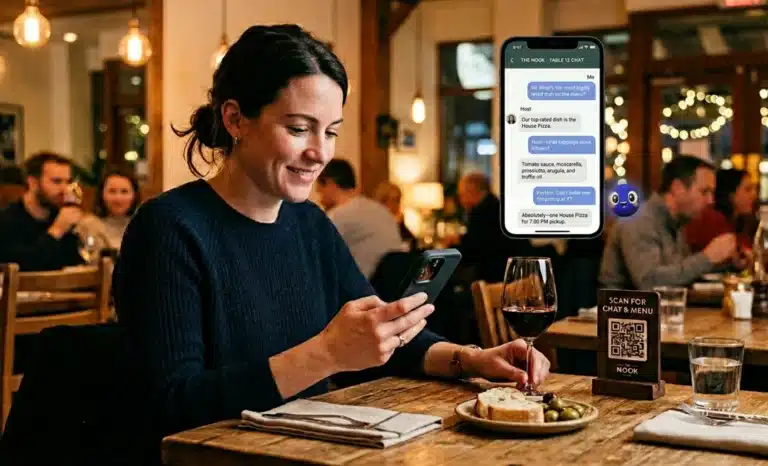
The most immediate and fully realized example of AI QR codes in action is the conversational restaurant menu. A customer sits down, scans a code, and instead of scrolling through a static list of dishes, they can ask questions in natural language: Is this vegan? Does it contain gluten? What would you recommend if I don’t eat shellfish?
This is exactly what QRCodeKIT has built with Cleo, its AI-powered menu assistant. When a customer scans the AI menu QR code, they are connected to a conversational interface that knows the full menu in depth: ingredients, allergens, nutritional data, dietary filters, and ordering options. Cleo doesn’t guess. It responds with precision, drawn from a complete knowledge base of the restaurant’s offering.
The practical impact goes beyond convenience. Staff spend less time fielding repetitive questions about ingredients and allergens. Customer confidence increases because they get accurate answers before ordering, not after. And the experience itself becomes something worth remembering: a restaurant that actually helped them find the right dish.
For businesses in hospitality, this is one of the most accessible entry points into AI-enhanced QR code technology. The QR code stays the same after printing. Everything behind it can be updated instantly, menu changes, seasonal items, new promotions, without reprinting a single code.
2. Dynamic menus that evolve without reprinting
One of the most practical advantages of dynamic QR codes has always been the ability to update what’s behind the code without touching the physical material. AI takes this a step further by making those updates smarter and more responsive to context.
With QRCodeKIT’s AI menu, a restaurant can change prices, swap out dishes, or launch a weekend special and have it reflected immediately in the conversational experience customers encounter when they scan. There’s no version mismatch between the printed menu and reality, which is a surprisingly common source of friction in busy restaurant environments.
This also opens the door to campaign flexibility. A restaurant can test a new dish description, measure how often customers ask about it or add it to their order, and use that scan data to make informed decisions about the menu. That feedback loop, from physical interaction to digital intelligence, is something static codes simply cannot provide.
The underlying principle here is important: the QR code is not a destination. It is a living interface. And that reframes how businesses should think about creating QR codes in the first place.
3. Multilingual service through one scan
Language barriers in hospitality are a real operational problem. A tourist who doesn’t speak the local language, a diverse urban customer base, an international hotel restaurant: these are everyday scenarios where a standard printed menu falls short.
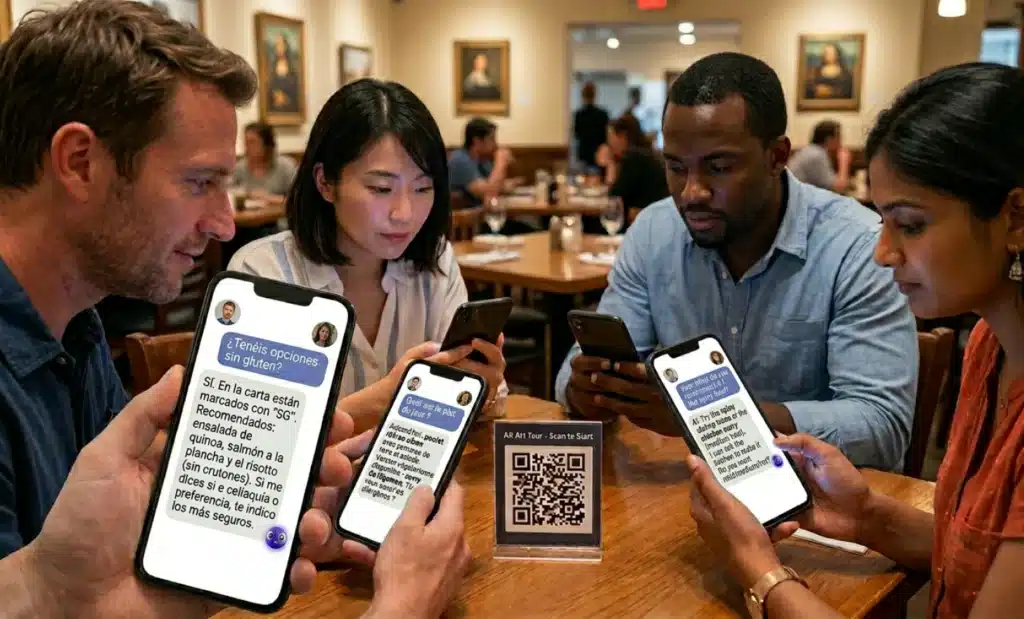
QRCodeKIT’s AI menu handles this by serving every customer in their preferred language. The same QR code, scanned by a French speaker and a Japanese speaker at the same table, delivers the full conversational experience in each person’s language without any manual switching or separate menus to manage.
This matters enormously in cities and tourist destinations where staff are already stretched. The AI menu absorbs the language workload entirely, freeing the team to focus on service rather than translation. For businesses operating across multiple locations with varied customer profiles, this kind of multilingual support is not a luxury. It is a baseline expectation that AI-powered QR systems can now meet at scale.
4. Fewer order errors, fewer awkward moments at the table
One of the most persistent and underestimated problems in restaurant operations is the order mistake. A customer asks about an allergen, the server isn’t sure, the kitchen interprets the request differently, and the dish that arrives is not what the customer expected. It creates friction for the customer, extra work for the staff, and in the case of serious food allergies, a genuine safety risk.
The AI menu addresses this at the source. Because Cleo has precise, verified knowledge of every ingredient in every dish, the information a customer receives when they ask is accurate and consistent, every single time. There is no chain of verbal communication where details can get lost. The customer reads the answer directly, confirms their choice with full information, and places the order knowing exactly what they are getting.
This matters especially in busy services where staff are juggling multiple tables and cannot always give a careful, unhurried answer to every dietary question. The AI menu doesn’t get distracted. It doesn’t misremember. It gives the same correct answer at 1pm on a quiet Tuesday as it does at 9pm on a packed Saturday night.
For restaurant owners, fewer errors means fewer remade dishes, less food waste, and fewer uncomfortable conversations at the table. For customers, it means a level of confidence in their order that a traditional printed menu simply cannot provide.
5. Branded QR codes that reinforce visual identity
The intelligence behind a QR code matters, but so does the first impression it makes. A generic black-and-white grid on a restaurant table communicates nothing about the brand it belongs to. QRCodeKIT addresses this with its AI-generated Artistic QR Codes, which incorporate brand colors, logos, and custom visual styles while maintaining full scannability.
This feature works alongside the AI menu. A restaurant can deploy a QR code that is immediately recognizable as part of its visual identity, on table cards, printed menus, window displays, or takeaway packaging, and have that same code connect customers to a fully conversational AI experience.
The AI behind the visual generation doesn’t simply apply a color filter. It reconfigures the structural elements of the code in ways that preserve the data density required for reliable scanning, even as the appearance changes significantly. For marketing teams and brand managers, this removes a long-standing compromise between aesthetics and function.
A QR code that looks like it belongs to the brand is more likely to be scanned. That might seem like a small detail, but in a competitive restaurant environment where the table is full of competing signals for attention, it is the kind of detail that adds up.
6. Real-time analytics that inform better decisions
Every scan of a QR code is a data point. The question is whether that data gets used or wasted. AI-powered QR systems turn passive scan counts into actionable intelligence, and for businesses running multiple locations or frequent menu changes, this distinction is significant.
With QRCodeKIT’s analytics, businesses can see when and where their codes are being scanned, which devices customers use, and how engagement patterns vary across locations or time periods. When combined with the conversational data from the AI menu, this picture becomes even richer: which dishes are customers asking about most, where do they drop off in the ordering flow, which language groups are underserved.
A chief marketing officer managing a restaurant group doesn’t just need to know that 3,000 people scanned a code last week. They need to know whether those scans translated into orders, which items generated questions, and whether the AI was giving answers that led to conversions. That level of insight requires AI at both ends of the QR experience: in the interaction itself and in the analysis of what those interactions reveal.
This is what separates a dynamic QR code strategy from a static one. The code becomes a continuous feedback mechanism, not a one-time print decision.
7. Contactless ordering that reduces operational friction
The contactless menu is now a baseline expectation in many markets, particularly among younger consumers and in high-volume hospitality settings. But a contactless menu that only displays information is only solving half the problem. The other half is the ordering flow itself.
QRCodeKIT’s AI menu integrates directly with ordering systems, so the conversation that begins with a dietary question can end with a confirmed order, without the customer needing to flag down a server or navigate a separate app. The entire journey, inquiry, recommendation, decision, order, happens inside a single scan.
This has meaningful operational consequences. Fewer steps between intent and order means fewer abandoned decisions. Staff can focus on delivery and experience rather than taking orders and answering ingredient questions. And the data generated by each completed order feeds back into the AI, improving the quality of future recommendations.
For restaurants operating at high volume or with lean teams, this kind of streamlined QR code experience is not a gimmick. It is a measurable improvement to throughput, customer satisfaction, and staff workload simultaneously.
8. What Cleo makes possible beyond restaurants
The AI menu is where Cleo lives today. But the architecture behind it, a conversational AI layer connected to a dynamic QR code, capable of understanding context, filtering information, and guiding a user toward a specific outcome, is not limited to food and beverage.
In education, a QR code on a textbook or classroom poster could connect students to an AI assistant that answers questions about the specific topic on that page, explains concepts at different levels, or suggests further reading based on what the student already understands. One code per chapter, no app to install, no login required.
In healthcare, a QR code on a medication package or a clinic waiting room display could provide patients with clear, accurate answers about dosage, side effects, and interactions. Studies suggest that better information access can improve medication adherence rates by up to 30%, and a conversational AI available through a single scan is one of the most friction-free ways to deliver that information.
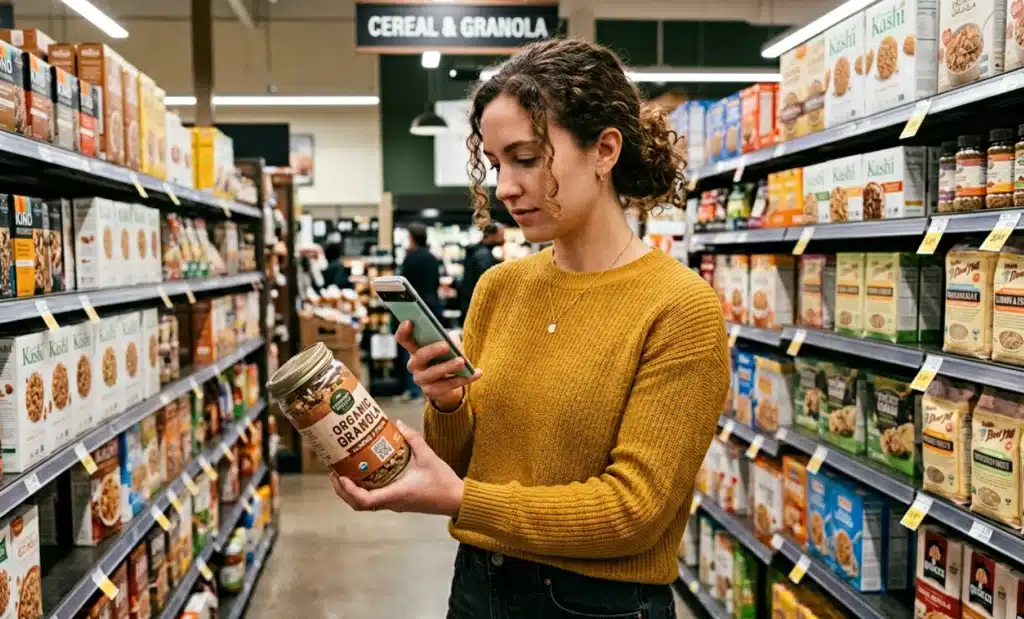
In retail, a QR code on a product label could let customers ask detailed questions about materials, manufacturing origins, sustainability certifications, or compatibility with other products. That is exactly the kind of information that influences purchase decisions but rarely fits on packaging.
In events, a QR code at a venue entrance or exhibition booth could handle FAQs, provide schedule information, and guide attendees to the right session based on their interests, without a single staff member involved in that part of the experience.
The common thread is not the industry. It is the pattern: a physical moment of attention, a scan, and an AI that knows exactly what that person needs in that context. QRCodeKIT is building toward this broader vision, with the AI menu as the first fully deployed application of what Cleo can do. The restaurant use case is the proof of concept. The roadmap extends considerably further.
Is setting up an AI-powered QR menu complicated?
Not at all. QRCodeKIT is designed to make the setup fast: the AI menu can be live in under five minutes, with no technical background required. You upload your menu, configure your preferences, and the dynamic QR code is ready to deploy. Any updates to the menu are reflected instantly without touching the physical code.
The more meaningful investment is thinking through the experience you want to create. What questions do your customers typically ask? What dietary needs come up most often? What would it mean for your team if those questions were handled automatically, accurately, every time? Answering those questions is where the real value of the AI menu gets defined. The QR code generation itself takes seconds.
What does the future of AI QR code technology look like?
The trajectory is clear: more intelligence, more personalization, and more integration with the physical environments where QR codes appear. Augmented reality is one direction, where scanning a code launches a spatial experience rather than a flat web page. Deeper integration with loyalty programs, purchase history, and user behavior is another, allowing the AI to recognize returning customers and adapt accordingly.
What connects all of these possibilities is the shift from the QR code as a static link to the QR code as an intelligent entry point. Cleo in the restaurant is the present. Cleo in the classroom, the pharmacy, the retail aisle, and the event space is where this technology is heading. The global QR code market is projected to reach approximately $3.78 billion by 2025, and the next wave of that growth will belong to businesses that understand what becomes possible when AI moves inside the scan.
The two-dimensional barcode was always a bridge between physical and digital. Now, for the first time, there is genuine intelligence waiting on the other side.
All images and visual content in this article were created using RealityMAX.
