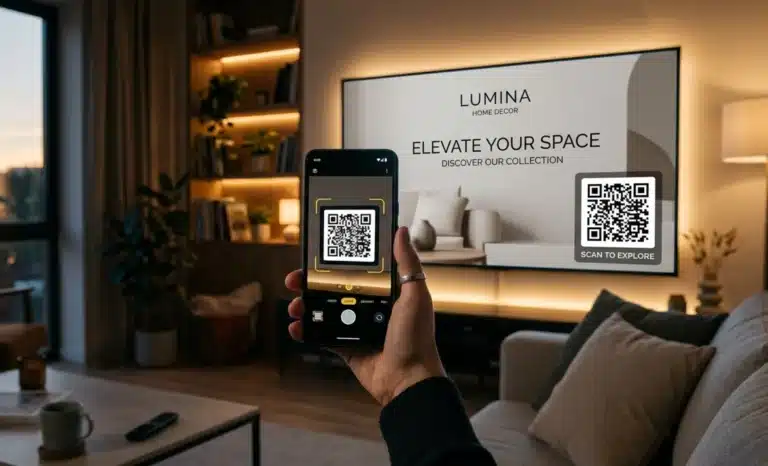
TV is back in the performance marketer’s toolkit. Not because the medium changed, but because the phone in the viewer’s hand now closes the loop that broadcast advertising never could. A QR code on TV commercials connects a passive viewing moment to an immediate action. But only if the code is placed, timed, and built correctly. Done wrong, it gets ignored or fails to scan. Done right, it becomes one of the most measurable touchpoints in a media plan.
This guide covers the technical, creative, and strategic decisions that determine whether a TV QR code campaign performs. It is written for marketing teams, media planners, and creative directors who are briefing or producing TV ads with a QR component.
The technical fundamentals of a scannable TV QR code
Most QR codes fail on television before the viewer ever raises their phone. The reasons are almost always technical, and almost always avoidable.
On-screen time is the first variable. A QR code that appears for two seconds will not be scanned by anyone. The minimum effective display time is five to seven seconds. Ten seconds is safer. Anything below five seconds is essentially decoration. The viewer needs time to notice the code, decide to scan it, unlock their phone, open the camera, and point it at the screen. That sequence takes longer than most creative directors assume.
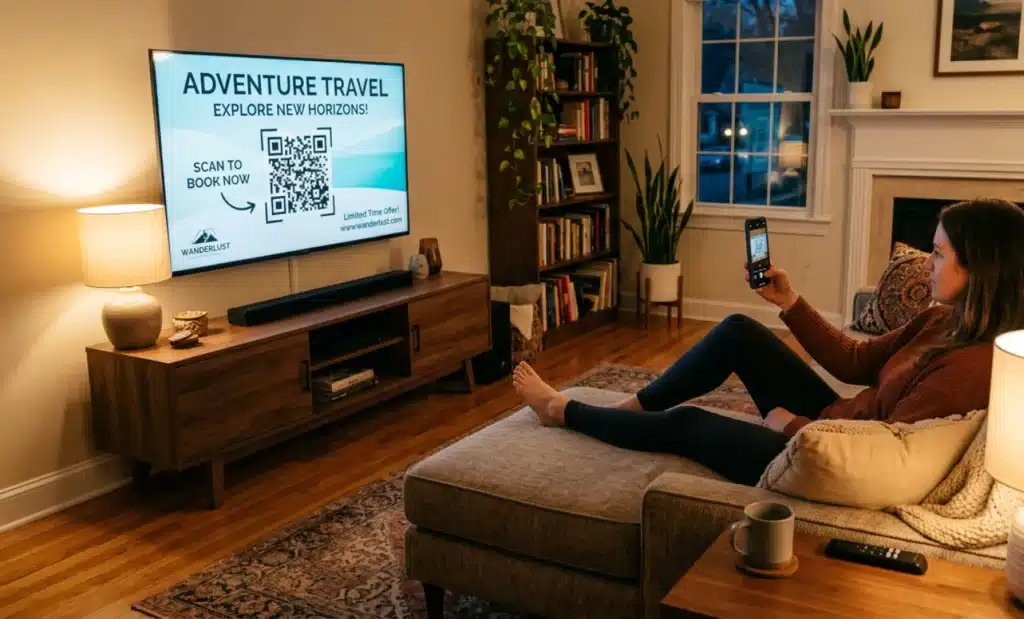
Size matters on screen more than in print. A QR code rendered too small relative to the frame will not resolve at typical viewing distances. As a guideline, the code should occupy at least 10 to 15 percent of the screen width when displayed full screen. On a 65-inch television viewed from three meters, that translates to a code large enough that the camera can read it without the viewer moving closer.
Contrast is non-negotiable. A dark code on a light background, or a light code on a dark background, works. Anything in between creates scanning failures. Placing a QR code over a video background without a solid color padding zone is one of the most common mistakes in broadcast creative. The quiet zone, the white (or consistently colored) border around the code, must be preserved. It is not decorative. It tells the camera where the code begins and ends.
Position on screen also affects scan rates. Lower-third placement frequently conflicts with network bugs, local station overlays, or closed caption bars. Center-screen or upper-right positions perform more consistently. If the code appears during a scene with camera motion, scan rates drop significantly. Static or near-static frames work best.
Why dynamic QR codes are the right choice for TV advertising
A TV commercial is expensive to produce and expensive to air. The last thing a media team needs is to recut and re-traffic an ad because a destination URL changed, a promotion ended, or a landing page needed to be updated.
Dynamic QR codes solve this. The code printed in the ad, or rendered in the video file, stays the same. What it points to can be updated at any time through the platform that manages it. If the campaign shifts from a product launch page to a limited-time offer, the redirect changes in seconds. No new creative. No new trafficking. The code on screen remains valid.
This flexibility is especially valuable for seasonal campaigns, A/B tests on landing pages, and any situation where the destination needs to evolve mid-flight. It also means that a single ad unit can serve different purposes depending on when it airs, without any changes to the broadcast file.
Platforms like QRCodeKIT are built around this model. Every QR code generated through the platform is dynamic by design. The destination and the content behind it are always editable, which makes them well-suited for the realities of TV campaign management.
Static QR codes have no place in TV advertising. A static code encodes the destination directly into the pattern. If anything about the campaign changes, the code is dead, and the ad is wasted.
Attribution and analytics: measuring what your TV QR code drives
Television has historically been difficult to measure. QR codes change that. Every scan is a discrete, timestamped event tied to a specific device, location, and time of day. That data is available immediately, not weeks later.
The most important metrics for a TV QR campaign are scan volume by air time, geographic distribution of scans, device type, and downstream conversion rate on the landing page. When layered against the media schedule, scan data reveals which dayparts and which networks drive the most engagement. That is information a brand can act on mid-campaign.
Most QR platforms provide scan analytics natively. For deeper attribution, the destination URL should include UTM parameters that pass campaign, source, and medium information into Google Analytics or whatever analytics stack the brand uses. This connects the QR scan event to the full customer journey, including whether the visitor converted, how long they spent on the page, and what they did next.
One practical note: scan volume from TV will always be lower than click volume from digital. That is expected. The people who scan are self-selected, high-intent viewers. Conversion rates on TV QR traffic are often significantly higher than on paid social or display, precisely because the friction of picking up a phone filters for motivation.
Creative considerations: integrating a QR code without breaking the ad
A QR code dropped into a TV commercial as an afterthought tends to look like one. When the creative team treats the QR as part of the concept rather than a compliance element, both the scan rate and the viewing experience improve.
Timing is the first creative lever. The QR code should appear at a moment of peak intent, typically at or near the end card, after the message has landed. Showing it too early interrupts the narrative. Showing it only in a flash frame wastes it.
Voice-over coordination matters more than most teams realize. When the narrator or on-screen talent explicitly references the code, scan rates increase. Phrases like “Scan now to see the full range” or “Point your camera here” give the viewer permission and a reason to act. Without that verbal prompt, many viewers will not make the connection.
End cards are the natural home for QR codes in TV advertising. They provide a static frame, a clear visual hierarchy, and a moment when the viewer knows the message is complete and action is appropriate. A well-designed end card with a clear code, a short call-to-action line, and enough on-screen time is the baseline for any TV QR placement.
Color choice for the code itself should be deliberate. A white QR on a dark background works well on television because screens are luminous. Avoid placing any code on a gradient, a busy background, or over any moving element.
Animated QR codes: what becomes possible when the code itself moves
Picture a QR code in the corner of your TV spot that does not sit still. It pulses gently in sync with the music. Its pattern shifts and breathes, drawing the eye without competing with the visual. The viewer notices it not because a voice told them to look, but because something in the frame is alive. They pick up their phone without being asked twice.
That is not a hypothetical format from a distant future. It is where QR code technology is heading, and QRCodeKIT is actively building toward it.
The foundation is real and it is solid. This is not a concept built on wishful thinking or design tricks. It is a genuine technical capability, one that requires deep expertise in how QR codes are architected at their core. That is precisely why most platforms cannot simply decide to offer it. It takes years of work in the QR space to build toward this, not weeks.
For television specifically, animated QR codes are not just a creative novelty. They are a structural solution to one of broadcast advertising’s oldest problems: how do you make a passive viewer take an active step? A static code competes with the rest of the frame for attention. An animated code behaves differently. Motion is processed pre-consciously. On a luminous screen, in a room where the viewer is half-distracted, a code that moves catches the eye the way a static label never will. It signals interactivity without a single word of instruction.

The creative possibilities extend beyond simple movement. A code designed to pulse on the beat of the ad’s audio. A code whose visual pattern transitions from one state to another as the end card fades in. A code that feels like part of the spot’s visual identity rather than a functional afterthought. These are not design decisions that require the code to be rebuilt or re-trafficked. The destination remains dynamic and fully updatable, exactly as with any QR code on the platform. The animation layer sits on top of the same flexible infrastructure that makes dynamic QR codes the right choice for TV in the first place.
Most QR platforms are nowhere near this. The majority generate static pattern outputs and have no technical roadmap for animation. It is the kind of capability that grows from years of work in the QR space, not something that can be bolted on quickly.
QRCodeKIT has been building in this space since 2009. Animated QR codes are part of what the platform is developing next. If you want to be among the first to use this format in a broadcast campaign, and to get the most out of your TV ad with a QR code that actually competes for attention on screen, the conversation starts here.
Common mistakes that kill TV QR code performance
The same errors appear across campaigns from brands of every size. They are preventable, but only if the production and media teams talk to each other early.
The most common failure is insufficient on-screen time. A QR code that appears for three seconds or less will collect almost no scans. This usually happens because the creative team treats the code as a late addition, dropped into an existing cut, rather than designing the end card around it from the start.
Lower-third placement is the second most frequent mistake. Local station overlays, network bugs, and news ticker bars live in the lower third of the frame. A QR code placed there may be partially or fully obscured depending on the network and daypart. Always verify placement against the actual broadcast environment.
Using a static QR code for a time-limited campaign is a structural error. If the campaign runs out of validity, whether a promotion ends, a landing page goes offline, or the destination changes, a static code becomes a dead link. There is no way to redirect it. Every subsequent scan after that point leads nowhere. Dynamic codes prevent this entirely.
Finally, assuming any QR code will scan from any television is wrong. Older screens, low-contrast displays, and screens with heavy glare or surface reflections all reduce scan success rates. Testing the code on the actual display type and at the intended viewing distance before the campaign goes live should be a standard part of the production process, not an afterthought.
Frequently asked questions
How long should a QR code appear on screen in a TV commercial?
The minimum effective display time is five to seven seconds. Ten seconds gives viewers enough time to notice the code, pick up their phone, and complete the scan. Anything shorter than five seconds typically results in near-zero scan activity, regardless of how prominent the code is on screen.
What is the difference between a static and dynamic QR code for TV advertising?
A static QR code encodes the destination URL directly into the pattern. It cannot be changed after the ad is produced. A dynamic QR code points to a destination that can be updated at any time through the managing platform, without changing the code itself. For TV campaigns, where the ad file cannot easily be updated mid-flight, dynamic codes are the correct choice. They allow the landing page, offer, or destination to evolve without touching the broadcast creative.
Can a QR code on a TV screen actually be scanned by a smartphone camera?
Yes, provided the code meets minimum size and contrast requirements, the display is not heavily reflective, and the viewer is within a reasonable distance of the screen. Modern smartphone cameras with native QR reading are sensitive enough to scan from typical viewing distances on most screens. The key variables are code size relative to screen, contrast ratio, and on-screen time. Testing at the intended viewing distance before the campaign goes live is strongly recommended.
How do I measure the performance of a QR code used in a TV ad?
Scan analytics are available natively through most dynamic QR platforms. For campaign-level attribution, append UTM parameters to the destination URL so that scan events flow into your analytics platform with source, medium, and campaign tags. Layering scan timestamps against your media schedule reveals which networks, dayparts, and ad placements are driving the most engagement. This is one of the clearest forms of TV attribution available today.
All images and visual content in this article were created using RealityMAX.