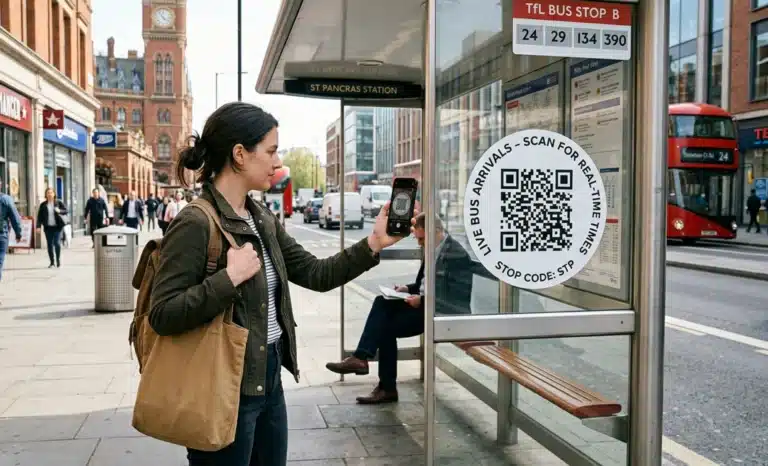
Public transport moves millions of people every day. And yet, for all its scale, it still leaves passengers standing at bus stops squinting at faded timetables, or arriving at train stations with no idea whether their platform has changed.
The information gap in transit is not a technology problem. It is a connectivity problem. The infrastructure exists. The data exists. What has been missing is a simple, frictionless way to put that data exactly where a passenger is standing, at the moment they need it.
AI QR codes for public transport are closing that gap, one scan at a time.
What makes an AI QR code different from a standard one
A standard QR code is a redirect. It points to a URL and that is the end of its role. For transit agencies, that might mean a link to a PDF timetable, a static route map, or a general information page. Useful, but passive.
An AI QR code does something different. When a passenger scans it, they land on a destination page configured by the transit operator. On that page, a conversational AI layer is ready to answer questions directly. Not a search bar. Not a menu of links. A conversation.
The passenger can ask which bus is next, whether a service is running, what the nearest interchange is, or how to buy a ticket. Cleo, the AI assistant built into QRCodeKIT, draws on the content the operator has provided and responds in real time. No app to download, no login required. Just a quick scan and an instant answer.
Because these are dynamic QR codes, the information behind them can be updated at any moment without replacing any physical signage. The code on the bus stop stays the same. The content it delivers is always current.
The real problem AI QR codes solve for transit agencies
Transit operators deal with a specific kind of information challenge. Their environment is distributed across hundreds or thousands of physical locations. Their passengers are time-pressured and often unfamiliar with the system. And the information that matters most changes constantly: service disruptions, route changes, delay alerts, platform reassignments.
Traditional signage handles none of that well. Printed timetables go out of date. Digital screens are expensive to install at every stop. Staff cannot be everywhere.
AI QR codes let transit authorities place a live information point at any physical location for a fraction of the cost of a screen. Each code can be configured with content specific to that stop, that route, or that vehicle. A code on a city bus might answer questions about the route, upcoming stops, and connecting services. A code at a train station might handle platform queries, accessibility information, and local destination guides.
The operator controls the knowledge base. Cleo handles the conversation.
Where AI QR codes work best in public transport
The most effective deployments share a common logic: place the code where passengers have a question and no immediate way to answer it.
Bus stops and shelters are an obvious starting point. A passenger waiting for a delayed service wants to know when it will arrive and whether an alternative is running. A well-configured AI QR code can answer both without requiring the passenger to call a helpline or navigate a cluttered app.
Train stations and transit hubs benefit from codes that handle wayfinding, platform information, and service alerts. In a large station, the volume of questions directed at staff is often dominated by the same handful of queries. An AI QR code that handles those automatically reduces pressure on staff and gets passengers to their platforms faster.
Inside vehicles is a less obvious but increasingly valuable placement. A QR code inside a bus or tram can answer questions about the route, final destination, stops on request, and connecting services at the terminus. For tourists or occasional riders, that kind of contextual information makes a significant difference to their experience.
Transit interchanges and park-and-ride facilities have their own information needs: parking availability, connecting routes, service frequency, ticketing options. A single AI QR code at the entrance can handle all of them.
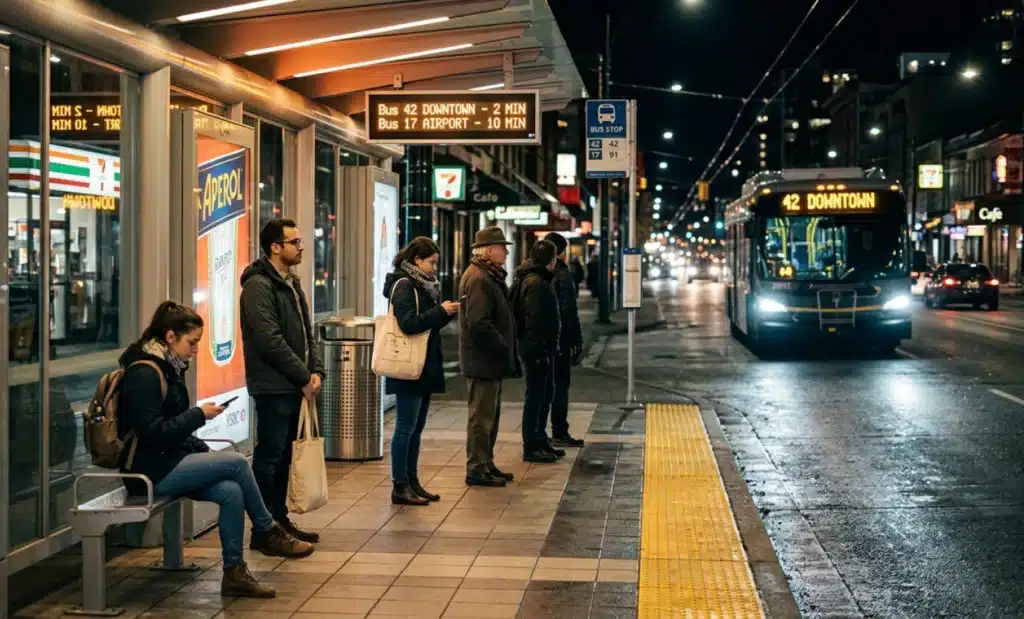
How transit agencies configure Cleo for their environment
The setup does not require developer involvement. Through QRCodeKIT, an operator creates a dynamic QR code and builds the knowledge base that Cleo will draw on. That content can include route information, service schedules, accessibility details, ticketing guidance, real-world examples of common journeys, and answers to the questions passengers ask most.
Because Cleo is multilingual by design, a single code handles conversations in whatever language the passenger chooses. The operator configures the content once. Cleo responds in dozens of languages. For transit systems serving international visitors or multilingual cities, that capability alone changes the quality of the passenger experience substantially.
The knowledge base can be updated at any time. If a route changes, if a service is suspended, if a new interchange opens, the operator updates the content and every code that draws on it reflects the change immediately. No reprinting. No physical maintenance. No lag between the operational reality and what passengers are told.
Can AI QR codes support contactless ticketing and boarding?
This is a question transit operators raise often, and it is worth addressing directly.
AI QR codes as described here are primarily an information layer, not a payment or validation system. Cleo’s role is to answer questions and guide passengers, not to process contactless payments or replace digital ticketing infrastructure.
That said, there is a natural complement between the two. A passenger scanning a code to ask about fares can be guided toward the correct ticketing channel. A code at a bus stop can explain how digital ticketing works, what the options are, and how to access them. The AI layer does not replace the ticketing infrastructure but it does reduce the friction and confusion that surrounds it, which in practice means fewer abandoned journeys and faster boarding processes.
Passenger feedback and the data transit agencies often overlook
Every scan and every conversation generates data. Transit operators using AI QR codes gain access to something they have historically lacked: a direct, ongoing signal from passengers at the point of experience.
What are people asking about most at this stop? What information is missing from the current knowledge base? Where are passengers getting confused or dropping off mid-conversation? That data is available through the analytics layer that comes with every QRCodeKIT deployment.
For transit authorities committed to service improvements, this kind of real-world feedback is more actionable than a quarterly survey. It reflects what passengers actually want to know, at the location where they want to know it, in the moment that matters.
What does a realistic AI QR code deployment look like for a transit authority?
A mid-sized city transit authority wants to improve the passenger experience at its 200 busiest bus stops without investing in digital screens or expanding its customer service team.
It creates a library of dynamic QR codes through QRCodeKIT, each configured with stop-specific content: the routes that serve that stop, typical frequency, key destinations, connections available, and answers to the questions its staff know come up constantly.
Those codes are printed on weather-resistant signs at each stop. When services are disrupted, the operator updates the relevant knowledge bases centrally. The codes on the physical signs do not change. Passengers who scan them get accurate, current information without calling a helpline.
Over the first month, the analytics show that the most common query at interchange stops is about connecting services. The operator adds more detailed content on that topic. Conversation completion rates improve. The stops with codes see measurable reduction in helpline call volume.
That is not a speculative scenario. It is the logic that makes AI QR codes for public transport a practical investment rather than a novelty.

Are AI QR codes the right fit for every transit context?
Not every transit environment is the same, and it is worth being realistic about where this approach works best and where it has limits.
AI QR codes perform well in environments where passengers are stationary for at least a few seconds, where smartphone use is normal, and where the information need is specific and answerable from a structured knowledge base. Bus stops, station concourses, vehicle interiors, and information kiosks all fit that description.
They are less suited to environments where passengers are moving quickly and have no time to pause, or where the information need is highly unpredictable and cannot be anticipated in the knowledge base. A busy platform during peak hour may not be the right place to rely on self-service information tools as the primary resource.
The strongest deployments treat AI QR codes as part of a broader information strategy, not as a replacement for all other communication channels. Combined with staff presence at key points, real-time departure boards, and app-based services for frequent riders, they fill the gap that those channels consistently leave: the passenger standing at a quiet stop at an off-peak hour with a question and no one to ask.
How do transit operators get started with AI QR codes?
The practical starting point is identifying the locations where information gaps cause the most friction. Which stops generate the most helpline calls? Where do passengers most often look confused or ask passing staff for directions? Where is the distance between a question and an answer currently largest?
Those locations are where the first codes should go. The knowledge base behind each one should be built from real passenger queries, not an internal assumption of what passengers want to know.
QRCodeKIT supports transit operators in configuring Cleo for their specific use case, including those not yet available as self-serve options in the platform. For agencies that want to move faster than a standard rollout, a deployment can typically be configured within hours.
The physical world has been static for a long time. AI QR codes do not replace that physical world. They give it a voice.
All images and visual content in this article were created using RealityMAX.