Hospitality operators have spent the last five years watching QR code scans in hospitality go from emergency pandemic tool to permanent fixture in the guest experience. The question in 2026 is no longer whether guests will scan QR codes. It is where they scan most, what they expect to find when they do, and what the numbers actually say about adoption across hotels, restaurants, and resorts.
This article looks at QR code scans in hospitality through publicly available data and industry context. The goal is practical. Operators reading this should walk away with a clearer picture of where scans happen, what guests do after they scan, and how dynamic QR codes fit into the service stack rather than as a short-term workaround.
Where do QR code scans in hospitality stand in 2026?
QR code scanning behavior shifted permanently between 2020 and 2022, and the elevated baseline has held. Statista’s 2024 reporting on global QR code usage estimated that U.S. smartphone QR code scanners would surpass 100 million users by 2025, more than double the 2020 figure of around 52 million. That growth reshaped guest expectations across the hospitality industry. Scanning a code is no longer a friction point. For many guests it is the expected path.
Why operators care about the numbers
What hospitality businesses care about in 2026 is the substance behind the scans. Raw scan counts are easy to inflate by putting codes everywhere. The numbers that matter are conversion from scan to action, completion rates on a feedback form, and repeat scans from the same guest across a stay.
Looking beyond raw scan counts
A high scan count on a table tent in a busy restaurant might mean little more than curious diners glancing at the menu. The real signal sits in what happens next. Did the guest place an order? Book a spa service? Join the loyalty program? Those downstream actions tell the story.
Where do guests actually scan QR codes in a hotel or restaurant?
QR code scans in hospitality cluster in a predictable set of locations. The pattern reflects when guests have a question, a decision, or an empty moment that invites them to pull out their mobile device.
The highest-traffic placement spots include:
- Restaurant tables and bar counters for digital menus
- Hotel room key envelopes and welcome cards at check in
- In-room information cards covering room service menus, Wi-Fi, and amenities
- Spa service menu displays and activity booking points
- Lobby displays for event schedules, local attractions, and concierge services
- Checkout folders or final invoices for feedback surveys
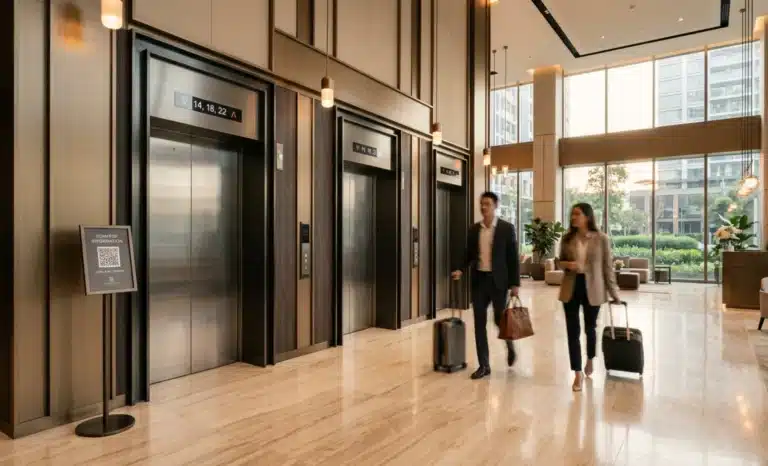
- Elevator banks and corridor signage for property-wide information
- Restaurant table tents listing specials, wine pairings, or weekly events
These are the placements where scan rates tend to be highest because they capture the guest at a moment of genuine need. A QR code on a restaurant table when the guest is hungry performs differently than a QR code on a brochure in the corporate office.
Strategic placement at high-touch moments
Strategic placement matters more than volume. Five QR codes placed where guests already have questions outperform fifty QR codes scattered across surfaces nobody looks at. The high-touch moments at check in, at the table, at checkout, and in the room are where intent is highest.
Where placement underperforms
QR codes in parking lots, on staff doors, or on exterior signage with no context tend to underperform. The scan needs a reason. Without context, the code is just a square on a wall.
What does public data show about adoption in the hospitality sector?
Several public reports give a useful baseline for adoption. Hospitality Net has documented the persistence of contactless service patterns established during 2020 to 2022, noting that many hotel groups retained QR-enabled menus and contactless check in options after restrictions lifted because guests preferred them. The National Restaurant Association’s 2023 State of the Restaurant Industry report found that the majority of full-service operators continued to offer QR-based digital menus alongside printed menus, with operators citing speed of updates and cost savings as the main drivers.
Consumer-side adoption
On the consumer side, Statista’s QR code usage forecasts show steady year-over-year growth in U.S. smartphone scanners, with the user base projected to exceed 100 million by 2025. The growth curve is global, not just American. European and Asian markets show similar patterns, with restaurant and hotel QR usage now a default expectation for many travelers.
Operator-side adoption
Skift and Phocuswright have both reported on the broader contactless trend in hotel operations, observing that mobile-first guest journeys including QR-based check in, digital keys, and in-room service ordering have become standard offerings at upper-tier brands and are spreading into mid-scale and limited-service properties.
These figures point to a clear pattern. QR code scans in hospitality are not a niche behavior. They are a mainstream channel.
How do digital menus work as a use case?
Digital menus remain the most visible QR code use case in hospitality. The appeal is operational as much as it is about guest preference. Printed menus have to be reprinted whenever prices change, dishes are added, or a seasonal item replaces an old one. A digital menu behind a dynamic QR code updates instantly. The QR sticker on the restaurant table stays the same. The menu behind it can change every week, every day, or every hour.

Cost savings versus printed menus
The National Restaurant Association has flagged printing costs and reprinting costs as a recurring pain point cited by operators. A multi-location group printing seasonal menus four times a year across hundreds of restaurants accumulates real expense on printed materials. Dynamic digital menus eliminate that line item entirely after the initial QR code rollout.
Multilingual support and real-time updates
Multilingual support is the other quiet advantage. A single QR code can serve guests in English, Spanish, French, Japanese, or whatever languages the property regularly hosts, without printing five separate menu versions. Real-time updates also mean that an 86’d dish disappears from the menu the moment the kitchen runs out, sparing servers the awkward conversation.
When to keep printed menus
The honest trade-off is that not every guest wants to read a menu on their phone. Older guests, larger tables, and guests at upscale restaurants often prefer the tactile experience of printed menus. A hybrid model with both options tends to work better than a strict digital-only policy.
How does contactless check in change the guest experience?
Contactless check in has matured from a 2020 stopgap into a real product feature. The flow is straightforward. A guest receives a QR code or link before arrival, completes identity verification and payment authorization in advance, and skips the front desk queue on arrival to collect a key card or activate a digital key. Check out works in reverse. The guest scans a code in the room, reviews the folio, settles any incidentals, and leaves without queuing.
Reduced front desk queues
The operational benefit is concrete. Front desk staff spend less time on routine transactions and more time on the conversations that actually shape guest satisfaction scores. A warm welcome from a staff member who is not buried in paperwork is more memorable than a rushed greeting at a crowded counter.
Smoother arrival and departure
Skift has reported that major hotel groups including Marriott and Hilton continued investing in mobile and contactless check in well past the initial pandemic period because the data supported it. The check in process and check out experience are now key touchpoints where guests judge the property, and friction at either end weighs heavily on online reviews.
Digital key integration
Many properties pair contactless check in with a digital key, sending the room access to the guest’s mobile device alongside or instead of physical room key cards. The QR code becomes the entry point to the whole arrival flow.
How do concierge services benefit from QR codes?
A QR code in the hotel room or lobby that links to a curated guide of nearby attractions, tourist attractions, restaurant recommendations, and transit information turns the property into a self-service concierge layer. This is particularly useful in a boutique hotel without a full concierge desk, but most hotels use it as a complement to human concierges rather than a replacement.
Self-service guides to local attractions
The content needs to be genuinely useful. A list of generic tourist attractions with no editorial voice does not earn repeat scans. A short list of restaurants the staff actually recommend, with a note on why and a walking distance, does. Guests reward specificity.
Event schedules and fitness classes
Hotels with active programming including fitness classes, wine tastings, kids clubs, or seasonal events benefit from QR codes that direct guests to live event schedules. The schedule changes constantly. A printed flyer in the room goes stale within days. A QR code linked to a dynamic page stays accurate.
How do feedback surveys capture guest sentiment?
Feedback surveys placed at high-touch moments capture impressions while the experience is still fresh. A QR code on the checkout folio, the restaurant bill, or the spa receipt can pull a guest into a short feedback form at the exact moment they are most likely to have a clear opinion. This timing matters for guest feedback collection. Surveys sent by email a week later compete with the rest of the inbox and capture stale memory.
Designing surveys that get completed
The design rule is to keep the survey short. Two or three questions get answered. Twelve questions get abandoned. Customer feedback is most useful when guests can finish in under a minute.
Linking feedback to online reviews
Some operators route happy respondents to public review platforms and unhappy respondents to a direct contact channel for service recovery. This pattern can improve guest satisfaction scores and online reviews while giving staff a chance to fix problems before they become public.
How do loyalty programs benefit from QR code enrollment?
Loyalty enrollment is one of the most natural QR code use cases in hospitality. The friction in joining loyalty programs is usually the form itself. Asking a guest at check in to type their email, phone number, and contact details into a tablet slows the line.
Low-friction signup via scan
A QR code on the welcome card lets the guest enroll on their own mobile device, at their own pace, often after they have settled into the room. The check in process stays fast, and the guest still joins the program.
Building loyalty over multiple stays
Branded QR codes that link to personalized member pages can help build loyalty over time. A returning guest scanning the same code sees their points balance, upcoming reservations, and any available complimentary upgrade waiting on their next stay.
Why are dynamic QR codes the right foundation for hospitality?
Hospitality content changes constantly. Menus rotate with seasons. Promotions run for a weekend. Events come and go. Spa service menus update when a new treatment launches. Restaurant hours shift between weekdays and weekends. If the QR code on a room key card or table tent links to a static destination, every change means reprinting physical materials.
Updating content without reprinting
Dynamic QR codes solve this. The code itself stays the same forever. The destination behind it can be updated at any time from a single dashboard. A particular hotel that prints 5,000 room key envelopes once a year does not need to reprint them when the breakfast menu changes. The QR on the envelope keeps working, and the content behind it stays current.
Seasonal menus, promotions, and marketing campaigns
This flexibility matters most during marketing campaigns. A summer promotion can be launched on Monday and replaced by an autumn campaign in October without touching a single printed piece. Lobby displays, table tents, and in-room cards all stay in place. Only the destination changes.
How QRCodeKIT supports dynamic QR codes
Platforms focused on dynamic QR code technology have positioned dynamic codes as the default for hospitality use cases. QRCodeKIT, active since 2009, generates only dynamic QR codes. There are no static codes on the platform, which means hospitality operators can update menus, promotions, and service information without reprinting any printed materials. The same logic applies whether the QR is on a brochure, a lobby display, or a restaurant table.
What are the limits of a QR-only approach?
Not every guest will scan. Some prefer printed menus. Some travel without a smartphone, or with a phone whose battery is dead, or with a data plan that punishes roaming. Older guests often scan less than younger guests, though the gap has narrowed every year since 2020.

Hybrid models that respect every guest
The realistic answer is a hybrid model. QR codes on every restaurant table, plus a small number of printed menus available on request. Digital check in as an option, plus a staffed front desk for guests who prefer it. The goal is to serve the full audience, not to push every guest through a single channel.
Avoiding alienation of less tech-comfortable guests
A QR-only policy can feel cost-efficient in a planning meeting and alienating in practice. The savings on printing costs are real but small compared to the cost of a guest who feels nudged into a workflow they did not want. Hospitality is about hospitality first.
What should hospitality operators track to measure QR code performance?
Scan counts alone are misleading. QR code performance needs a richer view. The metrics worth tracking include:
- Scan counts segmented by QR code placement and time of day
- Conversion from scan to action, such as completed orders, bookings, or signups
- Feedback survey completion rates
- Language preferences selected by guests
- Repeat scans from the same mobile device across a stay
- Drop-off points within the destination web pages
- Engagement with specific QR code links across different placements
Using Google Analytics and platform dashboards
Most dynamic QR code platforms expose this data through a single dashboard. For deeper analysis, Google Analytics can be layered on the destination landing page to capture full session behavior. The combination gives operators valuable data on how guests actually move through the digital touchpoints.
Spotting patterns in scan behavior
Patterns emerge over weeks. A spa service menu QR with high scans but few bookings might have a friction problem in the booking flow. A feedback survey with high scans but low completion has a survey design problem, not a placement problem. The data points to where to fix things.
How are QR codes used in hotels in 2026?
Hotels in 2026 use QR codes primarily for contactless check in and check out, digital room service menus, in-room information, spa and activity bookings, loyalty programs enrollment, and post-stay guest feedback collection. The trend is toward dynamic QR codes that link to content the property can update without reprinting physical materials. Most upper-tier brands offer QR-based mobile experiences as standard, and adoption has spread into mid-scale and limited-service properties.
What is the difference between static and dynamic QR codes for hospitality?
Static QR codes encode the destination directly into the pattern itself. Once printed, the destination cannot change. Dynamic QR codes encode a short redirect link, which means the destination can be updated at any time without changing the printed code. For a hospitality business, where menus, promotions, and events shift constantly, dynamic QR codes are the practical choice. All codes on QRCodeKIT are dynamic.
Do guests actually scan QR codes in hotels and restaurants?
Public data from Statista and the National Restaurant Association supports the answer that yes, a majority of guests scan when codes are placed at moments of genuine need. Scan rates are highest at restaurant tables, in-room information cards, and checkout points. Scan rates drop when codes are placed at low-context locations such as parking lots or unmarked lobby walls. QR code placement and context matter more than novelty.
What is the best QR code placement for a hospitality business?
The best placements are points where guests have a specific question, decision, or moment of idle attention. Restaurant tables, room key envelopes, in-room information cards, spa booking counters, lobby event boards, and checkout folios all perform well. Generic placements such as exterior signage or staff break rooms tend to underperform because the context for scanning is missing.
Can QR codes handle contactless payments in hospitality?
Yes. Many hospitality operators now use QR codes to direct guests to contactless payments at the table or at checkout. The guest scans, reviews the bill, and pays without handing over a card or waiting for a server to return with a terminal. This shortens table turn times in restaurants and smooths the check out experience in hotels.
All images and visual content in this article were created using RealityMAX.