TL;DR
- Olivia Rodrigo’s team placed four pink heart-shaped padlocks in four cities, each carrying one word of a hidden message that fans decoded over three weeks.
- A QR code mystery reveal campaign applies the same mechanics: fragmented clues, intentional placements, patient timing, and a community that completes the story.
- The format works best for brands with an engaged audience and a payoff worth the wait.
- Dynamic QR codes let the same printed code evolve from clue to full reveal to product page.
In the weeks before Olivia Rodrigo announced her single Drop Dead, four pink padlocks quietly appeared in four cities. No logos, no press release, no paid media. Fans did the rest. That campaign is the clearest recent blueprint for QR code mystery reveal marketing, and it rewards a close reading.
Why did four pink padlocks become a marketing case study?
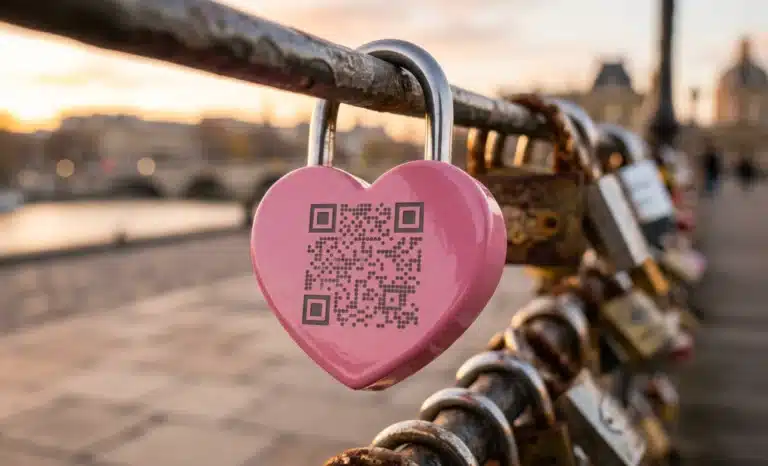
Because they turned an album announcement into a three week treasure hunt. Between mid March and early April 2026, Rodrigo’s team placed four heart-shaped padlocks in London, Hoboken, Los Angeles, and Paris. Each lock carried a single word. Found together, they spelled out April 17th drop dead: the release date and title of the lead single from her third album, You Seem Pretty Sad for a Girl So in Love.
The first lock surfaced in London on March 15 with the word april. Hoboken’s lock, reading drop, was found on March 26. Los Angeles delivered 17th on April 4, and Paris completed the set with the final word, dead. Rodrigo confirmed the campaign was hers on April 6 through a series of Instagram posts, in the run-up to the single’s April 17 release, with the album following on June 12 via Geffen Records.
The Livies, her fan community, searched their cities, photographed each find, shared the images, and pieced the message together collectively. The reveal was never the announcement itself. The reveal was the process of discovery that led to it.
What made the Olivia Rodrigo lock campaign work?
It worked because every design choice served the discovery, not the brand. The medium was iconic before it carried any message: pink heart-shaped locks placed in cities with a living tradition of love locks, from the bridges of Paris to Pier C in Hoboken. The object belonged to the landscape, which made finding it feel like uncovering something rather than being advertised to.
The campaign was distributed across time. Locks appeared gradually over more than three weeks, so anticipation had room to build between finds. It was distributed across space, with four cities generating four separate waves of local discovery and global coverage. And it was fragmented on purpose. No single lock told the whole story, which meant no single fan could complete it alone.
That last point matters most. The campaign was community completed. It only functioned because Livies actively hunted, documented, and connected the dots together. And through all of it, the brand presence stayed restrained. No sponsor marks, no teaser trailer explaining the teaser. Just the objects, waiting to be found.
What do padlocks have to do with a QR code mystery reveal campaign?
They share the same underlying structure. A QR code mystery reveal campaign is a marketing format where a message is revealed gradually across multiple physical placements, each carrying a QR code that customers must discover, decode, and share to complete the story. The medium becomes part of the message.
Physical padlocks worked for Rodrigo because her fandom is culturally invested enough to hunt for unmarked objects across continents. Most brands do not have that reach, and pretending otherwise is how campaigns fail. But QR codes let a brand run the same mechanics at an honest scale. A code on a poster, a sticker, or a package can carry one fragment of a larger message, and the audience assembles the rest. The hunt gets smaller. The logic stays identical.

How do you build a QR code teaser campaign?
Start with a message worth hiding, then design backward from the moment it completes. Six elements carry the weight.
The message
Decide what is being teased: a product launch, an event, a rebrand, a release. It needs genuine news value. Fragmenting a weak announcement just delays disappointment.
The fragmentation
Break the message into pieces that are meaningless alone and satisfying together. Each QR code carries exactly one piece. Rodrigo’s four words are a masterclass in economy.
The placements
Choose locations that feel intentional. The lock campaign leaned on cities with love lock traditions, so the placement itself carried meaning. A hidden QR code campaign gains the same depth when the where echoes the what.
The timing
Space the placements so the audience has time to find each one and talk about it. Too fast and there is no discovery, only a scavenger checklist. Too slow and attention drifts elsewhere.
The community layer
Give people somewhere to share their finds: a hashtag, a thread, a community space. Mystery marketing with QR codes lives or dies on whether finders can show their work.
The reveal
Plan the payoff before the first clue goes out. The moment the message completes should reward everyone who followed along, not just the person who scanned last.
When do mystery reveal campaigns work, and when do they not?
They work when an audience already cares enough to lean in. Brands with an engaged community, launches with real news value, and categories with cultural gravity such as music, film, gaming, fashion, and luxury, where artist releases and collector product drops already train audiences to hunt for clues, can sustain weeks of teasing because the audience wants to play.
They fail in the opposite conditions. Pure product marketing without emotional context gives people nothing to decode except an ad. Broad, low engagement audiences will not hunt for anything. And a brand without the cultural authority to hold attention for three weeks will watch its clues sit unscanned. The honest test before committing: would anyone notice if clue number two never appeared? If the answer is no, run a simpler campaign.
What formats can a brand mystery campaign take?
The structure adapts to almost any surface a code can live on. The most workable formats:
- Multi city physical placements. Posters, stickers, or small installations across cities, each carrying one piece of the message, in the closest spirit to the lock campaign.
- Sequential product packaging. Each week or each SKU carries a different fragment, turning repeat purchases into chapters.
- In store scavenger installations. Several codes hidden across one or more retail locations, rewarding customers who explore.
- Digital and physical hybrids. A code on a print ad opens part of a message that continues on packaging, out of home, or another format.
- Time locked reveals. Codes that display different content on different days, so even a found code keeps a secret until its moment.
Why do dynamic QR codes matter in a reveal campaign?
Because the story changes and the printed code cannot. A static code, in general, points wherever it pointed the day it was printed, which freezes the narrative at clue stage forever. A dynamic QR code separates the printed pattern from the destination behind it, so the same physical asset can evolve as the campaign does.
On day one, the code shows a single word. Once all fragments are public, the same code opens the full reveal. A month later, it links to the product itself. Nothing gets reprinted, replaced, or wasted. Platforms like QRCodeKIT are built around this model, where every code is dynamic and the destination stays editable for as long as the campaign needs to breathe.
How do you measure a QR code reveal campaign?
Not with a single scan count. A teaser reveal campaign generates a launch curve, and the useful signals map to its phases. Discovery velocity shows how quickly the audience finds each placement, which validates your locations and timing. Social propagation, meaning mentions, shares, and screenshots, shows whether the community layer is actually working. Decoding attempts, visible as unique scans across placements over time, reveal how many people are following the full trail rather than stumbling on one clue. And the reveal peak, the surge when the message completes, tells you whether the payoff matched the anticipation. Read together, these metrics describe a story arc, which is exactly what the campaign was designed to be.
What mistakes kill a mystery reveal campaign?
Most failures come from copying the surface of a campaign like Rodrigo’s without its discipline. The recurring ones:
- Fragmenting without a payoff. If the completed message is an ordinary announcement, the wait was a tax, not an experience.
- Random placements. Locations chosen for foot traffic alone break the intentionality that made the lock campaign resonate.
- Rushed timing. Dropping every clue in one weekend leaves no room for organic discovery.
- Heavy branding on every clue. A logo on the mystery answers the question before anyone asks it.
- Frozen destinations. Printing codes whose content can never change locks the story at clue stage and forfeits the reveal.
- Unearned mystery. Borrowing the structure without first building the emotional investment that makes people want to search.

A campaign worth studying
The pink lock campaign will be taught in marketing classrooms, and it will deserve the slot. It combined patience, cultural intelligence, physical craft, and genuine respect for its fandom, and it trusted the Livies to finish the story themselves. Very few brands can operate at that level, and not every campaign needs to. But the mechanics underneath it, fragmentation, intentional placement, patient timing, and community completion, scale down honestly. A QR code, a good secret, and the discipline to wait can take almost any brand further than another interruption ever will.
Frequently asked questions
What is a QR code mystery reveal campaign?
It is a campaign structure where a message is split across multiple QR code placements and revealed gradually. The audience discovers, scans, and shares each fragment, completing the story collectively rather than receiving it as a single announcement.
How long should a QR code teaser campaign run?
Most campaigns land between one and four weeks. Rodrigo’s lock campaign ran just over three. The right length is however long your audience stays curious, which depends on their engagement level and the strength of the payoff.
How many QR codes does a mystery marketing campaign need?
Enough to fragment the message meaningfully, usually three to six. Four worked for a four word message. More fragments extend the hunt but raise the risk that some are never found.
Do mystery reveal campaigns work for small brands?
Yes, at the right scale. A local brand can hide codes across one neighborhood or a single store and reach a genuinely engaged community. The mechanics matter more than the geography.
What should a hidden QR code campaign link to before the reveal?
Only the fragment: a word, an image, a coordinate, a sound. Resist the urge to add context or branding. The incompleteness is what drives sharing and speculation.
What is the difference between a scavenger hunt and a mystery reveal campaign?
A scavenger hunt asks the audience to find all the pieces to win something. A mystery reveal asks the audience to find all the pieces to understand something. The first is a game with a prize. The second is a story that only makes sense when it completes. Both use fragmentation, but the reward is different.
Can you run a QR code reveal campaign without physical placements?
You can, using codes embedded in emails, social posts, or digital ads, but physical placements add the discovery layer that makes these campaigns feel like events. Hybrids often perform best.
All images and visual content in this article were created using RealityMAX.