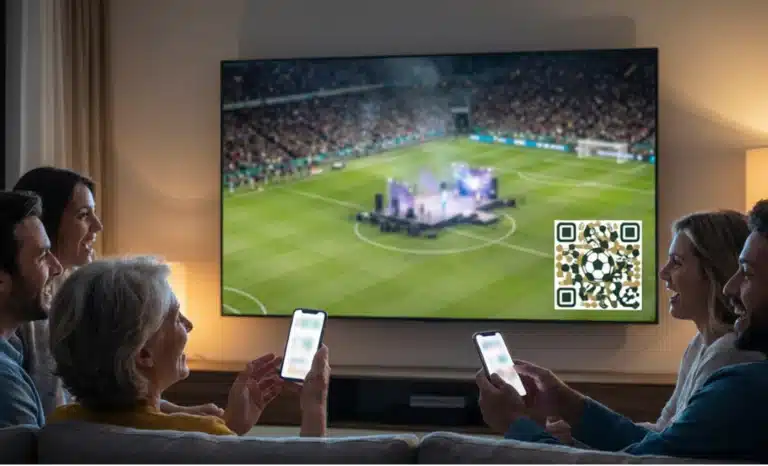
TL;DR
- The first ever FIFA World Cup Final Halftime Show on 19 July 2026 puts Madonna, Shakira, BTS, and Justin Bieber in front of roughly two billion viewers for 11 minutes.
- A halftime show QR code campaign turns that broadcast attention into measurable, trackable action across stadium signage, retail, social clips, and fan zones.
- Dynamic QR codes are essential because the destination must evolve before, during, and after the show without reprinting anything.
- The same framework applies to any massive cultural moment with predictable timing, from the Super Bowl to Eurovision to Olympic ceremonies.
On 19 July 2026, roughly two billion viewers are expected to watch the FIFA World Cup 2026 Final at MetLife Stadium. Halfway through, Madonna, Shakira, BTS, and Justin Bieber co-headline the first ever FIFA World Cup Final Halftime Show, curated by Chris Martin of Coldplay. For marketers, it is the biggest halftime show QR code opportunity ever staged.
2 billion people, 11 minutes, one QR code opportunity
A QR code marketing moment is a coordinated brand or campaign activation timed to a massive live cultural event, where a scannable code turns broadcast attention into measurable, trackable interactions in the moments viewers are watching. This final is the largest such moment ever assembled.
Consider the three numbers. FIFA has stated that a couple of billion viewers are expected to tune in, more than ten times the roughly 120 million who watch a typical Super Bowl halftime show. Eleven minutes is barely one and a half songs per co-headliner, so every second of attention is compressed and precious. And one printed QR code, placed thoughtfully across the campaign ecosystem around this moment, can outperform months of traditional media spend because it converts passive watching into an action a brand can count.
That last point is the thesis of this article. Massive attention is worthless without a bridge to measurable action. QR codes are that bridge, and big cultural moments are exactly where the bridge matters most.
Why did halftime shows become marketing infrastructure?
Halftime shows became marketing infrastructure because the Super Bowl proved that a mid-game entertainment slot could hold, and even grow, a broadcast audience. Decades of NFL broadcasts built the commercial machinery around it: sponsor integrations, teaser campaigns, second-screen conversation, and post-show content cycles.
The FIFA World Cup Final Halftime Show inherits that lineage while going global from day one. There is no history to build on here. This is the first halftime show ever staged at a FIFA World Cup Final, and it launches at a scale the Super Bowl template never had to consider. Where the American model reaches around 120 million viewers, this show is aiming for a couple of billion across every continent, time zone, and language at once.
What makes this halftime show different?
Three things separate this show from everything that came before it, and each one has direct consequences for how brands should think about activation.
First, it is global from the start. This is not an American event that gradually spread abroad. It was designed for a planet-scale audience, staged at MetLife Stadium, temporarily renamed New York New Jersey Stadium, at the close of a tournament jointly hosted by the United States, Mexico, and Canada.
Second, it is multi-fandom by design. Beliebers, ARMYs, Madonna’s decades of devoted fans, and Shakira’s enormous Latin American and global base will all be watching the same stage. Add Coldplay listeners drawn by Chris Martin’s curation, Burna Boy’s Afrobeats audience, families tuning in for characters from Sesame Street and The Muppets, and audiences following Venezuelan conductor Gustavo Dudamel and the Webby Award winning PS22 Chorus with Coldplay. Each fandom brings its own language, platforms, and expectations.
Third, it has a charitable spine. The show supports the FIFA Global Citizen Education Fund, which aims to raise USD 100 million for children’s education and football opportunities. Over USD 50 million had been raised as of July 2026, with USD 1 from every World Cup ticket contributing to the Fund. That gives brands and fans a shared cause rather than just entertainment, and it sets the tone for what kind of activation belongs near this moment.

What can brands learn from the halftime moment?
Brands can learn five practical lessons from how this halftime show is structured, each one transferable to any large live event where attention peaks in a narrow window and a QR code carries the response.
- Attention has phases. In an 11 minute halftime, the first 30 seconds, the pre-show buildup, and the aftermath each behave differently. A halftime show QR code activation should plan a distinct destination and message for each phase rather than one generic landing experience.
- Multi-fandom means multi-language. When BTS, Shakira, Bieber, and Madonna share a stage, the scanning audience is thinking in Korean, Spanish, English, Portuguese, and more. QR destinations built with a conversational AI layer, such as Cleo by QRCodeKIT, respond in whatever language the visitor chooses. A language selector menu forces a choice; a conversation simply answers.
- The moment is the campaign, not just the stage. Activations around halftime shows live simultaneously in broadcast, social, retail, and physical spaces. The QR code is the connective tissue between the televised moment and everything a brand runs around it.
- Attribution matters more than reach. Two billion viewers means nothing without a way to measure who acted. A QR code on a broadcast asset, a partner ad, or a fan zone poster turns anonymous reach into first-party data a brand can actually use.
- Charity elevates commercial. Activations aligned with the Education Fund’s cause will feel at home in this moment. Overtly commercial plays with no cause alignment will feel out of place next to a show built partly to fund children’s education.
How does a halftime show QR code campaign work?
A halftime show QR code campaign works by placing scannable codes across every surface the event touches, all pointing to destinations coordinated with the broadcast timeline. The code is printed or displayed once; the experience behind it is orchestrated in real time. In practice, the formats look like this:
- Stadium placements, with QR codes on seatback inserts and fan zone signage that reach the crowd physically present at the final.
- Partner brand ads during the pre-show, halftime, and post-match commercial windows, where an on-screen code gives the broadcast audience something to do with their attention.
- Retail activations in participating countries, with codes on product packaging or storefront displays timed to the broadcast schedule.
- Global fan zones, where posters, cups, and interactive displays carry codes that connect a public viewing crowd to the campaign.
- Social clips shared during and after halftime, with codes leading viewers from a shared video straight into a campaign hub.
Each format reaches a different slice of the audience, but all can resolve to one coordinated campaign, which makes measurement across the whole moment possible.
What happens if a QR code appears on screen during the halftime show?
Nothing has been publicly confirmed. As of publication, neither FIFA, nor Global Citizen, nor any authorized partner has announced that an on-screen QR code will appear during the 11 minutes of the halftime show. But the possibility deserves serious attention, because the closest precedent suggests what a broadcast QR code at this scale could do.
That precedent is Coinbase. On 13 February 2022, during the Super Bowl LVI broadcast between the Los Angeles Rams and the Cincinnati Bengals, Coinbase aired an ad consisting of a floating QR code bouncing across the screen for roughly 60 seconds. The company publicly reported approximately 20 million hits in one minute, enough to briefly crash the Coinbase app. The broadcast audience was approximately 100 million viewers in the US.
Now scale that up. A World Cup Final audience of roughly two billion is around 20 times larger than the audience Coinbase reached. If something similar happens on 19 July, the scan volume compressed into a few seconds would be unprecedented in QR marketing history.
Three implications follow for anyone planning around moments like this. The first is volume beyond any brand’s prior experience: a code shown for a handful of seconds to two billion viewers could generate more scans in that window than most brand campaigns generate in a year. The second is exposure. An on-screen code at this scale is a public stress test the platform behind it either passes or fails, and an unreachable destination during a global broadcast peak is a brand failure watched live by billions. Verifiable capacity under concentrated load matters here, not claims in marketing copy. The third is rarity. Traditional advertising can be timed and repeated at will, but concentrated broadcast peaks tied to moments the world watches together happen a few times per decade.
Whether or not a code appears on screen during this halftime show, the format is worth every marketer’s attention. The 2027 Super Bowl, the 2028 Olympics, and every major cultural moment ahead will include broadcast QR codes as a default option. The teams that understand what happens in those minutes will be better prepared when their brand is the one on screen.
Why are dynamic QR codes essential during a live event?
Dynamic QR codes are essential during a live event because the story evolves faster than anything printed can. A static code, the kind locked permanently to one destination, freezes a campaign to whatever was decided weeks before the broadcast. A dynamic code lets the destination change while the printed code stays exactly the same.
Picture the timeline for the final. Before halftime, the code points to a preview. During those 11 minutes, it switches to a live vote or a donation portal supporting the Education Fund. Immediately after, it serves a highlight reel. A week later, the same code on the same poster delivers the full campaign wrap. Nothing was reprinted. Platforms like QRCodeKIT, where every code is dynamic by design, exist precisely for this kind of choreography.
There is a second, less glamorous requirement: load. During a halftime peak, scan volume can concentrate into a few minutes. The platform behind the code must handle that spike without slowing down, and marketers should look for verifiable production performance rather than brochure claims. Attribution should also distinguish scans during the show from those before or after, separating what worked in the moment from what worked in the follow-through.
What should brands avoid around a cultural moment like this?
The fastest way to lose the moment is to disrespect it. FIFA logos, mascots, and the word official belong exclusively to authorized partners, and using them without permission invites legal trouble. The same applies to song lyrics and performer imagery, which remain the property of the artists no matter how celebratory a campaign feels.
The charitable dimension deserves equal care. The Education Fund gives this show its purpose, and brands that reference the cause without genuine contribution or alignment will read as exploitative to the very fandoms they hope to reach. Community-first framing wins here; brand-first messaging during a moment built around shared experience tends to backfire.
And on the technical side, a code locked to a single fixed destination is a self-inflicted wound at an event that will change minute by minute. If the campaign cannot evolve with the broadcast, part of its value is lost before the first scan.

How does this framework apply beyond the FIFA halftime show?
The same framework applies to any cultural moment that combines global attention with predictable timing. The Super Bowl, Eurovision, the Grammy Awards, Olympic ceremonies, Coachella, a major album launch, a royal wedding, an election night, or a flagship product launch all share the ingredients: a known date, a concentrated attention peak, phases of anticipation and aftermath, and audiences spread across languages and platforms.
Plan destinations for each phase, keep the printed code constant while the experience evolves, measure scans against the event timeline, and match the tone of the moment. The scale changes; the mechanics do not.
A benchmark worth studying
The FIFA World Cup Final Halftime Show on 19 July 2026 will be studied in marketing programs alongside the great Super Bowl moments. It combines the largest single sporting audience on Earth, a coalition of fandoms no single artist could assemble, a charitable purpose, and the weight of a genuine first. Brands that activate thoughtfully will benefit from being present. Brands that activate loudly may harm themselves. The mechanics underneath scale down honestly to any brand asking the same question: when the world is watching, how do you turn attention into action you can measure?
Frequently asked questions
What is a halftime show QR code campaign?
It is a coordinated activation placing scannable QR codes across broadcast assets, venues, retail, and social content, with destinations timed to the event so viewer attention converts into trackable visits, sign-ups, donations, or purchases.
How do brands activate during the FIFA World Cup halftime show?
Through authorized channels: partner advertising slots, retail campaigns in participating countries, fan zone presence, and social content. Codes on those assets link the broadcast moment to owned campaign destinations without requiring any official affiliation with FIFA itself.
Can a QR code be used during a live broadcast?
Yes. On-screen codes during live television have become common in recent years. The requirements are size, screen time of several seconds, and a destination prepared for a sudden concentrated spike in traffic.
What makes the FIFA halftime show different from the Super Bowl?
Scale and design. The Super Bowl halftime show reaches roughly 120 million viewers and grew from an American broadcast tradition. The FIFA World Cup Final Halftime Show expects a couple of billion viewers, was designed as a global multi-fandom event from day one, and channels its spotlight toward the FIFA Global Citizen Education Fund.
Why do brands use QR codes at major sports events?
Because broadcast reach alone is unmeasurable. A code converts a viewer into a visitor with a timestamp, a location, and a next step, giving brands first-party data on what their event presence actually produced.
How many people will watch the FIFA World Cup Final halftime show?
FIFA has stated that a couple of billion viewers are expected to tune in for the Final on 19 July 2026. That would make the halftime show the largest single live audience any halftime performance has ever reached.
Do brands need permission to reference the FIFA World Cup in their marketing?
Factual, informational references are generally covered by nominative fair use, but using FIFA trademarks, logos, mascots, or implying official partnership requires authorization. When in doubt, brands should consult legal counsel before building campaigns around protected marks.
All images and visual content in this article were created using RealityMAX.