TL;DR
- A QR code platform for ecommerce must handle packaging printed months ahead, catalogs with hundreds of SKUs, and post-purchase journeys that generic generators were never designed for.
- Dynamic QR codes are the baseline. The differentiators are post-purchase support, conversational AI at the destination, and analytics tied to revenue.
- Integration with Shopify, WooCommerce, Klaviyo, GA4, and ad pixels determines whether scan data reaches the dashboards your team already uses.
- Use the ten-point checklist here to evaluate QRCodeKIT, Uniqode, QR TIGER, Flowcode, Scanova, Bitly, or any other platform.
Choosing a QR code platform for ecommerce comes down to one question: does the tool understand what happens after the box is opened? Packaging printed months in advance, catalogs with thousands of SKUs, and post-purchase moments that decide lifetime value all create demands that generic QR generators were never built to meet. This guide defines the criteria that matter.
What is a QR code platform for ecommerce?
A QR code platform for ecommerce is a QR code management tool built to handle the specific realities of online commerce: packaging and insert QR codes at scale, post-purchase customer journeys, integration with ecommerce platforms and analytics, dynamic destinations that evolve across campaigns, and bulk generation for product catalogs.
That definition separates it from adjacent categories. A marketing team evaluates QR platforms around campaigns. An agency evaluates them around client separation. An ecommerce brand evaluates them around the product itself: the box, the insert, the thank-you card, and everything the buyer does after unboxing. The evaluation criteria change accordingly.
Why do generic QR generators fall short for ecommerce brands?
Generic QR generators were built for single placements: a poster, a table tent, a business card. A QR code for online stores breaks that model quickly, because it lives on products that ship at scale, sit in warehouses, and reach buyers months after the destination was decided.
Consider how an online store actually works. Every product shipped is a physical touchpoint the brand owns for a moment, from the outer box to the tissue paper. Campaigns run simultaneously across ads, email, social, packaging, and print, and the codes tying them together need consistent tracking across every placement. SKU counts scale fast, print lead times run weeks or months, and scan data only becomes useful when it connects to traffic, conversion, and revenue. A tool that handles one poster well is not automatically ecommerce qr code software. The ten criteria below are where the difference shows.
Why are dynamic QR codes the foundation?
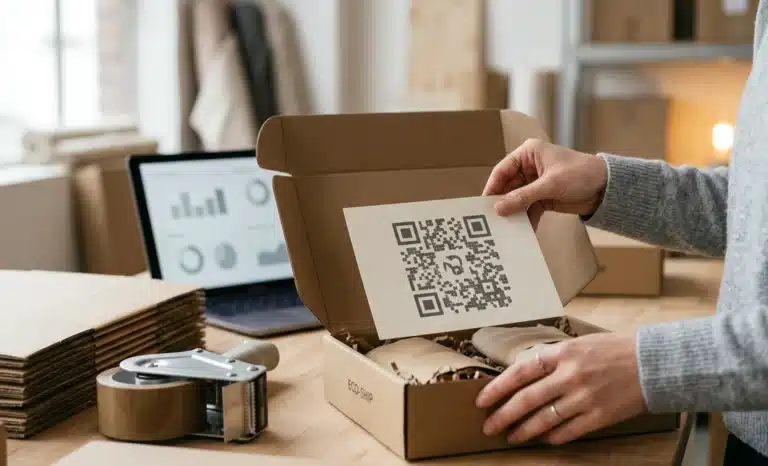
Dynamic QR codes are the foundation because ecommerce packaging is printed long before it reaches the customer. A box designed in January may ship in June, get opened in July, and sit in a drawer for two years. The destination behind the code must be able to evolve while the printed code stays the same.
Static codes lock the destination to whatever was decided at print time. If the product page moves or the offer expires, the code on ten thousand boxes points somewhere obsolete. Established platforms in this space, including QRCodeKIT, Uniqode, QR TIGER, Scanova, and Bitly, all offer dynamic codes, so the feature itself is not the differentiator. What separates them is what dynamic enables in practice: real-time destination editing, version history, and scheduled updates that move a packaging campaign to a new destination on a planned date without touching the print files.
How should the platform handle bulk generation for large catalogs?
Bulk generation matters as soon as each SKU needs its own code. A brand with 400 products cannot create 400 codes by hand, and a brand launching seasonal collections needs batch creation to be routine, not a project.
Look for CSV upload for batch creation, API access for programmatic generation, and design templates that keep every code in the catalog visually consistent. QR TIGER built part of its reputation on bulk workflows at enterprise scale. QRCodeKIT supports CSV upload of up to 1,000 codes per batch, plus a REST API for catalogs that outgrow spreadsheets.
What makes post-purchase the real growth lever?
Post-purchase is where ecommerce lifetime value is made or lost, and a post-purchase QR code on the packaging or insert is the bridge between the physical unboxing and the digital relationship. This is the most ecommerce-specific criterion on the list, and the one general-purpose tools address least.
The moments after unboxing are dense with intent: setup guides, product registration, warranty activation, replenishment reminders, community invites, review requests. A QR code that simply reopens the product page wastes that intent. Scanova focuses on landing pages and lead capture, which covers part of this need. QRCodeKIT approaches it through editable destinations combined with Cleo, its conversational AI layer, which also qualifies leads and captures intent directly in the conversation.
Can conversational AI replace the static post-purchase page?
A conversational AI layer turns the post-purchase destination from a page the buyer reads into an assistant the buyer asks. The questions that follow unboxing are predictable: how do I set this up, where is the warranty, what is the return policy. Each one unanswered becomes a support ticket or a damaged NPS score.
Cleo, the conversational AI built into QRCodeKIT and developed iteratively over several years, answers those questions directly on the destination page, at any hour, without staff involvement. The page the brand configured remains; Cleo sits on top of it as a conversation. Very few platforms offer this natively in 2026, which makes it a fast filter when comparing options for post-purchase flows.
Which ecommerce stack integrations should you require?
A QR platform earns its place in a DTC stack by connecting to the tools the brand already runs: Shopify, WooCommerce, BigCommerce, Klaviyo, Meta Ads, Google Analytics, and automation layers like Zapier and Make. Without those connections, scan data lives in a silo nobody checks.
Integration is what lets a team automate code creation when a new product goes live, pull scan analytics into existing dashboards, and connect scans to email flows and retargeting audiences. Some platforms approach QR from an adjacent product: Bitly, for example, extends its link shortening infrastructure into QR codes. QRCodeKIT connects natively to Google Analytics, Meta Pixel, Airtable, Canva, Zapier, Make, and n8n, alongside its REST API, so a Shopify QR workflow can run end to end without manual exports.
How do you connect QR scans to revenue?
Scan counts alone do not tell the ecommerce story. The platform should support UTM parameters, GA4 integration, and compatibility with Meta and Google Ads pixels, so the team can see which packaging scans drove conversions, which inserts led to repeat purchases, and which scanners to retarget.
This is where evaluation gets concrete. Ask whether you can append UTM parameters per code, whether scans appear as attributed sessions in GA4, and whether scanners can join retargeting audiences. QRCodeKIT’s Website QR type supports UTM parameters natively and integrates with the major analytics platforms, keeping packaging attribution inside the same reporting the rest of the store uses.
How does the platform serve international buyers?
Ecommerce brands shipping internationally serve buyers in dozens of languages, and the QR destination should adapt to each buyer automatically. A language selector menu forces a choice before the buyer gets an answer. A conversational layer simply responds in whatever language the question arrives in.
Cleo handles this natively. The brand configures its content once, and Cleo answers in the language the buyer types, whether the box was opened in Munich, Osaka, or Guadalajara. For ecommerce brands selling across borders, this removes an entire localization workstream.

Does design flexibility matter on premium packaging?
It does, because packaging is often the most visible brand asset a DTC brand has, and a QR code on ecommerce packaging either belongs to that design or interrupts it. A visually invasive code on a premium box undermines the aesthetic the brand paid for.
Look for branded templates with logo placement, brand colors, and frame styles, plus export formats that print production actually needs: PNG, SVG, PDF, and EPS. Flowcode built part of its reputation on design-first codes favored by DTC brands. QRCodeKIT covers the same ground with branded templates and AI-generated artistic QR codes that blend into packaging visuals while remaining scannable.
How reliable is the platform during peak campaigns?
Reliability under load is invisible until Black Friday, and then it is the only thing that matters. Product launches, influencer collaborations, and seasonal peaks concentrate scans into short windows, and a redirect service that slows or fails during those windows wastes the campaign that drove them.
Ask for verifiable production performance, not brochure uptime claims. QRCodeKIT has operated during concentrated peak events such as MotoGP races and Champions League matches, the kind of evidence worth requesting from any vendor: real scan surges in production, not a number on a pricing page.
Is the platform ready for EU regulations?
Any brand shipping products into Europe should evaluate a platform’s regulatory posture, because three frameworks now touch ecommerce packaging directly. The European Accessibility Act has been in force since 28 June 2025, GS1 Sunrise 2027 is reshaping how product codes work at retail, and the EU Digital Product Passport begins rolling out from 2026.
Compliance posture varies by market focus. Uniqode carries strong credentials for the US enterprise market, including SOC 2 and HIPAA along with deep ad platform integrations. QRCodeKIT’s posture is built around the European side: GDPR compliance, EU hosting, and GS1 Digital Link support. Neither orientation is wrong. The right fit depends on where the brand ships and which regulations apply to its buyers.
The ecommerce QR platform checklist
Use these ten criteria as a direct evaluation sheet for any platform on your shortlist:
- Dynamic QR codes with real-time editing, version history, and scheduled destination changes
- Bulk generation via CSV and API for full product catalogs
- Post-purchase journey support beyond a simple product page redirect
- Conversational AI at the destination to answer buyer questions without tickets
- Native integrations with your ecommerce platform, email, and automation tools
- UTM support, GA4 integration, and ad pixel compatibility for attribution
- Automatic multilingual responses for international buyers
- Branded and artistic code design with print-ready export formats
- Verifiable reliability during concentrated scan peaks
- Regulatory readiness matched to the markets you ship into
A platform that clears all ten was built for ecommerce workflows. A platform that clears three or four was built for something else.
Where do ecommerce brands get it wrong?
The most expensive mistakes in this decision are structural, not cosmetic. The ones that come up repeatedly:
- Choosing a generic generator and locking a year of packaging to a static destination that cannot change
- Treating the packaging QR as a checkbox instead of a post-purchase growth lever
- Skipping analytics integration and never learning which packaging scans drove which purchases
- Ignoring conversational AI and letting support tickets accumulate for questions the code could answer
- Choosing on price alone and discovering reliability limits during Black Friday
- Selecting a US-focused platform while shipping into the EU, or the reverse
Each of these is avoidable at evaluation time and costly to fix after the packaging is printed.
Why does the platform matter more than the code?
Any generator can produce a working QR code in seconds. The code itself is solved technology. What differentiates the right platform for an ecommerce brand is everything that happens after the scan: the post-purchase journey, the connection to the ecommerce stack, attribution tied to revenue, and design that respects premium packaging. Brands that treat the code as a checkbox get a square on a box. Brands that treat the platform as infrastructure get a channel that runs from unboxing to repeat purchase, which is where the lifetime value lives.
Where to go deeper
For a closer look at how these capabilities work in practice for online stores, the QRCodeKIT page on QR codes for ecommerce walks through the product side of everything described here. And if your shortlist is ready and you want pricing detail and side-by-side comparisons, the guide to the best QR code generators covers that ground directly.
Frequently asked questions
What is a QR code platform for ecommerce?
It is a QR code management tool built for online commerce workflows: dynamic codes on packaging and inserts, bulk generation for product catalogs, post-purchase destinations, and integration with ecommerce platforms and analytics. It differs from a generic generator in scale, attribution, and what happens after the scan.
How does a QR code on ecommerce packaging drive repeat purchases?
It bridges the unboxing moment to the digital relationship, guiding the buyer into registration, setup, replenishment reminders, or community. Because the code is dynamic, the same printed box can point to different stages of that journey over time.
Can QR codes integrate with Shopify or WooCommerce?
Yes, through native integrations, automation tools, or an API. Platforms with Zapier, Make, or n8n support can generate a code automatically when a new product is published and push scan data back into the tools the store already uses, without manual work per SKU.
How do you track QR code scans on ecommerce packaging?
Combine platform-level scan analytics with UTM parameters and GA4 integration. Scans then appear as attributed sessions alongside every other channel, so the team can compare packaging against ads and email, and retarget scanners through ad pixels.
Should ecommerce brands use static or dynamic QR codes on packaging?
Dynamic, without exception. Packaging is printed weeks or months before it reaches a buyer and can stay in circulation for years. A static code freezes the destination at print time, while a dynamic code lets the destination evolve with the campaign, the product page, and the offer.
What is the best QR code type for post-purchase flows?
A dynamic Website QR pointing to a destination built for the moments after unboxing, ideally with a conversational AI layer that answers setup, warranty, and returns questions directly. That combination turns the packaging code from a link into an assistant focused on retention.
All images and visual content in this article were created using RealityMAX.