May 13, 2026
QR code adoption: EU vs US in 2026
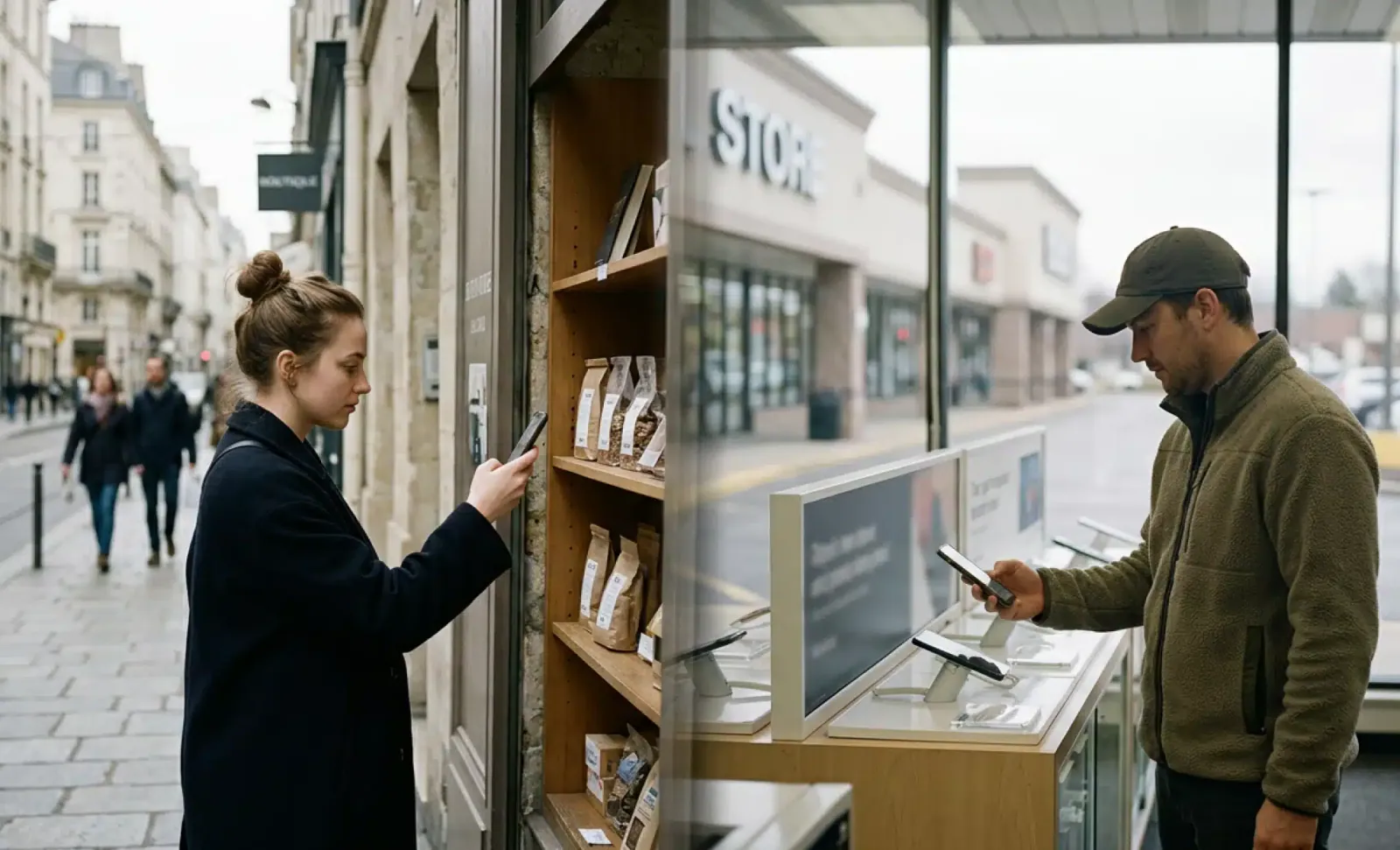
The two largest consumer markets in the Western world treat the same square pattern very differently. In Europe, QR code adoption is increasingly shaped by regulation, traceability, and payment infrastructure. In the United States, the same technology is shaped by marketing budgets, loyalty programs, and packaged goods promotions. Both markets are growing. They are not growing for the same reasons.
For decision makers operating on both sides of the Atlantic, that difference matters. A campaign or compliance approach that works in Munich will not always work in Miami, and vice versa. This article synthesizes publicly available data on QR code adoption in the EU and US in 2026, looks at where the two markets diverge, and where the public reporting itself runs out of road.
Why compare EU and US QR code adoption
The temptation is to look at one number, usually total scans, and declare a winner. That is the wrong lens. Scan volume tells you how often people interact with QR codes. It does not tell you why, in what context, or whether the underlying infrastructure is built for long-term use.
A better comparison looks at three layers. First, the user base: how many people actually scan QR codes, and how often. Second, the drivers: what is pushing adoption forward in each market. Third, the integration: whether QR codes are tied into payments, identity, packaging, or sit mostly on the marketing layer.
When you read EU and US figures through those three layers, the contrast becomes clearer. The US has a larger marketing-led adoption curve. The EU has a deeper structural integration into payments and product information. Neither is “ahead.” They are running on different rails.
Adoption levels in each market
According to Statista, the number of US smartphone users scanning a QR code was projected to reach roughly 99.5 million by 2025, up from around 83.4 million in 2022. eMarketer data, cited across multiple Statista summaries, has consistently shown US scan activity growing year over year since the 2020 pandemic-driven jump, when restaurants, retailers, and venues introduced QR codes for contactless menus and check-ins at scale.
In the European Union, public data is more fragmented because reporting happens at the member-state level. GS1 publications and Bluebite’s annual QR Code Report both indicate that European scan rates per capita are competitive with the US in retail and consumer packaged goods contexts, with stronger uptake in payment use cases. Boston Consulting Group has published analyses showing that QR-based payments are far more deeply embedded in parts of continental Europe, particularly in countries with strong real-time payment infrastructure, than in the US.
The global qr code market itself is forecast to keep expanding through the decade. Juniper Research and Future Market Insights have both projected continued double-digit growth in QR code payment market value globally, with Asia Pacific leading volume and Europe leading per-capita transaction value in mature payment corridors.
What the public data agrees on is direction. QR code usage is climbing in both regions. What it disagrees on, or simply does not report cleanly, is the relative weight of each use case behind that climb.
Where the EU and US diverge on code adoption
The clearest divergence is the driver behind growth.
In the EU, the push is regulatory and infrastructural. Three forces are reshaping how QR codes are deployed across the bloc:
The Digital Product Passport (DPP), introduced under the EU Ecodesign for Sustainable Products Regulation, will require many product categories sold in the EU to carry machine-readable identifiers linking to traceability, sustainability, and end-of-life information. QR codes are the most common carrier for this data layer.
The European Accessibility Act (EAA), in force from June 2025, requires that digital interfaces and product information be accessible to people with disabilities. QR codes linking to accessible digital information become a practical compliance tool.
The GS1 Sunrise 2027 initiative is the global migration from linear barcodes to GS1 Digital Link QR codes at point of sale. Europe has been one of the most organized regions in preparing retailers, brand owners, and supply chain partners for this transition.
In the US, the picture is more commercial. Adoption is driven by marketing teams, retailers, restaurants, and consumer packaged goods (CPG) brands looking for measurable customer engagement. Bluebite and Statista data on US QR usage consistently shows the largest scan volumes coming from print ads, restaurant menus, product packaging, and loyalty programs rather than from regulated traceability flows.
Payment QR penetration is the other big divergence. Eurozone payment infrastructure, particularly through SEPA Instant and country-level systems, has made QR code payment a natural extension of digital wallets. In the US, QR payments exist but compete with established card networks and tap-to-pay flows that are already deeply ingrained in consumer behavior. According to Boston Consulting Group and Juniper Research analyses, the share of consumers who routinely use QR codes for digital payments is markedly higher in much of Europe and Asia Pacific than in the US.
The result is two different adoption shapes. The EU curve is broader at the base, embedded across payments, packaging, and compliance. The US curve is taller in marketing and customer-facing campaigns.
Put it into practice
Create a dynamic QR code free and see it work. No credit card required.
Get started freeIndustry-by-industry differences
The macro picture clarifies further when you look at specific sectors.
Hospitality
Both markets saw mass QR adoption for digital menus during the pandemic. In the US, that adoption has partly receded, with many restaurants returning to printed menus after consumer pushback. In the EU, digital menus persist more visibly in tourist-heavy hospitality zones, partly because they double as multilingual interfaces. Statista hospitality surveys show that EU diners encounter QR-based menus at a meaningfully higher rate than their US counterparts in 2025.

Retail and CPG brands
This is where the EU regulatory layer makes the sharpest difference. CPG brands selling into the EU are already preparing packaging redesigns for the GS1 Sunrise transition, embedding QR codes that link to product details, certifications, recall information, and consumer-facing brand information. In the US, retail QR usage is more concentrated in promotional offers, exclusive deals, and loyalty programs. Same square, different job.
Healthcare
QR codes in healthcare are growing in both markets, but the EU again leans on regulation, with traceability requirements for medical devices under the Medical Device Regulation (MDR) and pharmaceutical serialization under the Falsified Medicines Directive. US healthcare QR use is more often patient-facing: appointment links, intake forms, and educational content.
Food packaging and product information
Food packaging is one of the clearest divergence points. The EU pipeline toward the Digital Product Passport, combined with farm-to-fork traceability ambitions, is pushing food brands toward QR-linked information layers covering origin, allergens, nutritional details, and sustainability claims. In the US, food packaging QR use is overwhelmingly tied to marketing campaigns, contests, recipe content, and loyalty programs.
Demographics and consumer behavior
Both markets show that younger consumers drive adoption, but the framing differs.
Gen Z and the scan habit
Gen Z consumers in both the EU and the US scan QR codes at significantly higher rates than older cohorts, according to Statista demographic breakdowns and eMarketer surveys. They scan in restaurants, at events, in retail, and on social media pages. They also have higher tolerance for being asked to scan something to access content.
Where US Gen Z adoption is concentrated in marketing or advertising campaigns and short-form content access, EU Gen Z adoption shows more crossover into payment behavior and product information lookups. The same demographic, the same comfort with the technology, applied to a slightly different default use case.
Older cohorts
Adoption among consumers aged 55 and over has grown sharply in both markets since 2020, particularly for restaurant menus, healthcare appointments, and retail payments. The gap between Gen Z scanning rates and older cohort scanning rates is narrowing, though it has not closed.
What this means for businesses operating in both markets
For organizations active in both the EU and the US, three implications matter.
First, design choices differ. A QR code on a European product package is increasingly expected to lead to a structured information layer compatible with GS1 Digital Link standards. A QR code on a US product is more likely to lead to a marketing landing page, a contest entry, or a loyalty enrollment flow. Both can be done with dynamic QR codes, but the destination logic is not interchangeable.
Second, compliance posture differs. EU operators need to plan for DPP, EAA, and Sunrise 2027 obligations in their QR strategy. US operators face a softer regulatory environment but need to think about state-level privacy laws when QR codes link to data collection flows.
Third, audience expectations differ. EU consumers, particularly in payment-heavy markets, expect QR codes to do something functional and verifiable. US consumers more often expect a promotional or content payoff. A campaign that assumes one expectation in the other market will underperform.
The practical recommendation is straightforward. Design QR strategies regionally, not globally. The same brand can run different QR logics in each market without losing coherence, as long as the underlying platform supports dynamic codes that can be updated, segmented, and analyzed by region. Static QR codes lock the destination at print time, which is the opposite of what cross-market operators need.
What the public data does not show
The honest part of any comparison is acknowledging where it ends.
Public reporting from Statista, eMarketer, Bluebite, GS1, Juniper Research, Future Market Insights, and Boston Consulting Group gives a solid view of scan volumes, demographic adoption, and headline use cases. It is weaker on the granular questions: how scans convert into actions, how repeat engagement behaves over months, what time-of-day patterns reveal about context, and how dynamic content changes affect behavior on the same printed code.
That layer of data lives inside QR code platforms, not in public reports. As a dynamic QR code platform active since 2009, QRCodeKIT has visibility across both EU and US deployments at the platform level, including how scan behavior evolves once a campaign or product is in market. That kind of operational data tends to be proprietary to platforms and rarely surfaces in public market reports.
For decision makers, the takeaway is this. Use public data to understand the macro picture of QR code adoption in each region. Use platform-level data to understand what your specific audience actually does once they scan. The two views are complementary, not redundant.

How should businesses approach EU and US QR code strategy in 2026?
Treat them as two different markets sharing a common technology. The EU rewards QR code strategies built around structured information, payments, and compliance with DPP, EAA, and GS1 Sunrise 2027. The US rewards strategies built around marketing campaigns, loyalty programs, and customer engagement. Use dynamic QR codes in both markets so destinations can adapt to local expectations without reprinting, and lean on platform analytics to understand how each audience actually behaves after the scan.
All images and visual content in this article were created using RealityMAX.
Related articles

Eaa compliance for small businesses
The European Accessibility Act entered into force on 28 June 2025, and a lot of small business owners are still trying to figure out what it actually means for…
QR code on podcast cover art
The short answer is: sometimes. A QR code on podcast cover art can drive new listeners, sponsor conversions, and real engagement, but only in the right…
QR codes for bars
Friday at 10:47pm. Three deep at the counter. One bartender shaking a drink, the other taking an order from a group who can’t agree on what to get. Someone in…
Two free dynamic QR codes. Yours forever.
No credit card. No expiry. The original dynamic QR platform since 2009.