A tourist stands in front of a 400-year-old fountain in the center of Rome. There’s a small QR code on the nearby information panel. They scan it, land on the site’s information page, and notice a small conversation bubble in the corner. They tap it and start talking to Cleo. They ask why the fountain was built, who commissioned it, and whether there’s a good restaurant nearby that serves traditional Roman food. They get clear, specific answers in their own language, instantly.
This is what AI QR codes for tourism look like in practice. Not a smarter brochure. A conversation that happens exactly where the visitor is standing, triggered by a single scan.
What makes an AI QR code different from a regular one
Most QR codes in tourism still work the same way they did a decade ago: scan, land on a page, read some text, maybe watch a video. The experience is passive. The visitor absorbs whatever was prepared for them, whether or not it matches what they actually needed.
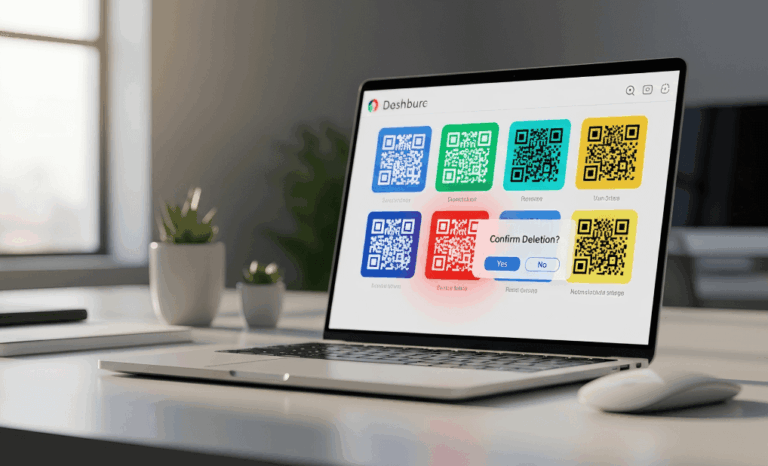
An AI QR code changes that dynamic entirely. The code itself is dynamic, meaning the destination it points to can be updated at any time without reprinting anything: a landing page, a menu, a PDF, a website, whatever the owner decides. But what makes it qualitatively different is what appears on top of that destination: a conversation bubble. That’s Cleo. The visitor can interact with it if they want, ask questions, request recommendations, clear up doubts, all in their own language. Or they can simply ignore it and consume the content as they would with any other QR code. The owner can also configure Cleo to take the initiative: appearing with a default welcome message as soon as the scan happens, without waiting for the user to open the conversation.
In QRCodeKIT, that assistant is called Cleo. QRCodeKIT was the first to launch the dynamic QR code back in 2009, and is equally the first QR code generator to implement intelligent agents directly within them. When a visitor scans a QR code powered by Cleo, they arrive at whatever destination the operator has configured: a page, a menu, a document. And on top of that content, Cleo’s bubble appears, ready to talk. No app download, no account creation, no waiting for a staff member to become available.
A practical scenario: A heritage site with no tour guide budget
Consider a mid-sized archaeological site, the kind that attracts serious visitors but doesn’t have the resources to staff multilingual tour guides at every point of interest. Information panels cover the basics, but they’re static, they’re usually in one or two languages, and they can’t answer follow-up questions.
The site places a dynamic QR code at each key location. Each code links to a dedicated page for that spot, with Cleo configured on top of it and trained on the specific content for that area: the excavation history, the artifacts found there, the people who built it, the cultural context, the ongoing research. A visitor from Japan can ask about the site in Japanese. A visitor traveling with children can ask for a simplified explanation. A researcher can ask a detailed technical question.
None of this requires reprinting the panels. If the site publishes new findings, the Cleo assistant is updated and the QR codes immediately reflect the new information. The physical markers stay exactly where they are.
This is the core promise of AI QR codes for tourism: turning a fixed, printed object into a living point of access.
How Cleo is trained for each context
The quality of any AI assistant depends entirely on what it knows. A generic AI answering tourism questions is useful up to a point, but it can’t tell a visitor which specific room in this museum contains the medieval jewelry collection, or whether this particular restaurant’s risotto is dairy-free.
Cleo is trained per deployment. Each QR code can have its own Cleo instance, built on knowledge that the operator provides: menus, historical records, service descriptions, pricing, hours, safety information, cultural context, or anything else that matters for that location. The training isn’t a complex technical process. It’s closer to briefing a new team member, but one who will remember everything perfectly and answer consistently every time.
For tour operators, this means the AI reflects the actual experience they offer, not a generic approximation. For tourism businesses managing multiple locations, each site can have its own Cleo configured with the relevant local knowledge, while the overall system remains centralized and manageable.

Breaking the language barrier at scale
Language is one of the most persistent friction points in tourism. Printed materials cover one or two languages at best. Hiring multilingual staff is expensive and still leaves gaps. Translation apps require the visitor to do extra work and the results are often clunky.
Cleo handles this naturally. Because the assistant responds in the visitor’s preferred language, the same QR code effectively speaks to every visitor in their own tongue. A single code at a train station information point can serve a French-speaking traveler in French, a Korean-speaking traveler in Korean, and a Portuguese-speaking traveler in Portuguese, with no extra setup and no additional printed materials.
For destinations trying to position themselves as accessible and welcoming to international visitors, this is a meaningful shift. It removes the language barrier not by adding more resources, but by making the existing ones smarter.
Beyond information: What visitors can actually do with one scan
The conversation doesn’t have to end with information. Depending on how the QR code is configured, a single scan can open access to a much wider range of actions.
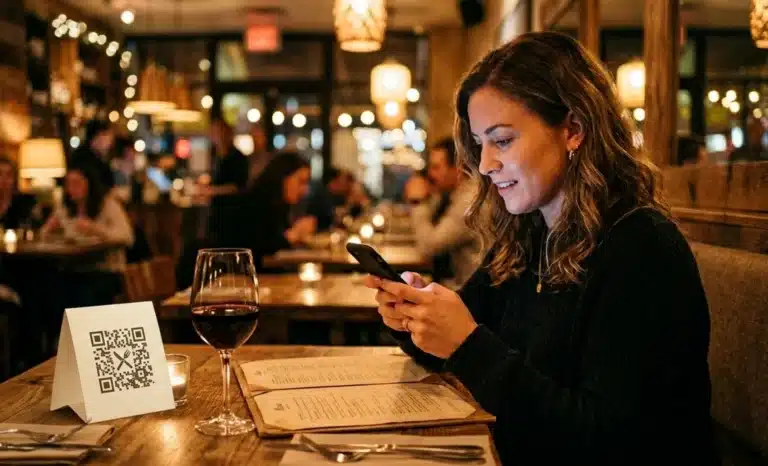
A visitor scanning a code at a hotel front desk arrives at the property’s digital welcome page, with Cleo ready to answer questions about room service options, local transport, check-out procedures, or nearby attractions, all tailored to that specific property. A scan at a restaurant leads to the menu, with Cleo available to clarify dietary restrictions, ingredients, or wine pairings before the order is placed. A scan at a museum entrance can land on the exhibition guide, while Cleo proactively opens with an offer to start an audio tour in the visitor’s language.
Tour operators can use Cleo to handle pre-visit engagement too: branded QR codes on flyers, table cards, or travel documents can connect potential customers to an assistant that answers questions about tour bookings, availability, cancellation policies, and what to pack, without the visitor having to navigate a website or wait for an email response.
This collapses a lot of friction that currently sits between a tourist’s question and a useful answer.
The data that comes back
Every scan generates data. With static QR codes, that data is limited: you know a scan happened, roughly when, and from what device. With AI-powered dynamic codes, the picture is much richer.
Because Cleo tracks what visitors are actually asking, tourism businesses get a detailed view of what their audience is interested in, where confusion tends to arise, which locations generate the most engagement, and what information is being requested most often. A museum notices that visitors consistently ask about a particular exhibit that isn’t featured prominently in the physical space. A tour operator sees that most scanning happens in the evening and adjusts their content accordingly. A destination management organization tracks which points of interest generate the most interaction and uses that to inform their next marketing campaign.
This kind of behavioral data is genuinely useful for improving the experience. It shifts the conversation from “how many people visited” to “what were they looking for when they got there.”
What tour operators should consider before deploying
There’s a common mistake in tourism QR code deployments: placing codes without thinking about context. A QR code that leads to a generic website, or worse, a broken link, does more harm than good. Visitors who scan and find nothing useful are less likely to scan again.
The same principle applies to AI-powered codes. Cleo is only as good as the knowledge she’s been given. A deployment that’s rushed, with thin or outdated content, will produce an assistant that frustrates rather than helps. The investment in training the assistant well: giving it accurate, specific, comprehensive information. Is what determines whether the experience feels genuinely useful or like a gimmick.
The good news is that this is entirely within the operator’s control. And once the assistant is well-configured, it scales without additional effort. One Cleo instance can handle thousands of visitor conversations simultaneously, without fatigue, without inconsistency, and without a queue.

Is this the future of tourist destinations?
The technology itself is already here. Dynamic QR codes have been in use for years. AI assistants capable of nuanced, multilingual conversation are no longer experimental. What’s changing now is the combination: an intelligent agent delivered through a physical touchpoint, sitting on top of whatever destination the operator has chosen, triggered by a scan, and trained on the specific knowledge of the place where it lives.
For tourist attractions, tour companies, destination managers, and travel brands, the question isn’t whether AI QR codes will become part of how tourism operates. It’s whether they want to be among the first to use them well, or wait until their competitors have already set the standard.
The fountain in Rome is still there. The visitors are already scanning. The only question is what happens next when they do.
All images and visual content in this article were created using RealityMAX.