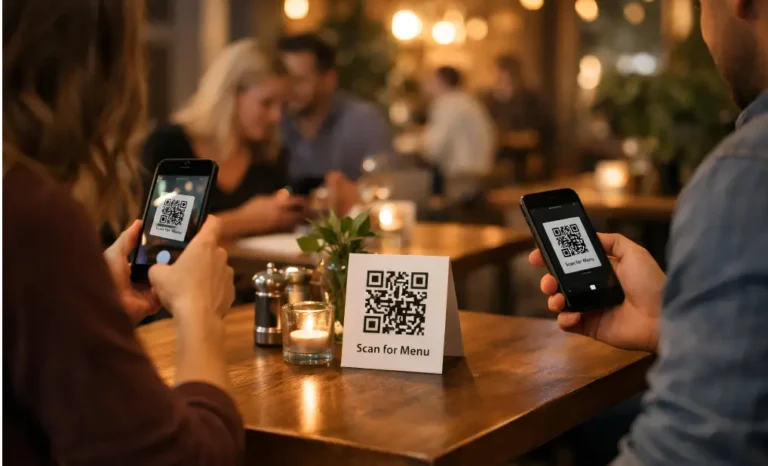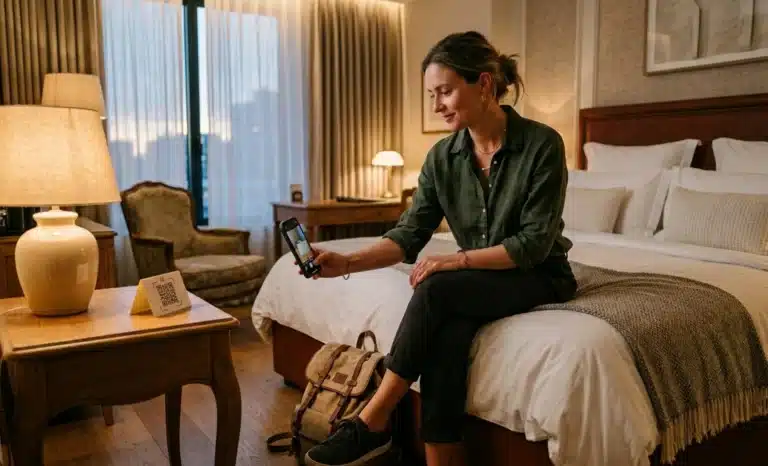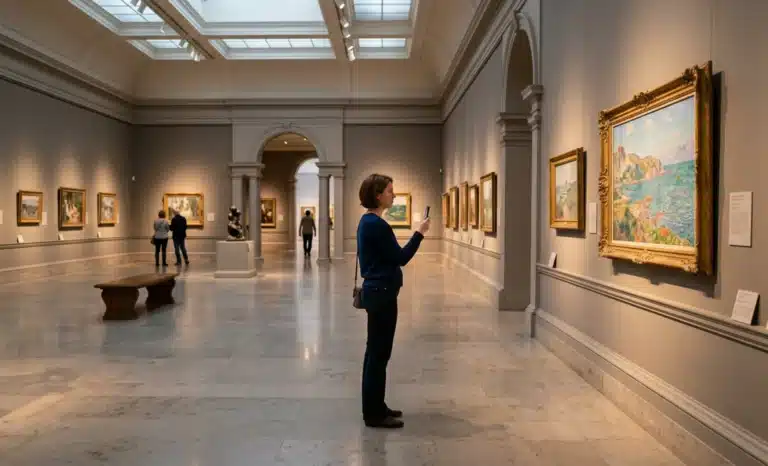
Walk into almost any museum today and the experience of interpreting what you see has not changed much in decades. There is a label on the wall with a title, a date, and a few lines of context. Perhaps there is a printed brochure at the entrance. If the institution has invested in it, there might be an audio guide device available for rent at the front desk. And that, for the vast majority of visitors, is where the interpretive experience ends.
The problem is not a lack of information. Museums hold extraordinary depth of knowledge about every object in their collections. The problem is delivery: getting the right information to the right visitor, in the right language, at exactly the moment they are standing in front of the piece and curious enough to want it. That is precisely the gap that an AI QR code museum guide is built to close, and it is what Cleo, QRCodeKIT’s AI assistant, makes possible today.
The real limitations of how museums communicate today
The printed label works for a single sentence of context. It fails the moment a visitor wants to go deeper. Who painted this and why? What happened to this object before it arrived here? What does this symbol mean? What else in this collection relates to what I am looking at right now? A label cannot answer any of those questions. A brochure cannot either.
Audio guides come closer, but they were designed for a world where personalization was not possible. Every visitor hears the same script, at the same pace, with the same level of detail. A seven-year-old and a doctoral researcher in art history receive identical information. Neither is particularly well served.
Mobile apps promised to fix this, but the adoption problem proved stubborn. Visitors resist downloading a dedicated app for a single afternoon’s visit. And even when they do download it, the experience depends on an app that is kept up to date, works across all devices, and is genuinely easier to use than simply reading the label. Most museum apps do not clear that bar.
The result is that most visitors, including international visitors who may not speak the local language at all, experience a collection at a fraction of its potential depth. That is a failure of communication, not of content.
What Cleo changes about the equation
Cleo is a conversational AI assistant that learns from the information you give it and then answers questions about that information in natural, fluent language. In a restaurant context, that information is a menu. In a museum context, it is the knowledge behind each individual piece in the collection.
The setup is straightforward. For each exhibit, a museum uploads a document containing everything relevant to that object: its history, provenance, the artist’s biography, the techniques used, the cultural context, the restoration work it has undergone, curatorial notes, related pieces, and anything else the institution wants a visitor to be able to access. Cleo reads and learns that material. A dynamic QR code is placed next to the physical piece. When a visitor scans it, they are not taken to a static page. They open a conversation.
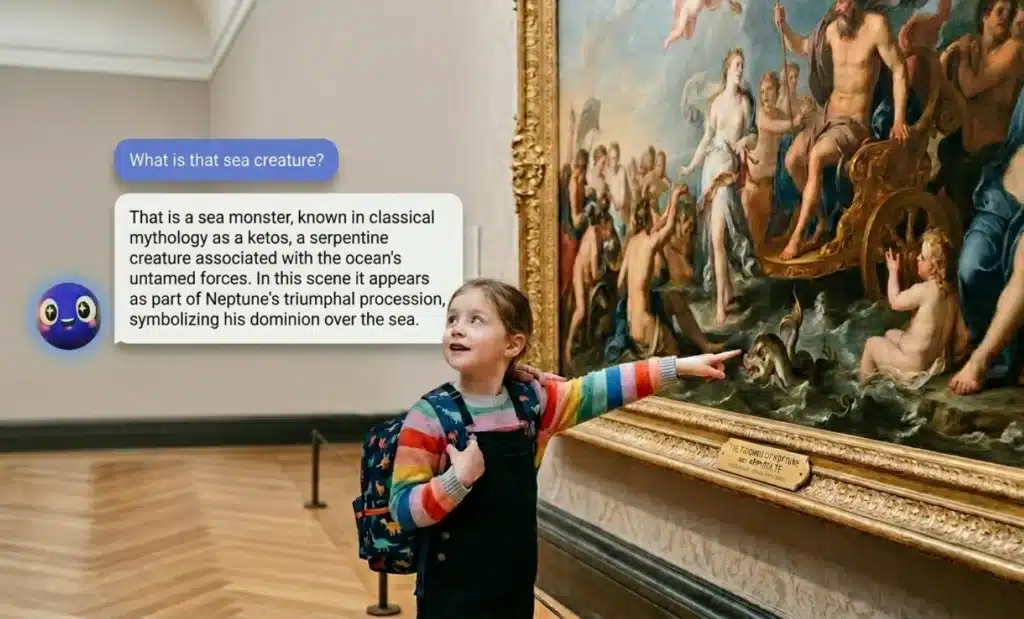
From that point, the visitor can ask anything. What year was this made? What does the inscription on the base say? Why did the artist choose this subject? Is there anything else like this in the collection? Cleo answers in natural language, drawing from the information the museum has provided, without guessing, without fabricating, and without ever running out of patience.
A guide that speaks every language
One of the most immediate practical advantages of Cleo in a museum setting is multilingual support, and it requires no additional work from the institution once the source document is uploaded.
A visitor from Japan and a visitor from Brazil can scan the same QR code next to the same painting and each receive a full, fluent conversation in their own language. The museum does not need to produce separate audio tracks, hire translators for each new acquisition, or maintain parallel versions of its interpretive content. The AI handles the language layer automatically.
For museums in cities with high international footfall, or for institutions with travelling collections that move between countries, this is a significant operational shift. The cost and complexity of genuine multilingual visitor support drops dramatically. And critically, the quality of the experience does not drop with it. A visitor engaging with Cleo in Portuguese is not receiving a machine-translated approximation. They are having a real conversation about the piece in front of them.
Personalization that a printed label can never offer
Every visitor arrives at a museum with a different level of knowledge, a different age, a different set of interests, and a different amount of time. A static interpretive system cannot account for any of that. Cleo can.
A child asks why the figure in the painting looks sad. Cleo explains in terms a child understands, with warmth and without condescension. A specialist asks about the specific pigments used in the background and whether they are consistent with the attributed date. Cleo draws from the technical documentation the museum has provided and answers with the appropriate depth. The same QR code, the same piece, two entirely different conversations.
This kind of adaptive communication is not something that requires the museum to anticipate every possible question and pre-record an answer. Cleo generates responses dynamically, within the boundaries of what it has been taught. The museum defines what Cleo knows. Cleo decides how best to communicate it depending on who is asking.
The knowledge behind each piece, finally accessible
Museums hold research that never makes it onto the wall. Curatorial notes developed over years, conservation records documenting every intervention a piece has undergone, correspondence between the institution and the artist’s estate, scholarship that informed an acquisition decision. Almost none of this reaches the visitor standing in the gallery.
With Cleo, it can. Because the knowledge base behind each QR code is a document the museum controls completely, the depth of what a visitor can access is limited only by what the institution chooses to include. A museum can decide that visitors should be able to ask about the full provenance of a contested piece. It can include behind-the-scenes content about how a major restoration was carried out. It can make accessible the kind of detail that previously existed only in an academic catalogue that most visitors would never read.
This does not clutter the physical space. The gallery wall stays clean. The label stays concise. The depth lives behind the scan, available to anyone who wants it and invisible to anyone who does not.
How quickly can a museum implement this?
The practical question that follows any discussion of new technology in cultural institutions is always the same: what does implementation actually require, and how long does it take?
For Cleo in a museum setting, the answer is more straightforward than most institutions would expect. The museum does not need to build anything, install any hardware, or manage any technical infrastructure. The work is content work: gathering and organizing the knowledge that already exists about each piece into a document that Cleo can learn from. For institutions that already maintain detailed curatorial records, that process can move very quickly.
A dynamic QR code is generated through QRCodeKIT and placed next to the physical exhibit. When the content behind a piece needs to be updated, whether because new research has emerged, an attribution has changed, or the piece is on temporary loan and a new one has taken its place, the update happens in the document. The QR code does not change. The physical installation does not change. Only the knowledge Cleo draws from is refreshed.
For museums that want to move quickly, deployment across a collection can be completed in a matter of days. For larger institutions that want to phase the rollout, starting with a flagship gallery or a temporary exhibition is a natural entry point that allows the team to develop a content workflow before scaling across the full collection.
What visitors actually experience
It is worth being specific about what a visitor encounters when they scan a Cleo-powered QR code in a museum, because the difference from a standard QR code experience is significant.
They do not land on a page of text they have to scroll through. They do not hear a pre-recorded narration they cannot pause or interrogate. They open a conversation. They type a question, or in interfaces that support it, speak one. They receive an answer that is directly responsive to what they asked, in their language, at a level of complexity that matches how they asked it.
If they want to go deeper, they ask another question. If they want to move on, they close the interface and walk to the next piece. There is no script to follow, no required listening time, no information they are forced to receive before they can access what they actually wanted to know. The visit becomes genuinely self-directed in a way that printed labels and linear audio guides cannot support.
Is a Cleo-powered museum guide available today?
Cleo is already deployed and proven in the restaurant sector, where the same fundamental model applies: a knowledge base, a conversational AI, a dynamic QR code, and a visitor with a question. The museum application of that same architecture is not a distant roadmap item. It is a near-term reality, and for institutions that want to move ahead of the curve, implementation is already possible.
The underlying technology is ready. The content workflow is simple. The visitor experience it produces is meaningfully better than what most museums currently offer. What the museum application requires is not a technology decision so much as a content decision: what do we want our visitors to be able to know, and are we ready to make that knowledge genuinely available?
For institutions that answer yes to that question, Cleo makes the delivery straightforward.
All images and visual content in this article were created using RealityMAX.