TL;DR
- QR codes for FIFA World Cup 2026 let bars, restaurants, and small businesses update menus, schedules, and promotions throughout the tournament without reprinting anything.
- Dynamic codes matter because the schedule keeps changing as teams move from the group stage to the knockout rounds.
- Most ideas here can be set up in an afternoon, well before the next match kicks off.
The 2026 FIFA World Cup is already underway, running from June 11 to July 19 across the United States, Mexico, and Canada. For a small business, that is a finite window of busy match days. QR codes for FIFA World Cup 2026 are one of the simplest ways to turn that extra foot traffic into orders, repeat visits, and a customer list you keep after the final whistle. None of the ideas below take more than an afternoon to set up.
Why use QR codes for FIFA World Cup 2026?
A QR code campaign during the World Cup is a simple way for restaurants, bars, and small businesses to turn the spike in foot traffic on match days into engaged customers and repeat visits. It works because three features of this tournament make static, printed materials a liability.
First, match days concentrate customers into short, intense windows. A code on the table or door lets people act in that moment, before they drift somewhere else. Second, the audience is unusually international. Away supporters, expat communities, and travelers are watching together, so menus and information in more than one language suddenly matter. Third, the schedule moves fast. With 48 teams, 104 matches, and 12 groups feeding into a round of 32, what is on next changes constantly. A code you can update keeps pace with a tournament that does not sit still.
What can restaurants and bars do with World Cup QR codes?
Restaurants and bars can use QR codes to put a match day menu, the day’s fixtures, and a quick loyalty signup within reach of every seated customer. The aim is to capture attention during the busy hours around kick-off, when staff are stretched and customers want answers fast.
- A match day specials menu that you update for each fixture, with no reprinting between the group stage and the knockouts.
- A table code linking to the live schedule, so customers can see which match is on next and plan a second round.
- A multilingual menu with allergens and dietary details, so international fans can read it in their own language.
- A pre-booking code on the door for high-demand fixtures, such as Argentina, Spain, France, or Mexico playing at peak hours.
- A loyalty signup code that turns a one-time match day visitor into someone you can reach before the next big game.
How can pubs and sports bars use QR codes on match days?
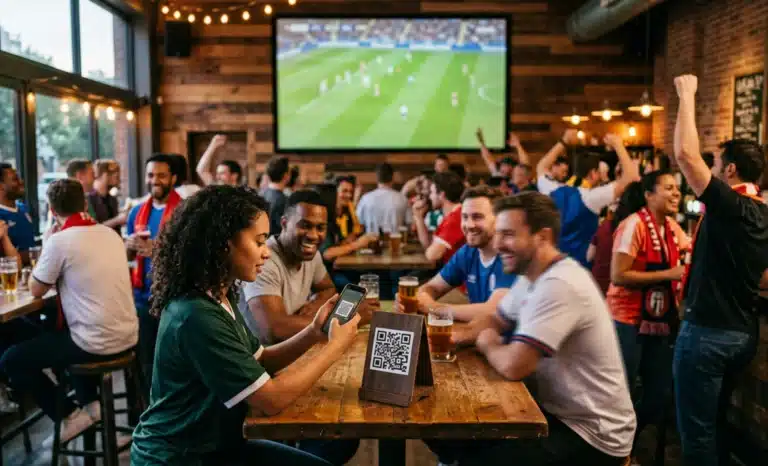
Pubs and sports bars get the most from QR codes when matches are packed and staff cannot reach every table. A code on each table, coaster, or wall turns waiting customers into active ones, whether they are ordering, predicting results, or posting about the game.
- A bracket challenge code where customers predict knockout results for a small prize, such as a free drink or a discount on the next visit.
- An order-at-the-table code, which is faster than waving down staff in a venue full of supporters.
- Coasters carrying a code that links to your social handles, so customers posting about the match tag you while they are at it.
- A fantasy league signup code for regulars who want to stay engaged across the whole tournament.
What about retail and other small businesses?
You do not need to show the match to benefit from it. Retailers and other small businesses near busy venues can ride the same wave of foot traffic with a single well-placed code. A code in the shop window can link to a World Cup themed discount that runs for the length of the tournament. A code on the receipt can invite shoppers to a viewing party or fan event you are hosting later that week. And a code on a flyer, handed out in a neighborhood with a strong expat or visiting community from a competing country, can point straight to an offer aimed at the people most likely to celebrate that team’s next match. Each one costs nothing to reprint when the offer changes, because the printed code stays the same while the destination updates.

How can larger venues and fan zones use QR codes?
Larger sports bars, hospitality groups, and fan zones can run several codes at once, each with its own job and its own analytics. One code handles the menu, another shows the schedule, a third drives social follows, and a fourth collects loyalty signups, with every scan tracked separately so you see what people actually use. Codes near broadcast displays invite viewers to engage without leaving their seats, and a distinct code per match or per location gives granular data on which fixtures and rooms drove the most activity. For a multi-site operator, that detail is the difference between guessing and knowing where the tournament paid off.
Why are dynamic QR codes essential during a fast-moving tournament?
A dynamic QR code can change where it points without changing the printed code itself, which is exactly what a month-long tournament demands. The group stage gives way to the round of 32, then 16, then the quarter-finals, and your menus, specials, and schedules need to follow. With a dynamic code, you update the destination from a dashboard and every table tent, coaster, and window sign stays accurate. A fixed code locked to a single page does the opposite, tying your printed materials to one moment and forcing a reprint every time the bracket moves. For an event that reshuffles itself every few days, that is a poor fit. QRCodeKIT has built dynamic QR codes since 2009, and its free plan is enough for a small venue to set up a couple of codes without committing a budget mid-tournament.
How can you help international fans in their own language?
The World Cup may be the most international crowd a small venue serves in a single month. Fans arrive speaking many languages, and the questions they ask are practical: does this dish contain peanuts, what time does the next Mexico match start, is there a vegetarian option. A conversational AI layer like Cleo, built into the QR code by QRCodeKIT, can answer those questions in the language the fan is already using. The owner sets up the information once, covering the menu, allergens, and fixtures, and Cleo handles the back and forth at any hour without pulling a server away from a packed floor.
How do you set up a QR code before the next match day?
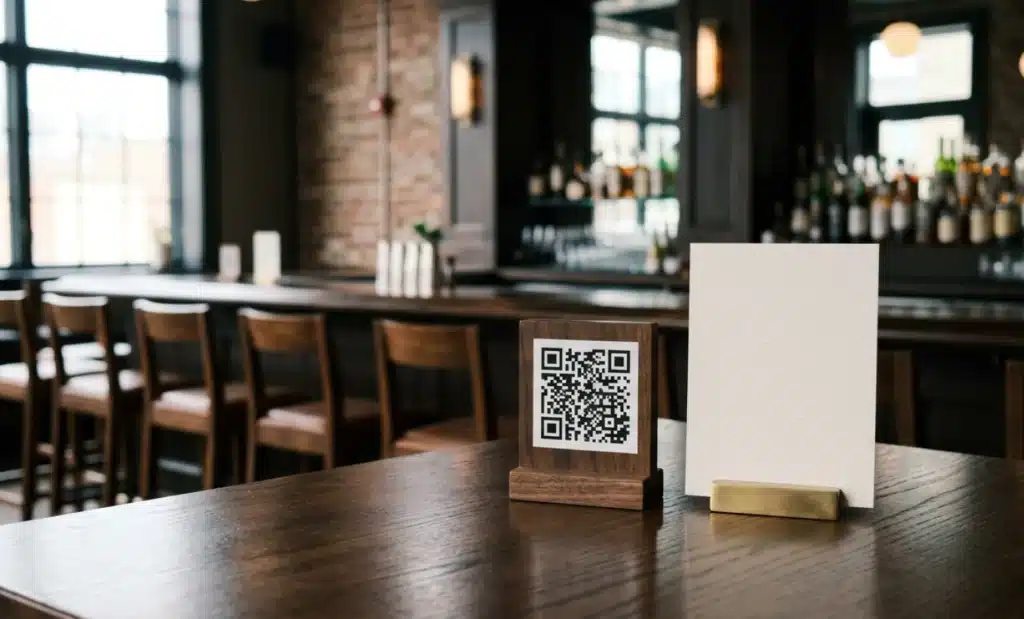
Setting one up before the weekend is quick if you keep it focused. Start by deciding the single thing you want the code to do, whether that is showing a menu, a schedule, a signup, or a predictions game, since one clear purpose beats a cluttered landing page. Choose a dynamic code so you can update it as the tournament progresses. Print it on something durable that survives spills and heavy handling, and add a short, plain instruction next to it, such as scan for today’s match menu, so customers know what they are getting. Then test it by scanning it yourself from a few distances and in the lighting your venue actually has, because a code that fails at the table on a busy night is worse than no code at all.
What should small businesses avoid with World Cup QR codes?
A few mistakes can undo good intentions. The first is legal: do not use FIFA logos, official mascots, or the word official in your promotions, because the trademark rules that apply to the tournament apply to your marketing too. Referring to the event as the World Cup and naming teams by country is fine, but borrowing the marks is not. The second is technical: avoid fixed codes you cannot update, and avoid hiding a PDF menu behind the code, since PDFs are awkward to read on a phone. The third is timing: do not build something complicated the night before a busy match, when there is no margin to fix it. And do not strip away every printed option, since some customers are less comfortable scanning and still deserve a menu they can hold.
Can small businesses use the FIFA World Cup name in their promotions?
Yes, with care. You can refer to the FIFA World Cup and World Cup 2026 as factual references to the event, and you can name teams by country, such as Mexico or Argentina. What you cannot do is use FIFA logos, official mascots, federation crests, or the word official in a way that suggests approval or sponsorship. Keep your wording descriptive and you stay on safe ground.
Do I need to reprint QR codes when the match schedule changes?
Not if you use a dynamic QR code. The printed code stays the same while you update the destination from a dashboard, so a single table tent or window sign can show the group stage one week and the round of 16 the next. That is the main reason dynamic codes suit a tournament that changes every few days.
What is the best type of QR code for a World Cup menu?
A dynamic menu code is the most practical choice, because you can swap in match day specials and update prices without reprinting. Link it to a mobile-friendly page rather than a PDF, since PDFs are hard to read on a phone. If international fans are likely, add allergen and language support so the menu works for everyone at the table.
How much does it cost to set up QR codes for a World Cup campaign?
It can cost nothing to start. QRCodeKIT offers a free plan with a couple of dynamic QR codes, which is enough for a small venue to test a match day menu or a loyalty signup before the next fixture. Paid plans add more codes and analytics if a single bar wants to track several campaigns at once.
Can a QR code answer questions from fans in another language?
It can when there is a conversational AI layer behind it. Cleo by QRCodeKIT responds to questions in the language the fan is using, covering things like ingredients, dietary options, and match times. The owner enters the information once, and Cleo handles the conversation, which helps when a venue is full of visiting supporters and staff are busy.
How quickly can I set up a World Cup QR code?
Usually within an afternoon. Decide what the code should link to, create a dynamic code, point it at a mobile-friendly page, and print it with a short scan instruction. The slowest part is preparing the content behind it, such as the menu or schedule, not the code itself. Test it before the match and you are ready.
Are QR codes worth it for a small bar during the World Cup?
For most venues, yes, because the cost is low and the tournament concentrates a lot of foot traffic into a few weeks. Even a single code that captures loyalty signups or speeds up table orders can earn its keep across 39 days of matches. The key is to keep it simple and set it up before the crowds arrive.
All images and visual content in this article were created using RealityMAX.