April 22, 2026
QR codes for outdoor music festivals: from lineup and stage maps to lost-and-found
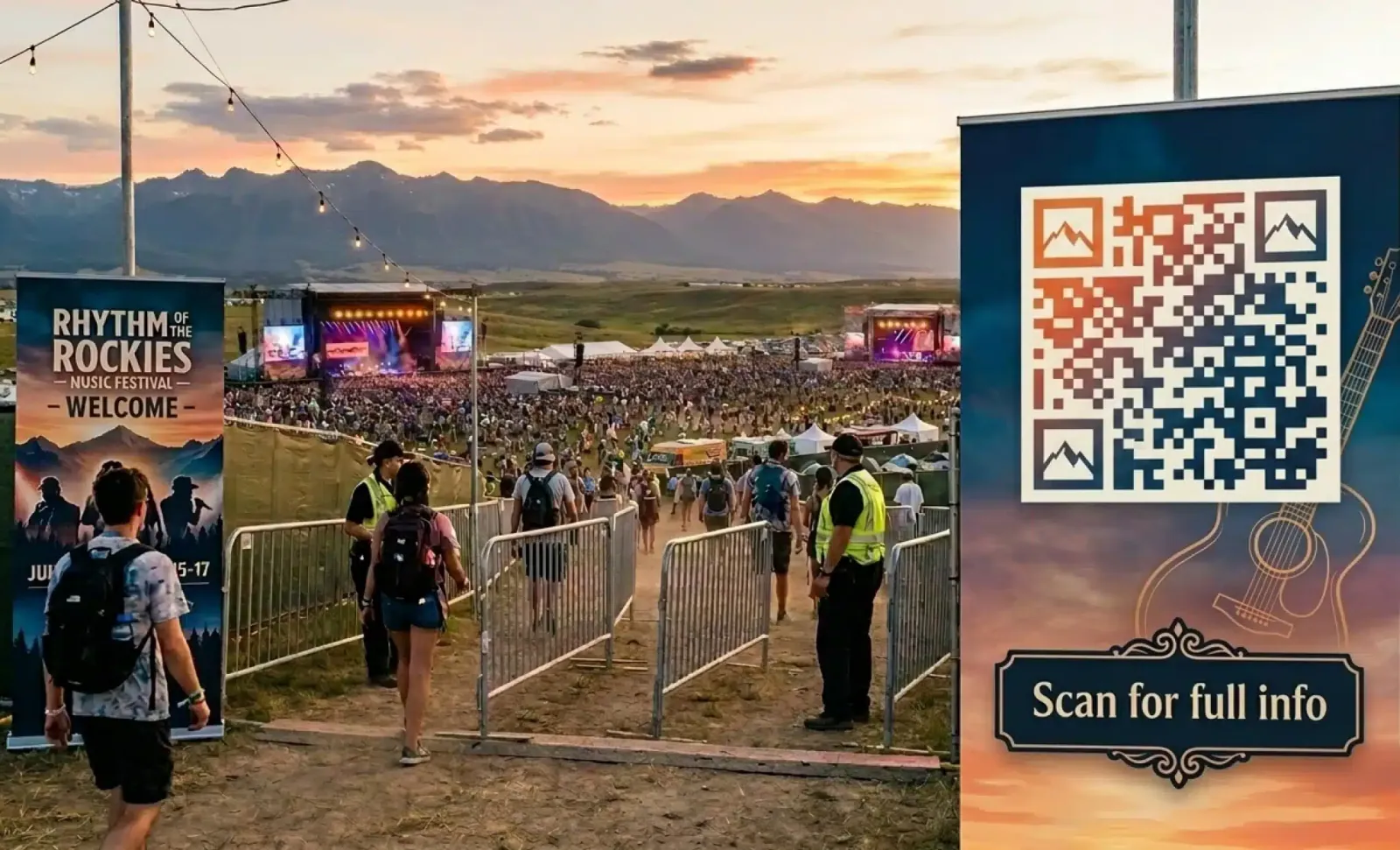
A festival gate at 4 PM on a Friday. Thirty thousand people funneling through security. Questions coming from every direction. Which stage is Phoenix playing? Where is the medical tent? Is the silent disco happening tonight or Saturday? Staff can’t answer fast enough, and the printed program ran out two hours ago.
This is where QR codes for outdoor music festivals stop being a nice to have and start becoming operational infrastructure. Not because QR codes are trendy, but because a festival is essentially a temporary city where tens of thousands of people need answers to the same questions, at the same time, across a physical space too large for any human team to cover.
This article is about how to think strategically about QR code usage at large scale events. Not how to make one, but where to put them, what jobs to give them, and how to design a system that holds up when the gates open.
Why outdoor festivals are a special case for QR code strategy
Most QR code deployments happen in controlled environments. A restaurant menu. A product package. A business card. The context is stable, the audience is small, and the information behind the code rarely changes.
Festivals break all of those assumptions.
The audience is massive and constantly moving. The information changes daily, sometimes hourly, as stages run late or weather shifts the schedule. The environment is hostile to technology, with spotty cellular coverage, bright sunlight washing out screens, and attendees holding drinks in one hand and phones in the other. Staff turnover is high because most workers are seasonal.
That combination means a festival QR code strategy cannot rely on printing a static link and hoping for the best. It has to be built around dynamic QR codes, which let organizers change the destination and content behind each code without reprinting anything. A dynamic QR on a banner can point to the Friday schedule on Friday and the Saturday schedule on Saturday, with no physical change to the banner itself.
This is the first strategic decision an event organizer has to get right. Everything else follows from it.
The five layers of a festival QR code system
Thinking about QR codes at a festival works better when you stop asking “where do we put one” and start asking “what jobs does this event need done.” From there, five clear layers emerge.
Pre event: building anticipation and selling tickets
The weeks before an event are where QR codes earn their keep on marketing efforts. A unique QR code on a poster in a record store is doing work that a printed URL never could, because it collapses the distance between “I saw this poster” and “I have a ticket.”
The strategic question here is what each pre event QR should do. Options include:
- Driving people to event registration or a page to purchase tickets
- Linking to video teasers of past editions
- Opening a WhatsApp thread with the organizer
- Sending people to a Facebook page or Instagram account to follow updates
The mistake most organizers make is using a single QR for all of this. A poster QR, a flyer QR, and a social media post QR should each go somewhere different, because they’re reaching people in different moments. The person scanning a poster on a subway platform is not ready to buy. The person scanning a flyer handed to them at a concert venue might be. Match the destination to the moment.
Multiple QR codes across your marketing materials also give you real time data on what’s working. If the poster QR outperforms the bus shelter QR three to one, that tells you where to spend next year.
On site navigation: stage maps and the schedule
Once attendees are inside the festival, the job changes. Now you’re solving wayfinding and information lookup, and the physical scale of the event becomes your main challenge.
A good approach is to treat the festival map as a layered system. The printed map on a banner at the entry gates shows the overall layout, with a QR code that opens the interactive digital version on a mobile device. Smaller signs throughout the grounds repeat this pattern, each one tailored to its location. The QR at the food court might open a map highlighting nearby vendors. The QR near Stage B might open that stage’s schedule for the day.
This is where Cleo by QRCodeKIT, the AI assistant built into QRCodeKIT’s AI QR codes, starts to change how you think about on site signage. A traditional QR sends someone to a page and leaves them to find the answer themselves. An AI QR code lets the attendee ask the question directly.
“What time does the headliner start?”
“Where’s the closest bathroom to Stage C?”
“Is there a vegetarian food option near me?”
The attendee scans, types the question, and gets an answer in the browser, no app required. The landing page is still there. The schedule, the map, the sponsor information. But on top of it sits a conversation bubble that can answer the specific thing that person actually wants to know, in whatever language they speak. For a festival with international attendees, the multilingual capability alone justifies the approach.
Entry and check in
The check in process at large scale events is where QR code technology has already become standard, but strategy still matters.
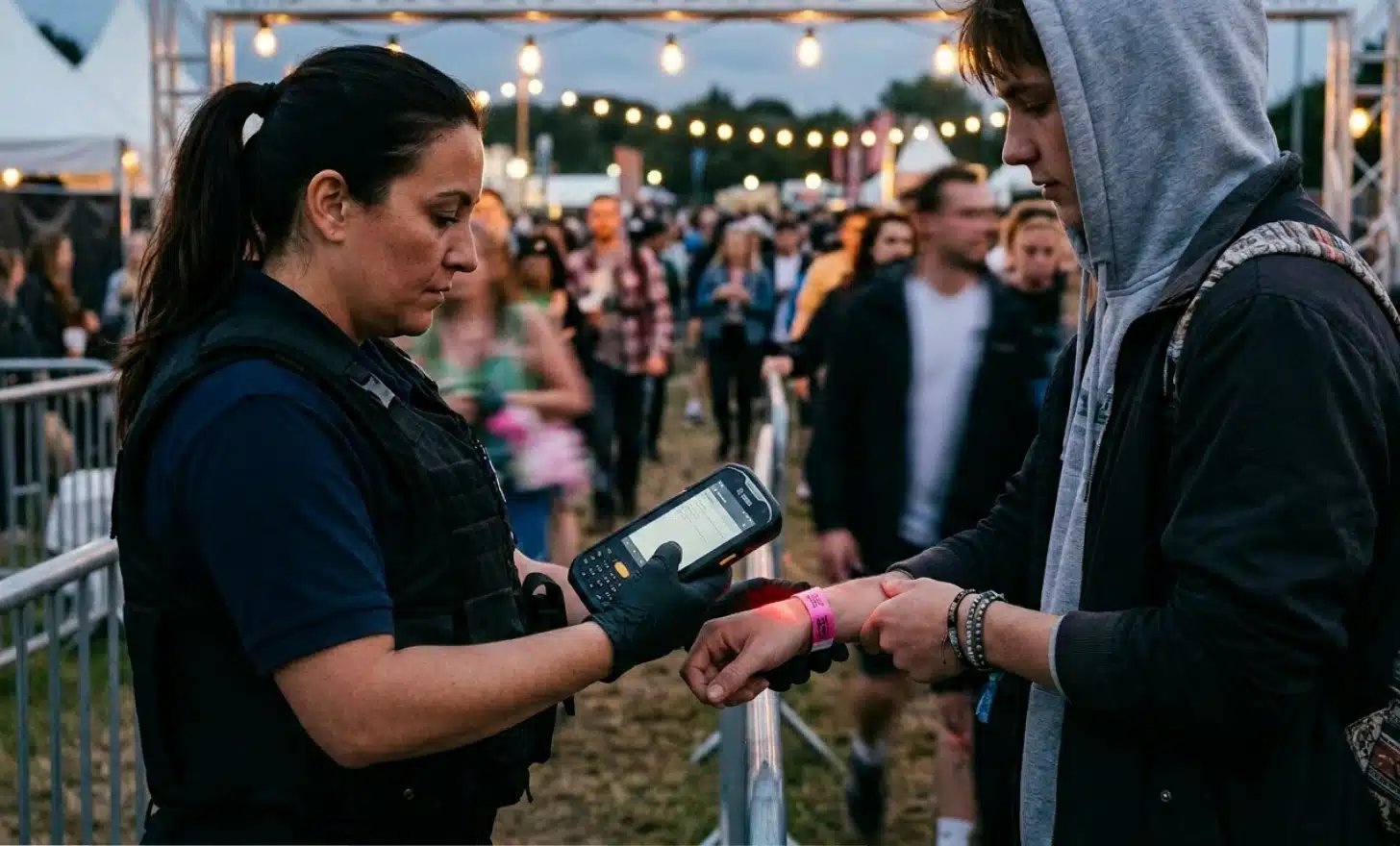
A digital ticketing system built around event QR codes solves several problems at once. It reduces ticket fraud, because each QR is tied to a specific event registration and can be invalidated after use. It speeds up the event check in process, because a quick scan at the gate beats checking IDs against a printed list. It eliminates cash handling at the entry point.
The strategic consideration is the backup. Phones die. Screens crack. Cellular networks collapse under the weight of thirty thousand people posting Instagram stories at once. A smart event organizer designs the entry process with a manual process fallback for the small percentage of attendees who will need it, and trains staff to execute the fallback without slowing the main line.
Entry gates are also the right place to introduce attendees to the on site QR ecosystem. A well placed sign just past the ticket scan, with a clear call to action to “scan the QR code for the full schedule,” onboards people into the system at the exact moment they’re most curious about what’s inside.
In festival engagement
Once attendees are past check in and spread across the grounds, QR codes shift from informational to experiential.
A scavenger hunt where attendees scan codes hidden around the festival to win prizes, collect points, or unlock exclusive content gives you a structured way to direct attendees toward less crowded areas and longer activations. A sponsored brand activation can use a QR to collect contact details in exchange for a free drink or merchandise. A video teaser of next year’s event can play from a QR at the exit, captured while the emotional high is still fresh.
Cashless payments are another layer worth thinking about carefully. Contactless payments through QR codes reduce the friction of cash handling at bars and food stalls, and the data tells you what attendees spend, where, and when. This is operationally useful beyond the event itself. If you know the craft beer tent did twice the revenue of the cocktail bar on Saturday night, next year’s layout plans itself.
Post event and lost and found
The festival ends, but the QR codes don’t have to. This is the layer most organizers underuse.
A QR on exit signage can point to a post event survey, a highlights reel, or a priority sign up for the next event. It captures intent at its peak, when the experience is still vivid.
Lost and found is the use case almost no one plans for, and it’s one of the most practical. A QR code printed on wristbands or on signage near common loss zones (the front of the main stage, the camping area gates) can link to a simple form where attendees describe what they lost, add contact details, and check back for updates. This replaces the traditional approach of posting photos on a Facebook page and hoping the right person sees them.
Put it into practice
Create a dynamic QR code free and see it work. No credit card required.
Get started freeDynamic QR codes as the foundation
Every use case above depends on one technical reality: the QR has to be dynamic.
A static QR encodes its destination permanently. Once printed, it can never change. For a festival, where the schedule shifts, the lineup evolves, and the day to day content is different, a static QR is a liability waiting to happen. If the main stage closes early due to weather and your static QR is printed on every banner pointing to the Friday night schedule, there’s nothing you can do.
A dynamic QR code separates the printed pattern from the destination URL. The code stays the same; the content behind it updates in real time. This is the difference between a flyer that’s obsolete in a week and one that keeps working for the entire event.
QRCodeKIT is built entirely around dynamic QR codes. Every QR generated through the platform can have its destination and content updated at any time, and each generates analytics on scans, locations, and engagement. For an event organizer managing dozens of different codes across entry gates, stage maps, food vendors, and sponsor activations, that central control is not a luxury. It’s how the system holds together on event day.
How AI QR codes change the attendee experience
Traditional QR codes are one way streets. The attendee scans, reads, leaves. If the page doesn’t have the exact answer they need, they’re stuck.
AI QR codes flip that dynamic. The landing page still does its job, but Cleo sits on top of it as a conversational AI layer, ready to answer questions that the page itself doesn’t explicitly cover.
Consider a festival goer who scans a QR near the medical tent. The landing page shows hours, location, and a list of services. But what they actually want to know is whether the medical tent has ibuprofen, or whether their friend with a sprained ankle can walk in without an appointment. A static landing page can’t answer that. An AI QR code can, drawing on the knowledge base the event organizer provides during setup.
Multiply that across every QR at the festival, and the experience shifts. Attendees stop treating QR codes as links and start treating them as the easiest way to get an answer to any question, anytime, in their own language. Staff get freed up from answering the same five questions a thousand times a day. The event organizer gets analytics on what attendees are actually asking, which feeds directly into next year’s planning.
This is what makes Cleo distinct. It’s not a separate service added on after the fact. It’s native to the QR code itself, built into the QRCodeKIT workflow from the moment the code is created.
Designing QR codes that actually get scanned
A QR code that no one scans is a dead asset, no matter how smart the technology behind it is. Strategic QR code design at a festival comes down to three practical variables.
The first is placement. A QR at eye level on a banner performs dramatically better than one at knee height on a directional sign. A QR near a bottleneck, where people are standing still anyway, outperforms one on a surface people walk past at speed. Exit signage, bar queues, and bathroom lines are the highest value real estate for scans, because the attendee already has a phone in their hand and nothing else to do.
The second is context. A QR needs a reason. “Scan for the schedule” works. A naked QR code with no explanation does not. The clearer the call to action next to the code, the higher the scan rate. Tell people exactly what they’ll get.
The third is size and contrast. An outdoor festival environment is harsh. Bright sun, rain, dust, distance. A QR printed too small or in low contrast colors is invisible at practical scanning distance. Festival QR codes should be larger than you think necessary, with strong contrast against their background, and tested with a smartphone camera from the distance attendees will actually be standing.
Common mistakes event organizers make with QR codes
A few patterns come up again and again, and all of them are avoidable with some upfront planning.
Organizers often use one QR code for everything. A single code on every flyer, every banner, every social post, all pointing to the same homepage. This destroys your ability to track QR code performance. You can’t tell which channel is working, which materials convert, or where to invest next year. Use multiple QR codes, each with a distinct purpose, and let the analytics do their job.
Another common mistake is printing QR codes without testing them at scale. A QR that scans perfectly from six inches away on a well lit phone screen may not work at three feet in direct sunlight on a cracked screen. Test in real conditions before printing ten thousand wristbands.
The third is treating QR codes as a marketing thing, not an operations thing. The most valuable use cases at festivals are often the least glamorous. Lost and found. Staff briefings. Volunteer check ins. Emergency contacts. These are the QR codes that save the event on a bad day, and they get overlooked because they don’t feel like marketing.
How should event organizers measure QR code success?
The temptation is to measure total scans and leave it there. Total scans tell you almost nothing.
Better metrics are tied to what each QR was supposed to accomplish. A ticketing QR should be measured on conversion to purchase. A navigation QR should be measured on whether attendees ask the same question at information booths less often. A lost and found QR should be measured on recovery rate. A scavenger hunt QR should be measured on completion rate and social media shares.
Dynamic QR codes make this kind of measurement possible, because each code generates its own analytics stream. The strategic event organizer looks at performance code by code, not in aggregate, and asks what each specific QR is actually doing for the event.

What does a good festival QR code system look like next year?
After your first season deploying QR codes strategically, the real work begins. You have data now. You know which codes got scanned, which got ignored, which questions attendees asked most, which locations delivered the highest engagement.
The second year is where you consolidate. You remove the codes that didn’t earn their space. You expand the ones that did. You refine the knowledge base behind your AI QR codes based on the actual questions attendees asked, not the questions you assumed they would ask. You treat the QR system as a living part of the festival’s infrastructure, the same way you’d treat sound, lighting, or security.
Festivals that do this well build a compounding advantage. Every edition, the system gets smarter. Attendee experience improves without adding staff. Organizer decisions get sharper because the data keeps getting richer.
That’s the real strategic value of QR codes for outdoor music festivals. Not the code itself, but the operational intelligence it gives you over time.
All images and visual content in this article were created using RealityMAX.
Related articles

Trusted domain QR codes
Every week, security teams deal with a threat most of their tools were not built to handle. Someone sends a QR code by email or prints it on a flyer. A…
State of dynamic QR codes
Surveys tell you what people say they do. Platform data tells you what they actually do.

How beach clubs use QR codes?
There is a particular kind of frustration that belongs specifically to beach clubs. You are settled in. The sun is right. You have found the exact angle on…
Two free dynamic QR codes. Yours forever.
No credit card. No expiry. The original dynamic QR platform since 2009.