May 28, 2026
Why are QR codes for resorts essential for the summer holiday season?
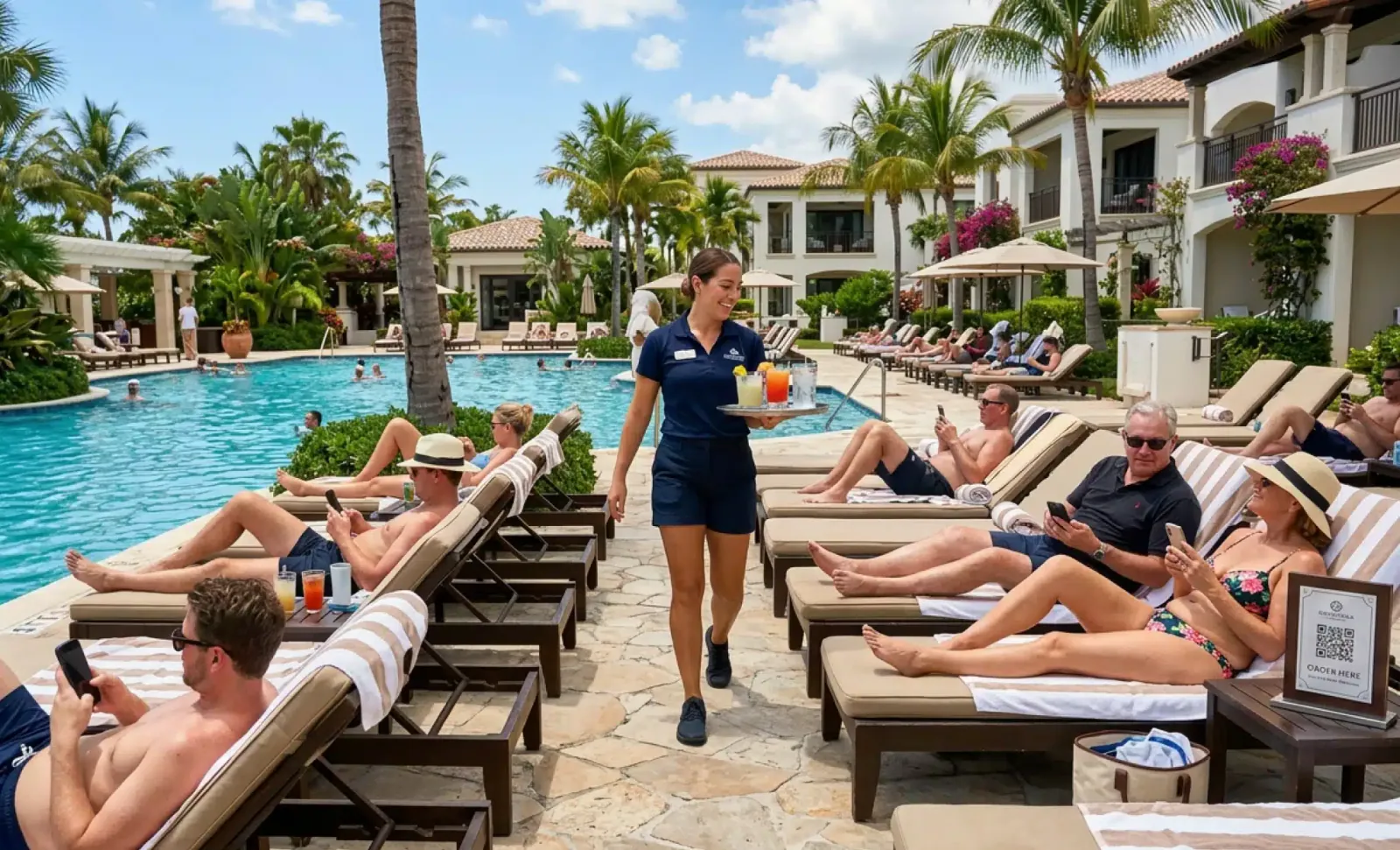
TL;DR QR codes for resorts absorb the operational pressure of peak summer occupancy by moving repeatable interactions into the guest’s phone. They shorten front desk queues, power digital menus across every dining outlet, take in-room orders without phone calls, and handle excursion bookings around the clock. Because every code is dynamic, schedules and menus can change mid-season without reprinting anything in rooms or lobbies.
Summer is when a resort’s systems get tested. Occupancy climbs to the ceiling, international guests arrive in waves, and the front desk handles the same five questions a few hundred times a day. Staff is stretched, the pool bar is slammed at 2 p.m., and the spa phone rings while three couples wait at the concierge to book the same sunset excursion. This is the season where small friction points compound across thousands of interactions.
QR codes for resorts are how mature properties absorb that pressure without scaling headcount for ten weeks a year. Not as decoration on a table tent, but as the connective tissue between a guest with a question and the answer they need. When the codes behind those interactions are dynamic QR codes, which means the destination URL can be changed at any time without reprinting the physical code, the resort gains something more valuable than convenience. It gains the ability to adjust in real time to weather, supply, staffing, and demand.
This article walks through where QR codes earn their place during the summer season at a resort, why dynamic codes are the only sensible foundation, and how a conversational AI layer like Cleo by QRCodeKIT extends the code into something closer to a 24/7 multilingual concierge.
What problem do QR codes for resorts actually solve in summer?
The structural challenge of summer in the hospitality industry is that demand is non-linear and information requests are repetitive. A 400-room resort at 95% occupancy is not just busy. It is fielding the same questions about pool hours, spa availability, breakfast service, and the Wi-Fi password from hundreds of guests, in a dozen languages, often at the exact same hour.
QR codes for resorts solve this by moving repeatable interactions away from staff and into the guest’s own phone, on the guest’s own time. Check-in paperwork that used to require a front desk conversation becomes a scan in the lobby or even on the airport transfer. A question about the dinner menu that used to interrupt a busy waiter becomes a scan at the table. A booking for tomorrow’s snorkeling tour that used to require standing at the concierge desk becomes a scan from a sun lounger.
Where the pressure actually builds during peak weeks
The result is not fewer staff. It is the same staff handling the interactions that actually require human judgment, while the predictable ones flow through the codes. The pressure points are remarkably consistent across properties: arrivals between 3 and 6 p.m., breakfast service between 8 and 10 a.m., the pool bar from noon to 4 p.m., and the dinner rush across all outlets between 7 and 9 p.m. Each of those windows is a candidate for QR-assisted flows.
How do QR codes streamline contactless check in and check out?
The front desk is the operational pinch point of any resort, and summer turns it into a queue management problem. Afternoon arrivals from international flights cluster into windows of two or three hours. Morning departures hit between 8 and 11 a.m. as families catch return flights.
Contactless check in before the guest reaches the lobby
A contactless check in flow through a QR code lets guests handle the paperwork on their phone before they reach the desk. They scan, complete the registration through online check in forms, upload identification, sign whatever the local regulator requires, and arrive at the front desk for one thing only: key pickup. The guest journey starts smoother, and the front desk team is no longer the bottleneck between an exhausted family and their room.
Faster check out and key handling
The same logic works at check out. A scan to settle the folio, review charges, and request a transfer to the airport removes the morning queue that used to back up into the breakfast restaurant. For resorts that already use room key cards or digital key technology, the QR can even deliver the digital key directly to the guest’s phone, removing the desk step entirely for guests who prefer it. The point is not to replace the front desk. It is to keep the human conversation for guests who want one, while giving everyone else a faster path.
What role do digital menus play across resort dining outlets?
A resort in peak season is rarely running one menu. There is the hotel restaurant, the pool bar, the beach service, the in-room dining menu, and often a specialty restaurant or two. Each of those menus changes, sometimes daily, based on what arrived from the supplier that morning, which staff member is leading the kitchen tonight, and what ran out at lunch.
Why a digital menu beats reprinted cards
A digital menu behind a dynamic QR code at each outlet solves the reprint problem permanently. When the chef runs out of branzino at the beach restaurant, the menu updates once and every guest who scans after that sees the current version. When the pool bar introduces a new cocktail for the August calendar, no one needs to redesign and print laminated cards. Printed menus also get sticky, torn, and lost. A digital version stays clean on every device.
Where to place menu codes in each outlet
The placement matters as much as the codes themselves. The most effective spots tend to be:
- Table tents at every outlet, with a clear short instruction next to the code
- The pool bar counter, where guests order standing up
- Beach service signs at the entrance to lounger zones
- In-room bedside tables or the desk, for room service menus
- Lobby displays near the elevators, for the all-outlets overview
A digital menu also opens the door to ordering directly through the code, which is where the room service angle becomes interesting.
Can QR codes handle room service and in room ordering?
Room service is one of the highest-friction interactions in any hotel restaurant operation. A guest picks up the phone, often hesitating because of language, asks for the menu to be repeated, places an order that is then handwritten or typed by an operator, and waits for confirmation. Each step is a chance for an error or a delay.
How in room ordering through a QR code works
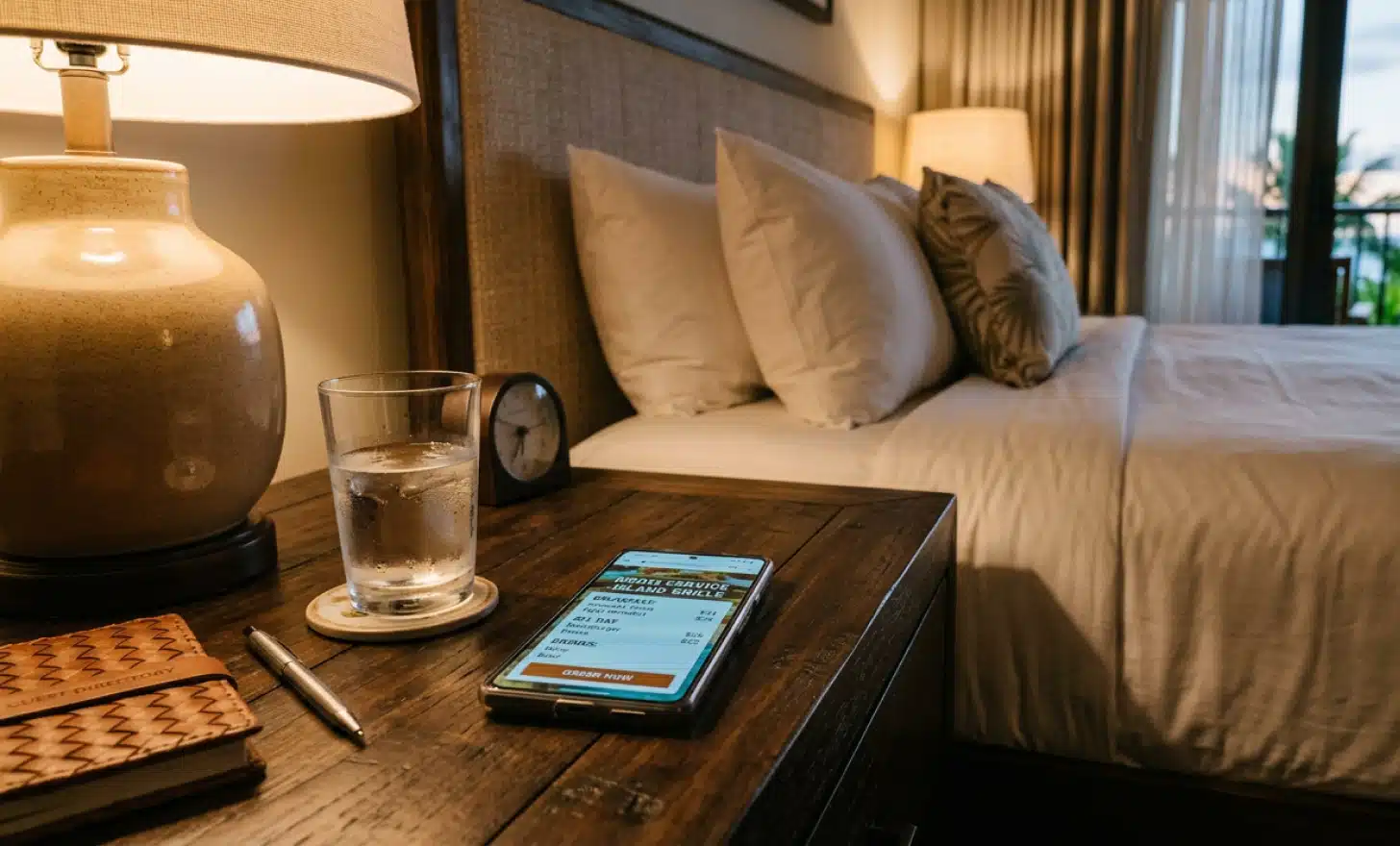
A QR code on the bedside table that opens the current room service menu and allows the guest to place the order directly removes most of that friction. The guest reads the menu in their own time. They tap what they want. They add a special request in text rather than over a phone. The order arrives in the kitchen system already formatted, with the room number attached. The kitchen reads exactly what the guest selected, in writing, with no translation step.
The multilingual angle for international guests
For international hotel guests, this is where the multilingual capability of a conversational AI layer like Cleo by QRCodeKIT becomes valuable. A French family scans the code, reads the menu in French, asks Cleo whether the children’s pasta contains nuts, gets the answer in French, and orders. None of this required a multilingual operator at 11 p.m. The same code serves a guest from Tokyo, Berlin, or São Paulo without any change on the resort’s side.
How do guests book spa, fitness, and excursions without queueing?
The concierge desk is the second great queue of a summer resort, after the front desk. The bottleneck is rarely a lack of availability. It is the serial nature of one guest at a time speaking with one concierge.
QR codes placed in guest rooms, lobby touchpoints, and dining outlets that link to live availability calendars let guests browse and book on their own time. Spa treatments, sunrise yoga, sunset cruises, kids’ club sessions, tennis courts, and external excursions all become self-service when the booking page is one scan away. Wait times disappear because the queue is no longer linear. Ten guests can book ten different activities in the same minute.
Why dynamic destinations save the booking flow
The dynamic part matters here as much as anywhere. A morning thunderstorm cancels the catamaran tour, and the destination URL behind the relevant code can switch to “next available departure” or “weather update” without anyone reprinting collateral. A new yoga instructor adds a class for next Thursday, and it appears in the calendar that every code already points to.
Why do dynamic QR codes matter more in summer than any other season?
Summer schedules at a resort change constantly. Weather rearranges the activity program. A supplier delivery gets delayed and three menu items disappear. A new entertainment act is added Tuesday for Saturday. A road closure changes the route to the recommended sunset viewpoint.
If the QR codes in rooms, lobbies, restaurants, and pool areas are static, every one of those changes either gets ignored or triggers a reprint cycle. If they are dynamic QR codes, the resort updates the destination once in QRCodeKIT and every code, including the ones already printed on welcome cards, table tents, room directories, and lobby displays, immediately points to the current information.
How analytics and UTM parameters refine the strategy
Beyond the update flexibility, dynamic codes generate data on every scan. Scan rates by location, time of day, and device type tell the operations team where placement is working and where it is not. UTM parameters attached to the destination URL let the marketing team pipe the same data into Google Analytics alongside the rest of the digital funnel. After a season of data, the resort can fine tune which codes earn prime real estate and which can be retired. This is the operational reason dynamic codes are not a preference at a resort. They are the only foundation that survives a season where the schedule is in motion every day.
Put it into practice
Create a dynamic QR code free and see it work. No credit card required.
Get started freeHow do QR codes serve international guests across languages?
Summer guests at most resorts speak a wide range of languages, often more than the hotel staff can cover fluently. The traditional answer was to print the resort directory in five or six languages and hope guests find the right one. The result was thick binders that nobody reads.
A QR code that opens a conversational AI like Cleo gives every guest a contact point that responds in their own language. A German guest scans the code in the hotel room and asks about breakfast hours in German. A Japanese guest scans the same code and asks about the gluten-free options at the buffet in Japanese. The resort maintains one source of information, in one language, and Cleo handles the conversation in whichever language the guest opens.
This is not a chatbot bolted onto a webpage. It is a conversational layer native to the QR code itself, drawing on the content the resort already maintains. For amenities, dietary considerations, transportation options, and local attractions, it does the work of a multilingual concierge for the simple questions, freeing the human concierge for the complicated ones. The impact on guest experience is immediate. Guests feel understood from the first interaction in their room.
How can resorts collect guest feedback through QR codes?
The best time to capture feedback is during the experience, not after. A guest who is annoyed about a room issue at 10 a.m. on day two is a guest the resort can still recover. The same guest, three weeks after checkout, leaving a review online, is a problem.
Where to place feedback codes for real time feedback
Placing QR codes for feedback at strategic moments throughout the customer journey makes it easy for guests to share feedback while impressions are fresh. The high-value spots:
- The checkout receipt at breakfast
- The room key envelope at check in
- The bill folder at dinner
- The towel card at the pool
- The post-treatment card at the spa
The dynamic destination can rotate based on the touchpoint, so a code at breakfast asks about the buffet, and a code at the spa asks about the treatment.
Why mid stay feedback protects public reviews
The real value is the recovery window. A complaint that arrives mid-stay can be addressed by the staff on duty. A complaint that arrives on a public review site after checkout cannot. Real time feedback is not just a metric. It is service recovery in practice.
What about loyalty enrollment during the stay?
Loyalty programs at resorts have a known conversion problem. The signup ask at checkout, on a paper form, when the guest is already mentally on the way to the airport, performs poorly. The signup ask during a positive moment of the stay, say after a great spa treatment or at the end of a memorable dinner, performs much better.
A QR code on the spa receipt, the dinner bill, or the activity confirmation card that opens a one-screen enrollment form catches that moment. Guests scan, fill in three fields, and they are in. The resort then has the contact details for future direct bookings, off-season promotions, and personalized communications that do not depend on third-party booking platforms. Over a full summer, a resort that gets enrollment placement right ends the season with a meaningfully larger pool of guest preferences and contact details to work from.
What mistakes should resorts avoid when deploying QR codes?
Every season, the same patterns of mistakes show up at resorts that have rolled out codes without thinking through the operational reality.
Technical and format mistakes
A common one is using a PDF QR code that just opens a scanned menu document. PDFs do not render well on phones, especially on weaker hotel Wi-Fi. Use a proper digital menu page, not a scanned PDF. Another is forgetting that some guests have older devices. The destination URL needs to load fast and look right on a five-year-old phone, not just the latest model.
Communication mistakes around the code
A code with no context next to it does not get scanned. A square on a table tent with no instruction is invisible. A short line like “Scan for tonight’s menu” doubles the scan rate. The same applies to ordering codes, feedback codes, and booking codes. Always tell the guest what happens when they scan.
Strategy mistakes that hurt the guest experience
Two strategy mistakes are worth flagging. The first is removing every paper alternative. A small share of guests, especially older ones, will not scan a code under any circumstance. Keep one printed copy at the host stand or front desk for them. The second is treating the code as the end of the interaction. A code that opens a static landing page and ends there is a missed opportunity. A code that opens a conversational AI that can answer follow-up questions does the actual work.
How should resorts decide where to place QR codes first?
The right starting points are the spots where the same question gets asked most often. For most resorts, that means:
- Bedside tables and the room desk, for in-room dining and resort information
- Every dining outlet, for digital menus and ordering
- Lobby displays and the concierge desk, for activity bookings and local guides
- Front desk welcome area, for contactless check in paperwork
- Pool and beach service points, for ordering and information
- Spa reception, for booking and treatment information
The first three deliver the largest operational efficiency return. The rest can be added in a second phase once the first set is generating data and feedback through scan analytics.
Quick answers to common questions
Are QR codes for resorts only useful in summer?
They are useful year-round, but summer is when the absence of them becomes most visible. The same questions and the same queues exist in shoulder seasons. They just hurt less. Many resorts roll out QR codes for the summer pressure test and keep them running through the rest of the calendar because the operational gains do not go away.
What happens if a guest does not want to use a QR code?
A well-designed resort QR strategy never removes the human alternative completely. It reduces the load on staff so they can give attention to guests who prefer to talk. Older guests, guests without smartphones, and guests who simply prefer face-to-face interaction always have a printed alternative or a human option available.
Do QR codes for resorts work without Wi-Fi?
The scan itself works on cellular data, but the destination page loads faster on Wi-Fi. Properties with weak guest Wi-Fi should fix that first, because it affects every digital interaction, not just the codes. A good rule is that if the hotel’s app or website is slow on the property’s Wi-Fi, the QR experience will feel slow too.
Can the same QR code be used for two seasons?
With dynamic QR codes, yes. The physical code stays the same and the destination is updated between seasons. The summer menu becomes the autumn menu behind the same square of pixels. The same goes for activity programs, opening hours, and event schedules. The resort prints once and updates as often as needed.
How do resorts measure whether QR codes are working?
Through scan analytics on each code. Volume, location, time of day, and what guests ask through a conversational layer like Cleo all become data the operations team can use to fine tune placement, content, and staffing for the next peak window.
All images and visual content in this article were created using RealityMAX.
Related articles
Pharmaceutical serialization with QR codes
Every box of prescription medicine that crosses a border, sits on a pharmacy shelf, or reaches a patient now carries something it did not carry twenty years…
Branded QR code vs generic QR code
When a customer pulls out their phone to scan a code on a product, a poster, or a restaurant table, they make a quick decision in less than a second. They look…
QR code mobile os breakdown
A scan looks like a single action. Point the camera, tap the notification, land on a page. From the user’s side, it feels uniform across every phone in the…
Two free dynamic QR codes. Yours forever.
No credit card. No expiry. The original dynamic QR platform since 2009.