QR code marketing has matured. What started as a clever way to bridge print and digital has become a default tool for brands that want to turn physical touchpoints into measurable, trackable, conversational experiences. In 2026, the question is no longer whether to use QR codes in marketing campaigns. It is how to use them well, and how to keep up with what they can now do.
This guide walks through the practical side of QR code marketing: what works, what to avoid, where to place them, and what the next wave of AI QR codes is bringing to the table.
What is QR code marketing?
QR code marketing is the practice of using QR codes as connective tissue between physical touchpoints and digital experiences. A scan on a poster, a product label, a receipt, or a billboard takes the customer somewhere specific: a landing page, a video, a menu, a discount, a form, or increasingly, a conversation with an AI assistant.
The point is not the code itself. The code is a doorway. What matters is what sits behind it, how trackable it is, and how easily marketers can adjust the destination without reprinting anything.
That is why dynamic QR codes have become the standard for marketing. They can be updated post-print without redesigning the physical asset, and they provide analytics on scan count, time, device, and location. QRCodeKIT has been building dynamic QR codes since 2009, when the company first introduced the technology to the market.
Why QR codes still matter for marketing in 2026
Adoption has been steady, not viral, and that is precisely the point. QR codes are now part of normal consumer behavior. People scan menus without thinking. They scan packaging to check ingredients. They scan tags in stores to compare prices. The friction that used to exist around QR codes (apps required, awkward framing, slow scans) is gone.
For marketers, this means the QR code is finally doing what it was always meant to do: act as a measurable bridge between offline impressions and online action. Every scan is a signal. Every conversion is traceable to a specific placement, campaign, or piece of creative.
It also means competition for the scan is higher. A QR code on its own no longer earns curiosity. The reason to scan has to be clear, and the experience behind the scan has to deliver on whatever the code promised.
What types of QR codes work best for marketing campaigns?
Different campaigns call for different destinations. The most common QR code types used in marketing today include:
- Landing page QR codes for campaign-specific microsites, with full analytics and the option to update the page over time.
- Menu QR codes for restaurants, hotels, and event catering, often combined with multilingual content.
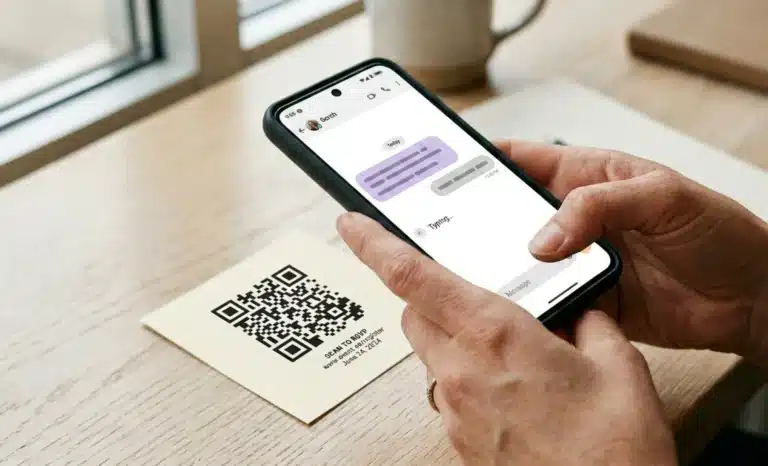
- WhatsApp QR codes that open a pre-filled message, useful for service inquiries and local businesses.
- File download QR codes for catalogs, press kits, and digital brochures.
- Social media QR codes that route to whichever platform performs best for the audience.
- Digital business card QR codes for events, trade shows, and sales teams.
- App store QR codes that detect the user’s device and send them to the correct app store automatically.
All of these are dynamic. The destination, the design, and the data layer can be adjusted at any time after the code has been printed and distributed.
How do you use QR codes in loyalty programs?
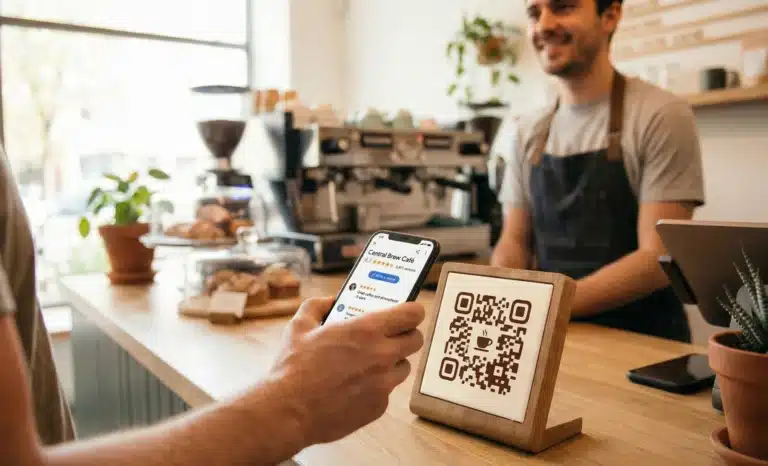
Loyalty programs are one of the strongest fits for QR code marketing because they reward repeat behavior, and repeat behavior depends on low friction. A printed QR code on a coffee cup, a receipt, or a shop window can take a returning customer directly to their loyalty account without forcing them to download yet another app.
The most effective loyalty setups use one QR code per location or per touchpoint, route the user to a mobile-optimized landing page, and offer either instant enrollment or instant point redemption. Analytics on the back end then show which locations and which placements actually drive sign-ups versus which ones just collect scans.
This is also where dynamic codes prove their value. A loyalty program changes over time. New tiers, new rewards, new partner offers. The code on the cup never changes. What it points to does.
QR codes on menus and in hospitality
Restaurants and hotels were among the earliest mainstream adopters of QR code marketing, and the use case has only deepened. A menu QR code today is rarely just a PDF link. It is a full digital menu with photos, allergen information, language switching, and increasingly, a conversational layer that lets the guest ask questions directly.
For hospitality marketers, the value goes beyond the menu itself. Each scan tells you which table or which room generated the engagement, what time it happened, and which language the guest used. Multiply that across a property and you have a real picture of guest behavior that no static menu could ever produce.
QR codes on packaging and product labels
Product packaging is prime real estate for QR code marketing. The customer is already holding the product. They are already in a decision moment. A scan can take them to ingredient details, recipe ideas, sustainability information, a warranty registration form, or a conversational AI that answers questions in their language.
For brands managing multiple SKUs, dynamic QR codes solve a practical problem: campaigns can be updated, recipes refreshed, and content localized without touching the physical packaging. A holiday promotion can run for six weeks behind the same code that points to product information the rest of the year.
QR codes for virtual stores and pop-up retail
Virtual storefronts, window shopping after hours, pop-up activations, and short-run retail events all benefit from QR codes that turn a passive display into an active checkout. A code on a shop window can let a passerby browse the catalog and place an order at midnight. A code at a pop-up event can collect leads, take orders, or send the customer to a livestream.
The marketing value here is twofold. The scan extends the trading hours of a physical space, and it captures customer intent that would otherwise walk away.
QR codes for payments and checkout
Payment QR codes have gone from novelty to standard in many regions, especially across Asia and parts of Europe. For marketing teams, payment codes integrated with loyalty or discount logic are a natural fit. A scan at the register can apply a campaign discount, redeem points, and process payment in a single flow.
The marketing layer sits on top of the payment layer. Which campaign drove the payment, which channel sent the customer, which offer converted. All of it becomes traceable.
AI QR codes: the conversational layer marketers should know about
This is the biggest shift in QR code marketing since dynamic codes became standard. An AI QR code does not just send the customer to a page. It opens a conversation at the destination, where the customer can ask questions and get answers in real time.
Cleo, QRCodeKIT’s native conversational AI layer, has been developed iteratively over years and is built directly into the QR code workflow rather than added as a separate chatbot. The owner provides the content (product details, FAQs, availability, pricing, menu items, anything relevant), and Cleo draws on that content to answer questions from anyone who scans the code.
For marketers, the practical implications are significant. Cleo handles questions 24/7 without staff involvement. It responds in multiple languages natively, so a single QR code can serve customers regardless of where they are from. It can qualify leads through the conversation itself, capturing contact details and buyer intent before a human ever gets involved. And it can handle bookings, reservations, and appointments directly within the chat.
The customer does not download an app. They scan, land on the page the marketer configured, and find a conversation bubble ready to help. The page is not replaced. It is enhanced.
This matters for marketing because it changes the conversion math. A traditional landing page converts when the visitor finds what they need and acts on it. A landing page with a conversational AI layer can recover the visitors who would otherwise have left with an unanswered question.

QR codes and augmented reality
Augmented reality remains relevant in QR code marketing, particularly in retail, real estate, and product launches. A QR scan can launch an AR view of a piece of furniture in the customer’s living room, a car in their driveway, or a sneaker on their foot.
The use cases that work best are the ones where physical sight is genuinely limited and AR fills the gap. Showing how a product looks in context, how a complex item assembles, or how a space might be furnished. AR is less useful when it is added for novelty alone. Marketers should ask whether the AR experience answers a question the customer was already asking, or whether it is just dressing up the scan.
QR codes and regulatory readiness
QR codes are increasingly intersecting with regulation, and marketers should be aware of the direction this is heading.
The EU Accessibility Act entered into force on 28 June 2025, requiring that digital experiences (including those reached through QR codes) meet accessibility standards. This affects the landing pages and digital menus QR codes point to, not the codes themselves.
The EU Digital Product Passport (DPP), rolling out under ESPR (Regulation 2024/1781) from 2026, will require certain product categories to carry digital information about their origin, materials, and lifecycle. QR codes are one of the carriers designed to make that information accessible to the customer.
GS1 Sunrise 2027 is the global retail initiative to transition point-of-sale systems to support 2D barcodes (including QR codes) by the end of 2027. For brands selling through retail, this changes how product information can be carried on the pack.
None of these regulations should drive panic, but marketing teams working with packaging, retail, or cross-border campaigns should be in the conversation early. The QR code is increasingly the vehicle for compliance, not just for marketing.
Where should QR codes be placed for maximum impact?
Placement is where most QR code marketing campaigns succeed or fail. A great destination behind a poorly placed code earns no scans.
The strongest placements share a few characteristics. The viewer is stationary or close to stationary. They have a reason to engage. The code is at a comfortable distance, well lit, and not competing with other visual noise. Common high-performing placements include restaurant tables and menus, hotel rooms, retail shelves at eye level, packaging, business cards, event signage, indoor billboards, transit stations, and printed receipts.
Less effective placements include moving vehicles, highway billboards (where the viewer cannot stop), digital screens that change before the scan completes, and any surface where the lighting is unpredictable.
What size should a QR code be in marketing materials?
The general rule is a minimum of 2 by 2 centimeters for printed materials viewed at close range. For posters and signage viewed from a distance, the size needs to scale with the viewing distance. A useful guide is that the code should be roughly one tenth of the viewing distance. A code viewed from one meter away should be at least 10 centimeters across.
Contrast also matters. Dark code on a light background scans most reliably. Reversed contrast (light code on dark background) can work but should always be tested across multiple devices and lighting conditions before going to print.
What types of marketing materials can include QR codes?
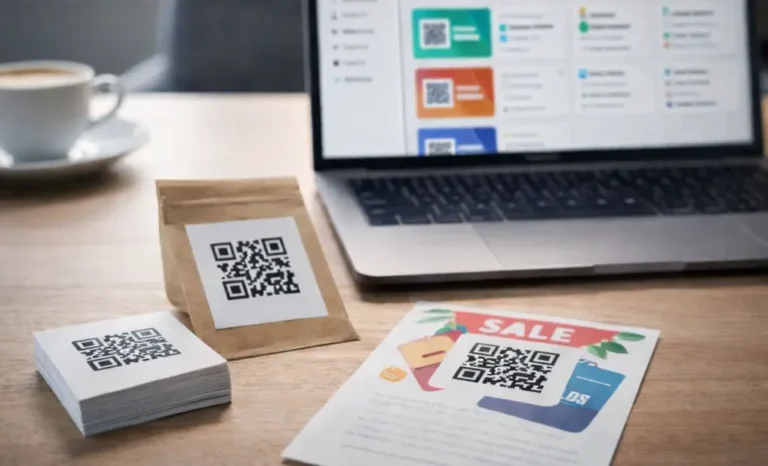
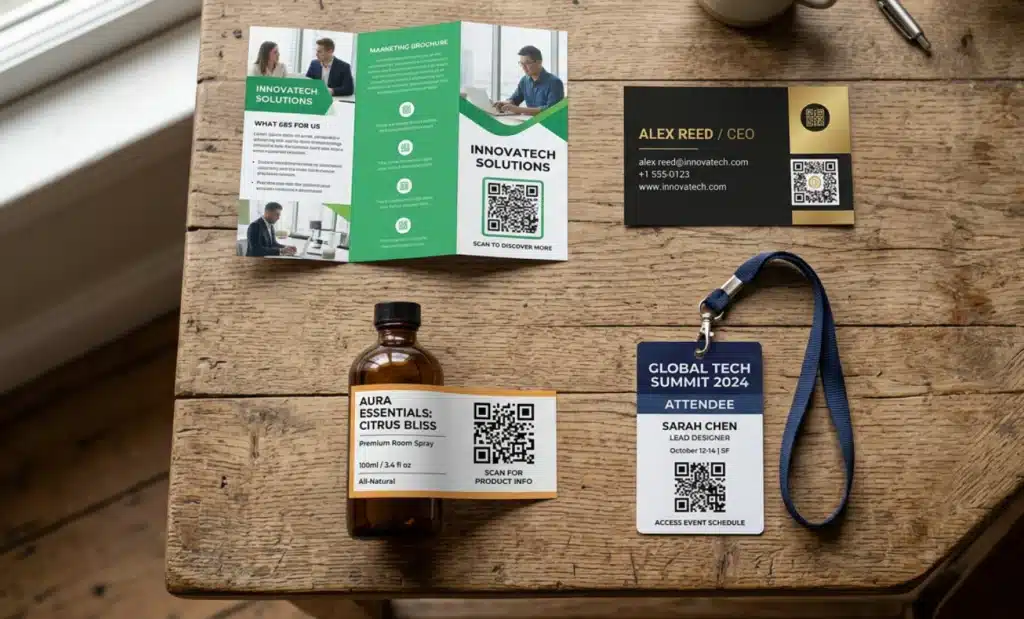
Almost anything printed or displayed. The most common categories include posters, flyers, brochures, business cards, packaging, product labels, receipts, menus, table tents, window displays, vehicle wraps, trade show booths, event lanyards, magazine ads, direct mail, billboards, and bus shelter displays.
Digital materials also benefit from QR codes for cross-device handoffs. A code on a desktop screen lets the viewer continue the experience on their phone. A code in a video lets the viewer act on what they just watched.
Common mistakes to avoid in QR code marketing
A few patterns separate campaigns that perform from campaigns that do not.
Skipping the call to action is the most common mistake. A QR code without a one-line prompt explaining what the scan delivers will be ignored. “Scan to see the room in AR” works. A naked QR code does not.
Using static QR codes for marketing is another. Static codes cannot be updated, cannot be tracked, and cannot adapt to campaign changes. Every QR code at QRCodeKIT is dynamic, which means analytics and updatability are built in from the start.
Pointing to an unoptimized landing page is just as damaging. The customer is on mobile. The page has to load fast, fit the screen, and deliver what the code promised within seconds. If it does not, the scan is wasted.
Failing to test is the quiet killer. A code that looks fine on the design file may not scan reliably once printed, especially if the contrast is off or the print resolution is low. Every code should be scanned in the conditions it will live in before the campaign goes live.
Frequently asked questions about QR code marketing
What is the difference between static and dynamic QR codes for marketing?
Static QR codes contain the destination URL directly in the code itself, which means the destination cannot be changed once the code is printed. Dynamic QR codes route through a short URL that can be updated at any time, and they provide scan analytics. For any serious marketing use, dynamic is the only practical option. QRCodeKIT does not offer static QR codes for this reason.
How do I measure QR code marketing ROI?
Dynamic QR codes provide scan data including count, timestamp, device, and approximate location. To measure ROI, connect those scans to the action that happened on the destination page, such as a form submission, a purchase, a booking, or a download. Marketing teams typically tag each campaign with a unique code or set of codes and then attribute conversions back through that data.
Can QR codes work in TV commercials?
Yes, and they work better than many expect, provided the code stays on screen long enough to be scanned and the viewer has a reason to act. A code that flashes for two seconds will be missed. A code held on screen for ten seconds with a clear prompt can drive measurable response. Connected TV and streaming ads are particularly effective because the viewer is often on their phone already.
What are AI QR codes in marketing?
AI QR codes add a conversational layer to the destination behind the scan. Instead of just landing on a static page, the customer can ask questions and get answers in real time, in their own language. QRCodeKIT’s Cleo is a native conversational AI layer built into the QR code itself. For marketers, AI QR codes turn a passive landing page into an active interaction, which can lift conversion rates and capture leads that would otherwise leave with unanswered questions.
Are QR codes still relevant in 2026?
More than ever. QR codes have become a default behavior for consumers across hospitality, retail, packaging, and events. They are also increasingly required by regulation, including the EU Digital Product Passport and the GS1 Sunrise 2027 transition. The technology has moved past the question of relevance into the question of how to use it well.
How do I design a QR code that gets scanned?
Three things matter most. Contrast (dark on light scans most reliably), size (at least 2 by 2 centimeters for close range, scaled up for distance), and a clear call to action next to the code explaining what the scan delivers. Branded or artistic QR codes can also work well when designed within scanner tolerance, but should always be tested on multiple devices before printing.
Where QR code marketing is heading
QR code marketing is becoming quieter and more capable at the same time. The codes themselves are receding into the background of normal consumer behavior, while what sits behind them is getting smarter, more conversational, and more accountable.
The next few years will be shaped by three things. AI layers that turn landing pages into interactions, regulation that makes QR codes a standard carrier of product information, and multilingual experiences that let a single code serve customers across borders.
For marketers, the work is less about whether to use QR codes and more about whether the experience behind each scan is worth the customer’s attention. That is the part worth focusing on.
All images and visual content in this article were created using RealityMAX.