If you’re asking how many QR codes does a business need, you’re already thinking strategically.
This is not a technical question about black and white squares. It is a decision about structure, tracking, customer journeys, and growth. The real answer depends on what you want each code to do, how you plan to measure it, and how your business operates in real life.
For some businesses, a single QR code is enough. For others, multiple unique QR codes are essential to understand performance, manage marketing campaigns, and improve customer experiences.
Let’s break down how to think about it.
One QR code or multiple QR codes?
Most businesses start with a single QR code. It feels simple. You generate one code, print it on business cards, product packaging, and posters, and link it to your website or a mobile friendly page.
This works when:
- You have one clear goal
- You do not need detailed tracking per channel
- You are testing QR code technology for the first time
For example, a small business might place a single QR code on printed materials that links to a simple URL with contact details. If the goal is just easy access, one code can be enough.
But as soon as you care about scan metrics, campaign performance, or understanding which placement drives more QR code leads, one code becomes limiting.
The most common reason businesses create multiple QR codes
The most practical answer to how many QR codes does a business need is this: you usually need one code per objective.
A business rarely has just one objective.
You might want to:
- Track performance across different marketing campaigns
- Separate operational uses from marketing efforts
- Test different printed materials
- Measure results per location or store
- Link physical products to different types of linked content
If you use the same QR code everywhere, all scan data blends together. You lose visibility.
Creating unique QR codes for each channel allows you to see which print campaigns actually work. A poster in your store may generate more scans than your packaging. A flyer might outperform business cards. Without distinct codes, you cannot test or compare.
This is why many companies leverage QR codes in a more structured way over time.
Operational QR codes vs marketing QR codes
Another useful distinction is between operational and marketing use.
Operational use cases
These are stable, long term workflows. For example:
- A code that links to installation instructions
- A code used for internal inventory tracking
- A code printed on physical products for warranty registration
In these cases, the link and data rarely change. A standard QR code might technically work. However, a dynamic code still gives you flexibility if details need updating in the future.
Operational codes are often fewer in number but permanent.
Marketing use cases
Marketing codes evolve constantly.
You may want to:
- Promote a seasonal offer
- Run a short term contest
- Collect customer feedback
- Direct customers to an app or store page
- Launch new additional modules on your website
Marketing campaigns benefit from dynamic QR codes because you can update the url, track scan metrics, and analyze user behavior without reprinting.
In practice, most growing businesses end up with multiple dynamic QR codes for marketing and a smaller set for operations.
When does one QR code become a problem?
A single QR code becomes restrictive when:
- You want more data than just total scans
- You run campaigns in different locations
- You need to compare placements
- You change linked content frequently
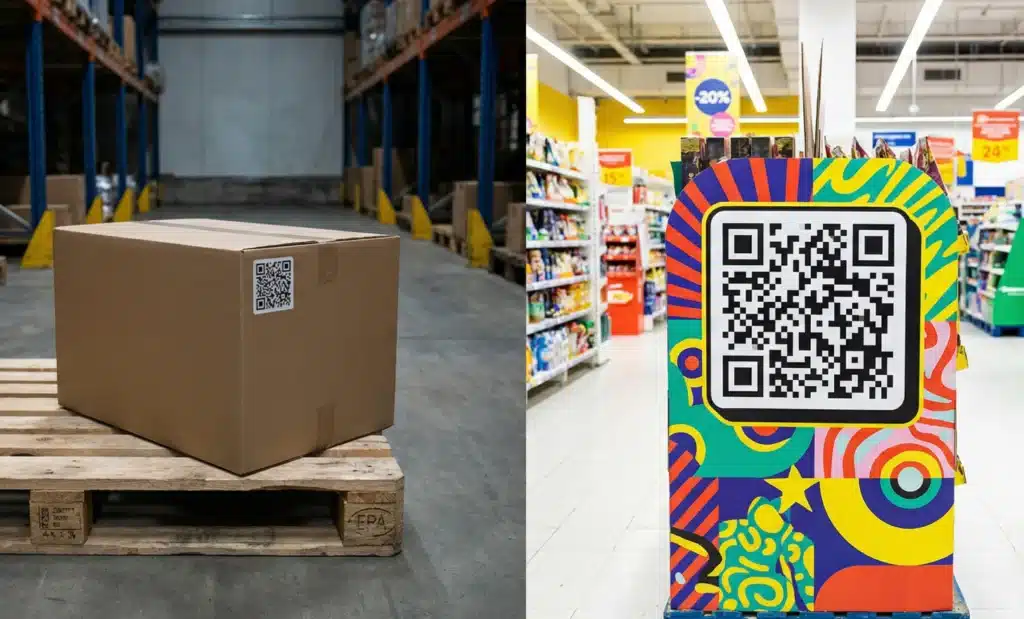
Imagine a retail business that places one code on product packaging, in store displays, and in email print campaigns.
All scans appear as one data stream. You cannot tell which placement drives direct customers. You cannot measure ROI per channel. You cannot test improvements.
From a strategy perspective, this is a missed opportunity.
Creating unique combinations of codes per initiative allows you to see specific performance per page, location, and date.
How dynamic QR codes change the decision
The question how many QR codes does a business need becomes easier when you understand the difference between static and dynamic.
Static codes store the final data directly inside the code. If you encode a simple url, that link cannot change. If the page changes, you must generate and print a new code.
Dynamic QR codes work differently. The code contains a short url that redirects to your chosen destination. You can update that destination anytime.
That flexibility changes how you plan.
Instead of reprinting larger codes every time you update details, you keep the same printed code and adjust the linked content. This is particularly useful in a crowded marketplace where marketing efforts evolve quickly.
Platforms such as QRCodeKIT support dynamic code workflows, which makes managing multiple QR codes more realistic over time without increasing complexity.
How many QR codes does a small business typically need?
For a small business, the answer often follows stages.
Stage 1: Testing
You might start with:
- One QR code linking to your website
- Or one linking to a mobile friendly landing page
At this stage, you are testing adoption. The focus is on easy access and simple implementation.
Stage 2: Channel differentiation
As soon as you notice regular scans, you may add:
- One code for business cards
- One code for in store posters
- One code for product packaging
Now you can compare scan metrics and see which channel generates more QR code leads.
Stage 3: Campaign optimization
Later, you may create:
- Unique QR codes per campaign
- Separate codes per location
- Codes for customer feedback
- Codes for promotions
At this stage, how many QR codes you create depends on how granular your tracking needs to be.
Practical trade offs to consider
More codes bring more clarity. But they also require thoughtful design and organization.
Here are the main trade offs.
Tracking vs simplicity
If you create one code per channel, you gain precise tracking. But you must manage more assets.
If you use fewer codes, management is easier, but insights are limited.
Data storage and code size
The more data you embed directly in a static code, the larger codes become. Higher versions increase data storage capacity but produce denser patterns.
Larger codes can be harder to easily scan, especially on small printed materials.
Dynamic QR codes reduce this issue because the code only stores a short url rather than full data. This keeps the physical code cleaner and more flexible.
Design and scannability
Regardless of how many QR codes you create, every code must:
- Have high contrast against a white background
- Maintain a proper quiet zone around it
- Include enough white space
- Respect minimum size guidelines
- Be tested in real life with different mobile devices
Brand colors and unique shapes can improve visual identity, but only if you maintain enough contrast and error correction.
Testing with different scanner apps and mobile friendly pages is essential before launching print campaigns.
How to decide strategically
Instead of asking only how many QR codes, ask these questions:
- What is the single job of this code?
- Do I need separate tracking for each placement?
- Will the linked content change frequently?
- Do I need to compare performance across locations or campaigns?
- Am I trying to improve customer experiences in multiple following ways?
Every QR code should have a clear purpose. Avoid combining too many goals into one single scan experience.
If one code tries to handle payments, feedback, additional information, and downloads at once, it often creates confusion.
Clear purpose leads to better customer experiences.

A realistic example
Consider a mid sized retail business.
They might use:
- One code on product packaging linking to product details
- One code in store linking to a promotional page
- One code for customer reviews
- One code for event registration
- One code embedded in business cards
Each code supports a different initiative. Each can be tracked independently. Each can be updated if necessary through a dynamic code workflow.
In this scenario, five to ten unique QR codes are completely reasonable. For larger organizations with multiple stores, the number can grow significantly.
So, how many QR codes does a business need?
There is no universal number.
The real answer to how many QR codes does a business need depends on:
- The number of objectives
- The level of tracking required
- The number of physical placements
- The frequency of content updates
- The scale of marketing campaigns
Most businesses start with one. Mature businesses often operate with dozens of unique QR codes across different initiatives.
The shift from one to many usually happens when a business moves from experimentation to optimization.
If you treat QR code technology as a powerful tool rather than a decorative add on, multiple codes become a natural part of your growth strategy.
The key is not to create as many codes as possible, but to create the right number of codes for clear, measurable goals.
When done thoughtfully, adding QR codes is not about volume. It is about clarity, data, and better customer experiences.
All images and visual content in this article were created using RealityMAX.