AI QR codes for real estate: From listings to conversations
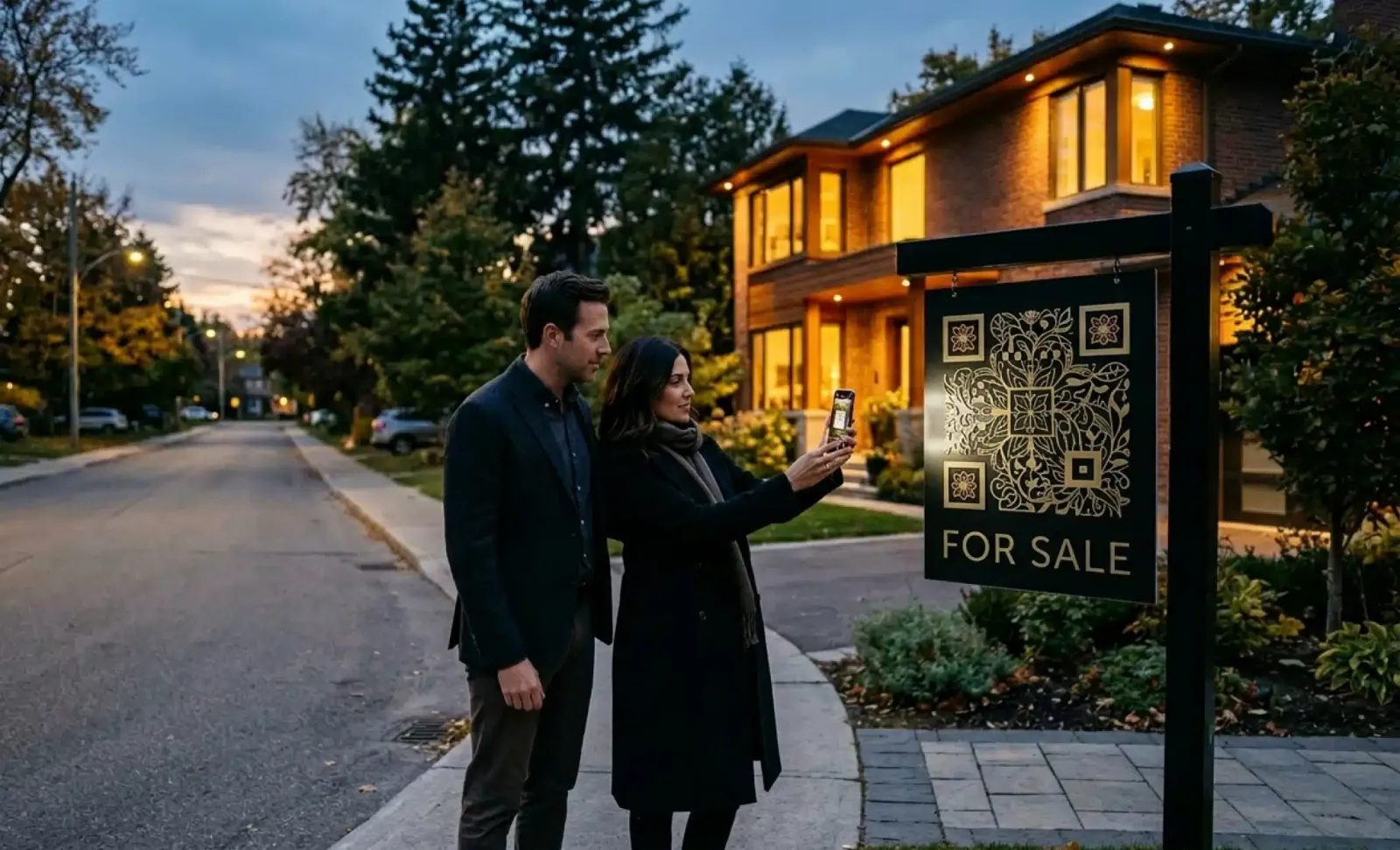
A buyer stops in front of a for-sale sign on a Saturday afternoon. The office is closed. The agent is across town. The brochure box is empty. They scan the QR code, land on the property page, scroll through six photos and a phone number, and leave.
The page had everything the agent prepared. It had nothing the buyer needed in that moment.
That is the gap that AI QR codes for real estate are built to close. Not by replacing the listing page, but by making it capable of answering back.
The listing page was never the problem
Property listing pages do their job well. They show photos, describe the space, display the price, and provide contact details. For a buyer who is already committed to reaching out, that is enough.
But most buyers are not there yet. They have questions. Specific ones. Does the building allow short-term rentals? Is the seller flexible on the closing date? What are the maintenance fees? These are not questions a static page can answer, no matter how well it is designed.
Dynamic QR codes helped by allowing agents to update that destination page without reprinting materials. A price change, a new photo set, an updated availability status: all of it could be reflected in real time without touching the physical code. That was a genuine step forward.
But the page itself remained passive. It could be kept current. It still could not have a conversation.
What actually changes with an AI QR code
When a buyer scans an AI QR code from QRCodeKIT, they land on the same property page the agent has always used. The photos are there. The details are there. Nothing about that experience is taken away.
What is added is Cleo.
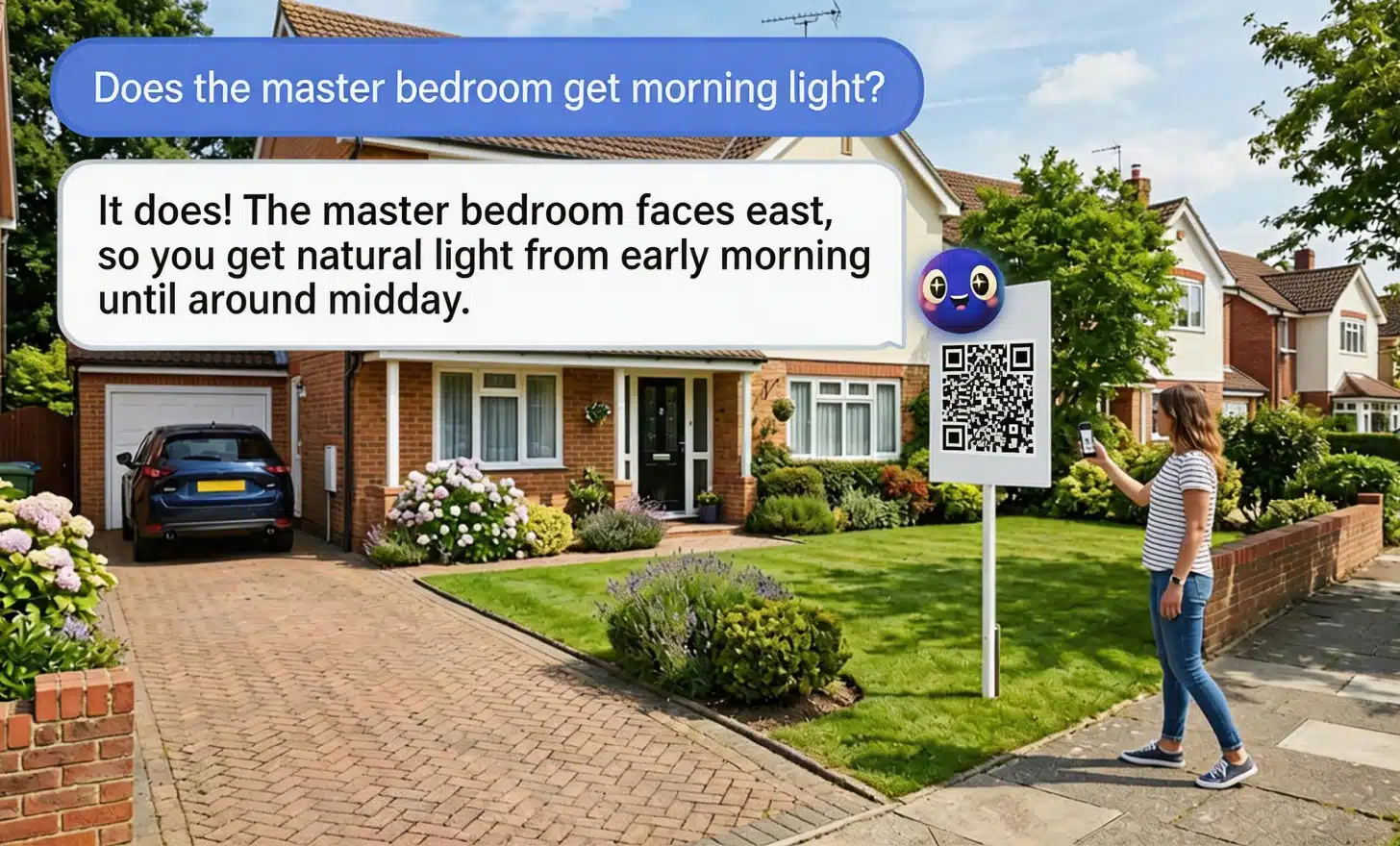
Cleo is an AI assistant that appears as a conversation bubble on the page. It knows everything the agent has configured about that property and it is ready to answer questions the moment the page loads. The buyer does not need to download anything, create an account, or wait for a callback. They type a question and get an answer.
This is what separates an AI QR code from a standard one. The destination is the same. The experience is completely different. QRCodeKIT is the first platform to offer this natively, embedding a conversational AI layer directly into the QR code workflow.
The questions buyers actually ask
Anyone who has worked in real estate knows that the questions buyers ask are rarely the ones listed in the FAQ section of a property page. They are specific, situational, and often time-sensitive.
Is there natural light in the living room in the afternoon? What is the noise level like from the street? Has the property had any structural work done in the last ten years? When is the earliest a viewing can be arranged?
Cleo handles all of these. It draws on the information the agent has provided and responds in a natural, conversational way. If the answer is not in the configured content, it says so clearly rather than guessing. The buyer always knows where they stand.
For the agent, this means that the most common pre-qualification questions are handled automatically, around the clock, without their involvement. By the time a buyer reaches out directly, the conversation has already started.
Where AI QR codes work in real estate marketing
The practical value of this format becomes clear when you map it against the places buyers actually encounter property information.
Yard signs and for-sale boards are the most obvious case. A buyer drives past a property, pulls out their phone, and scans. With a standard QR they get a page. With an AI QR code they get a page and a conversation. Cleo is there to answer whatever comes to mind in that moment, while the interest is live.
Printed flyers and open house materials work the same way. The buyer takes the flyer home, scans it later that evening, and can ask follow-up questions they did not think of during the visit. The materials do not expire. The conversation layer keeps them active.
Business cards become considerably more useful. Instead of linking to a generic agent profile, the QR connects a potential client to a page with Cleo ready to discuss specific listings, capture contact details, and qualify interest before any human time is spent.
During open houses, Cleo can handle registration, answer questions from visitors who prefer to explore at their own pace, and gather lead information in a format the agent can actually use.
Lead qualification before the first call
The most significant shift that AI QR codes bring to real estate is not informational. It is the quality of leads that reach the agent.
When a buyer interacts with Cleo on a property page, the exchange is doing two things at once. It is providing information and it is revealing intent. A buyer who asks about parking, school catchment areas, and available viewing slots within the same session is not casually browsing. That signal matters.
Cleo captures contact details naturally within the conversation. It can ask what the buyer is looking for, whether they have a timeline, and whether this property fits their criteria. None of it feels like a form. It feels like a conversation. And by the time the agent follows up, the groundwork has already been laid.
For agencies managing large portfolios, this changes the entire economics of lead generation. The team stops fielding every preliminary inquiry and starts focusing on buyers who are already warm.
Put it into practice
Create a dynamic QR code free and see it work. No credit card required.
Get started freeMultilingual support without extra setup
International buyers are a substantial part of the market in many regions, and the language barrier is one of the most persistent obstacles they face. A static property page in a single language leaves a large portion of potential interest unaddressed.
Cleo handles multilingual conversations natively. A buyer from Germany, China, Brazil, or anywhere else can scan the same code, land on the same page, and ask their questions in their own language. The agent configures the property information once. Cleo handles the rest, in whatever language the buyer chooses.
For luxury listings and new developments with an international target audience, this is not a secondary feature. It is what makes genuine engagement possible across borders.
Viewings booked inside the conversation
Scheduling a viewing is one of the most friction-heavy parts of the real estate process. A phone call, a voicemail, a text exchange, a confirmation. Several days can pass between initial interest and a confirmed appointment, and buyers lose interest fast.
Cleo can close that gap from within the conversation on the property page. A buyer who has asked their questions and confirmed their interest can arrange a viewing without leaving the page or waiting for the agent to become available. Availability is reflected in real time. The booking is done.
For agents juggling multiple listings, the time saved on scheduling logistics is significant. More importantly, the buyers who would have moved on during the wait no longer do.
Analytics that go beyond scan counts
Standard QR code analytics tell you how many people scanned a code, where they were, and what device they used. That is useful context but it does not tell you much about what those people wanted.
AI QR codes go further because the conversations themselves are data. What questions are buyers asking most about a particular property? Which listings generate interest but not bookings? Where is the drop-off happening in the conversation?
This kind of behavioral intelligence is hard to get from a landing page alone. With Cleo, it surfaces naturally as a byproduct of every interaction. Agents and agencies can use it to sharpen their listings, adjust their marketing focus, and understand their buyers in a more concrete way.
QRCodeKIT allows the creation of unique codes per listing, making it straightforward to track campaign performance across different properties without the data bleeding together.
Dynamic content that stays current without reprinting
One of the practical strengths of dynamic QR codes has always been the ability to update the destination without touching the physical code. In real estate, where prices change, properties sell, and listings evolve constantly, that flexibility matters.
With AI QR codes, that same logic applies to Cleo’s knowledge base. When the price changes, when new photos are added, when the availability status shifts, the update is reflected in every future conversation. The sign stays on the lawn. The flyer stays in circulation. What buyers encounter is always the current version.
This removes a significant source of friction for agents who manage multiple active listings. Materials do not need to be reprinted every time something changes. The physical touchpoint is permanent. The information behind it is not.
How does an AI QR code differ from just adding a chatbot to a page?
The distinction matters and it is worth being precise about it.
A generic chatbot on a property page is a tool bolted on after the fact. It is typically rule-based, limited in what it can handle, and disconnected from the specific content of the listing. Buyers notice quickly when they hit its edges.
Cleo is different because it is built into the QR code itself. The agent does not need to add it manually to a webpage or manage a separate integration. It is part of how the QR code works. The property information the agent provides becomes the foundation of a real conversation, not a decision tree.
QRCodeKIT is the first platform to integrate this kind of conversational AI directly into the QR code creation and management workflow. The result is not a page with a chatbot. It is a QR code that carries a conversation with it wherever it is placed.
Is this difficult to set up for a property listing?
The setup is simpler than most agents expect.
Through QRCodeKIT, creating an AI QR code for a listing means providing the property information that Cleo will draw on: the description, pricing, availability, common questions and answers, and any other details that matter. The platform handles the rest. The resulting code can be placed on any printed material, any digital asset, or any physical signage immediately.
There is no developer involvement, no separate subscription to a chatbot service, and no ongoing manual management beyond keeping the property information current. The code is generated once and works from that point forward.
Scan. Ask. Know. That is the experience from the buyer’s side. Behind it is a system that runs without the agent needing to be present.

What kinds of real estate businesses benefit most?
The format works for any situation where a buyer might have questions that cannot wait for an agent to pick up the phone.
Independent agents benefit because Cleo covers the hours they cannot. Large agencies benefit because the format scales across entire portfolios without scaling the workload proportionally. Property developers benefit because buyers exploring a site or a show home can get precise answers without needing a sales representative in the room.
The format is particularly strong for high-value and complex properties: luxury residential, commercial real estate, new developments with multiple unit types. These are the cases where buyer questions are most specific, most frequent, and most likely to determine whether a conversation with an agent ever happens at all.
But the simplest case is also the most common. A buyer, a phone, and a question that deserves an answer right now. AI QR codes make that possible every time, without exception.
All images and visual content in this article were created using RealityMAX.
Related articles

AI QR code for events
Every event has the same pressure point. Organizers spend months preparing. Attendees arrive with questions. And at the exact moment when information matters…

AI QR code museum
Walk into almost any museum today and the experience of interpreting what you see has not changed much in decades. There is a label on the wall with a title, a…

AI QR codes for hotels
She drops her bag on the bed, kicks off her shoes, and looks around. The room is beautiful. But it’s also completely unfamiliar. There’s a binder on the desk…
Two free dynamic QR codes. Yours forever.
No credit card. No expiry. The original dynamic QR platform since 2009.