Car dealership QR codes: how to turn every vehicle into a 24/7 salesperson
TL;DR
- A car dealership QR codes turns every vehicle, sign, and document into a self-service channel that works around the clock, including the after-hours moments when buyers browse a closed lot.
- Structure your deployment around the customer journey, from the first ad to the post-sale service reminder, so each code has a clear job.
- Use dynamic QR codes so the destination behind a printed sticker can change as inventory rotates, without reprinting anything.
- QRCodeKIT covers the operational needs a dealership has: dynamic updates, bulk generation, per-placement analytics, and multilingual answers through Cleo.
Pricing transparency is now what customers care about most in the car-buying experience. The Deloitte 2026 Global Automotive Consumer Study found that transparency of pricing and work performed is the most important aspect of the service experience for 24% of US consumers, rising to 41% in Japan. That is exactly the gap a car dealership QR code closes. It puts full specifications, financing terms, vehicle history, and booking options in the buyer’s hand the moment they stand in front of a car, with no app and no wait for a salesperson.
This guide approaches dealership QR codes by customer journey stage rather than as a scattered list, because a code’s value depends on where the buyer is and what they need next.
What is the car dealership QR codes?
A car dealership QR code is a scannable QR code placed on a vehicle, showroom sign, or dealership marketing material that opens instant access to vehicle information, test drive booking, financing options, or service scheduling on the prospect’s phone, without an app, a login, or a wait for a salesperson. It is the bridge between a physical object the dealership already owns and the digital information the buyer wants right now.
The distinction that matters most is dynamic versus static. A dynamic code lets you change the destination after the code is printed, which for a business where inventory turns over constantly decides whether QR codes are an asset or a maintenance headache.
Why do QR codes work so well at dealerships?
QR codes work at dealerships because a dealership is unusually rich in physical touchpoints that sit in front of prospects for weeks or months. Every vehicle on the lot is an asset a buyer can walk up to, and a code turns each one into a self-service information channel.
Several things make the fit particularly strong. Buyers browse dealer lots outside opening hours, and a code answers questions when nobody is on shift. The gap between the sticker price and the full picture of financing, options, and history is precisely where a code delivers value, because that context does not fit on a windshield tag but does fit behind one. Multilingual destinations handle international buyers without needing a staff member who speaks their language. And every scan carries attribution, so you learn which vehicle, sign, or campaign drove the visit. All of this happens with zero download friction, unlike a dealer-specific app most shoppers will never install for a single visit.
Stage 1: Attracting prospects before they arrive
The journey starts before anyone reaches the lot, and this is where a QR code for car dealer marketing earns its place on printed media. A code on a billboard or print ad can link to the dealership’s live inventory page, turning curiosity into browsing in one scan. Direct mail can carry a code that opens a personalized offer or a booking calendar. Newspaper and magazine ads can point to a financing pre-approval form, pulling a warm lead in before they visit.
The reason to use dynamic destinations here is timing. A printed campaign runs for weeks, but the promotion behind it changes. With a dynamic code, the same billboard can point to a spring finance offer in April and a clearance event in June, without reprinting anything.
Stage 2: The vehicle on the lot
This is the highest-volume dealership QR use case. Each vehicle carries its own code, on a windshield sticker, a dashboard tag, or a license plate frame, and that code opens everything a shopper would otherwise have to ask a salesperson for:
- The full spec sheet with options and trim details
- Real photos of the vehicle from every angle
- A video walkaround
- A financing calculator with the vehicle already pre-filled
- Test drive booking with the vehicle already pre-filled
- The vehicle history report, for used cars
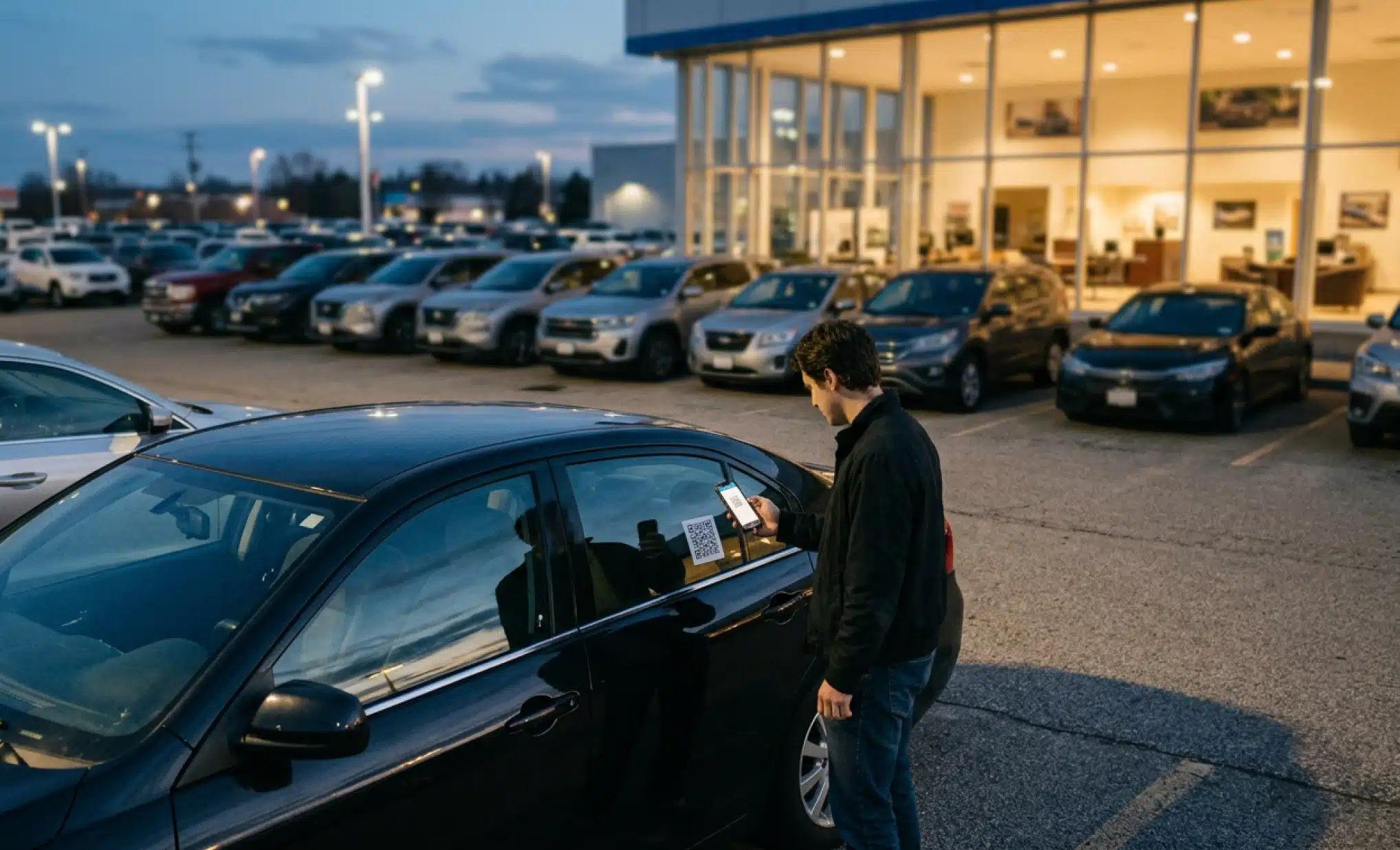
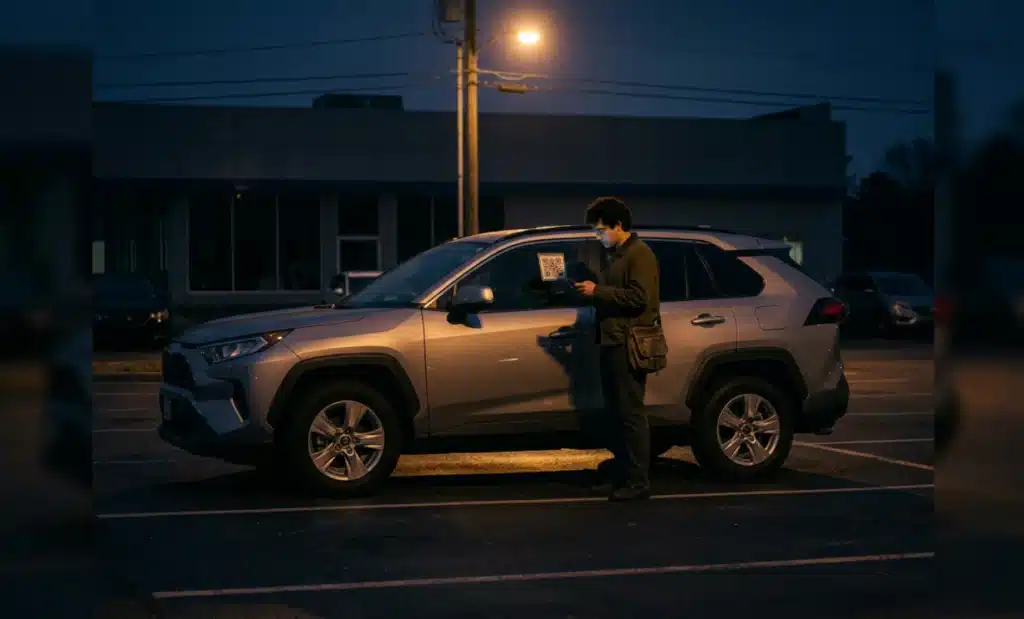
The after-hours value is the part dealerships underestimate. A large share of lot browsing happens on evenings and weekends when the showroom is locked. A shopper walking the rows on a Sunday can scan the car that caught their eye, read every detail, and book a test drive for Monday while the sales floor is empty. Every parked car becomes a salesperson that never clocks out.
Stage 3: The showroom visit
Inside the showroom, codes turn static signage into interactive help. A code on model signage can open a comparison tool that stacks two trims side by side. A code on the hot deals board can link to a promotions page you update centrally, so the board never shows an expired offer. Service department signage can carry a code that opens appointment booking while service is already on the buyer’s mind. Even the waiting area works: a code there can lead to a loyalty sign-up or a quick feedback form.
Stage 4: Test drive and salesperson handoff
The handoff to a salesperson is where a QR code car dealership setup keeps the relationship moving. A code on a business card can open a vCard that saves the salesperson’s direct contact details to the prospect’s phone in a single tap, so the buyer leaves with a real contact instead of a card that ends up in a drawer. A code on a test drive key tag can open the route map. And during the financing conversation, a code on the desk can open pre-approval forms so the paperwork starts while interest is fresh.
Stage 5: Financing and paperwork
Financing is the stage most weighed down by documents, and codes cut the friction. Financing paperwork can carry a code that opens an online form for pre-fill and e-signature, warranty options can link to comparison guides, and insurance quotes can point to partner forms. Dynamic codes add durability here: forms change and financing partners update, but a dynamic code lets you repoint the same printed template to the current version instead of reprinting every folder.
Stage 6: Delivery and handover
Delivery is a high-emotion moment, and the best time to plant codes that pay off later. A code in the delivery folder can open a personalized welcome page with the vehicle’s manuals, service schedule, and warranty terms in one place. A code in the glovebox can link to owner support, from roadside assistance to service booking to dealer contact, so the driver always has help one scan away. And a code on the delivery paperwork can open the Google Business or Trustpilot review page at the moment satisfaction peaks. Dealerships that ask for reviews with a code at delivery tend to collect far more than those relying on an email that arrives days later and goes unread.
Put it into practice
Try QRCodeKIT Pro free for 7 days and see it work. No credit card required.
Start free trialStage 7: Ongoing service and retention
After the sale, codes keep working for retention. A code in the owner’s manual and service book can open appointment booking, so the next service is always one scan away. Service department signage can link to live wait time updates or online check-in. Service receipts can carry a code to a feedback form and a next-service reminder. Codes on parts inventory can even support internal team workflows.
Stage 8: Marketing across channels
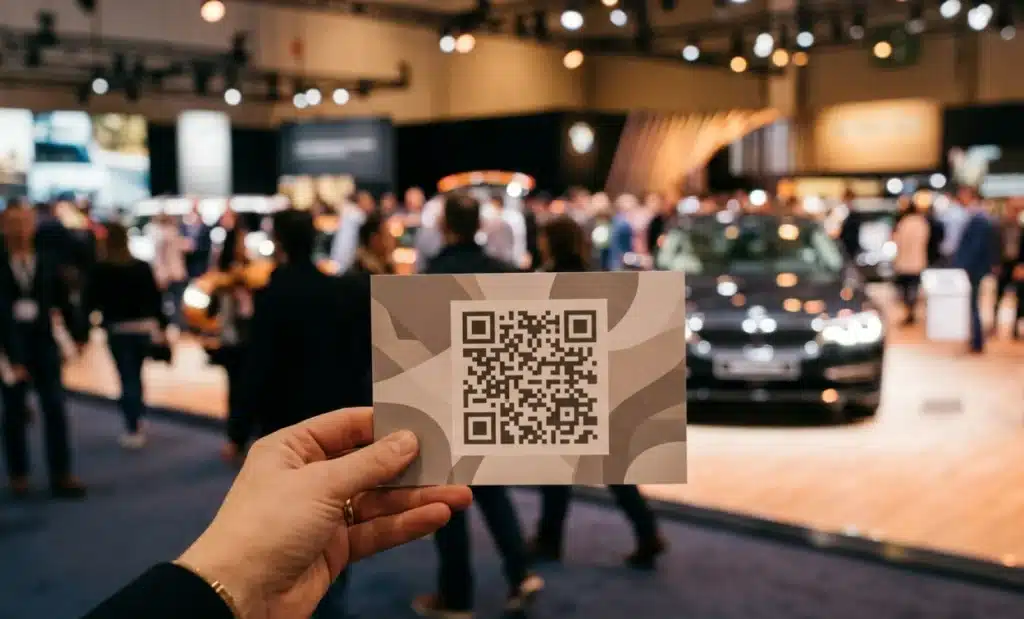
Beyond the lot, codes tie the dealership’s wider marketing to trackable action. A code on a TV commercial lets a viewer act during the break, and radio spots can point to a companion card. Trade show materials at auto shows, sponsored community events like charity drives, and the dealership’s own newsletters can all carry codes. The discipline that makes this work is giving each placement a unique code or UTM, so you know which channel drove which conversion rather than guessing.
Why are dynamic QR codes essential for dealerships?
Dynamic QR codes are essential because a dealership’s information changes faster than its printed materials. Inventory rotates constantly, so a vehicle sold today needs its code repurposed for a new arrival tomorrow. Promotions change weekly, salespeople move on, and financing partners revise their terms. A static code locks every printed sticker to the information that was true the day it was printed, forcing a reprint every time the lot turns over. A dynamic code separates the printed asset from the destination, so the windshield sticker stays put while the page behind it changes. This is why a dynamic qr code for car dealers is the baseline requirement, not a nice-to-have.
What makes conversational AI valuable at a dealership?
Dealership questions are highly repetitive, which is exactly what conversational AI handles well. What is the price, does it come with a warranty, what financing is available, when is service open, do you have this model in another color. Cleo, the conversational AI built natively into QRCodeKIT, answers those questions in the buyer’s own language at any hour, including during the after-hours browsing that happens on the lot. The buyer gets an instant answer instead of a voicemail, and the team stays free for the higher-value conversations that close deals. Cleo extends the sales team’s reach rather than replacing the relationship that sells the car.
How do you measure QR code performance at a dealership?
You measure dealership QR performance by tying scans to the actions that matter. The most useful metrics are scans per vehicle per week, which flags the cars generating interest; scan-to-booking conversion rate per placement, which shows what is working; and time-of-day distribution, which usually confirms how much browsing happens after hours. Comparing placements, windshield versus signage versus business cards, tells you where to invest. For dealer groups, Projects in QRCodeKIT compares performance across sites so a franchise group can see which store runs its codes best.
What mistakes do dealerships make with QR codes?
The common mistakes are avoidable once you know them:
- Using static QR codes and reprinting stickers every time inventory changes
- Placing a code with no call to action, so shoppers have no idea what scanning will give them
- Sending scans to a generic homepage instead of the specific vehicle page the shopper is standing next to
- Skipping analytics, which throws away the ability to prove which placements drive walk-ins
- Choosing a platform without multilingual support and losing international buyers
- Ignoring after-hours scan patterns and missing the single biggest audience segment
How to get started
- Create a QRCodeKIT account. The free plan gives you two dynamic QR codes, enough to test on a couple of vehicles before scaling.
- Choose the QR code type. A Website QR pointing to a vehicle-specific page works for most cases, or a Landing Page QR for a self-contained mini-page per vehicle.
- Print codes on windshield stickers or window clings for each vehicle on the lot.
- Add codes to showroom signage, business cards, and service department displays.
- Review scan analytics weekly and adjust placements based on what the data shows.
For the broader picture of how QR codes are used across the automotive sector, including parts, service networks, and manufacturing, see the QRCodeKIT article on QR codes in the automotive industry.
Frequently asked questions
How do you use a QR code for a car dealership?
You place codes at each stage of the buyer journey and point each one at what the buyer needs there. On the lot, a windshield code opens the vehicle’s specs, photos, and test drive booking. On signage, it opens promotions or service booking. On a business card, it saves the salesperson’s contact details. Each code has one clear job.
What is the best QR code for car sales?
The best code for car sales is a dynamic vehicle-specific code that opens the full listing for the exact car the shopper is standing next to, with specs, photos, financing, and booking in one place. Dynamic matters because the same printed sticker can be repointed to a new vehicle once the current one sells. A Website QR or Landing Page QR both work well for this.
How do you put a QR code on a car?
Most dealerships use a windshield sticker or window cling, since both are visible from outside the car and survive weather. A dashboard tag or license plate frame also works. Whatever the format, the code should sit where a shopper walking the lot can scan it without opening a door.
Are QR codes on cars effective for sales?
Yes, because they capture buyers at the moment of highest interest and outside opening hours, when many people browse. A shopper standing in front of a car can get answers and book a test drive immediately, rather than leaving to research elsewhere and possibly never returning.
How do you track QR code scans at a dealership?
Give each placement its own code or UTM and review your QR platform’s analytics. Useful views include scans per vehicle, scan-to-booking conversion by placement, and time-of-day distribution. For multi-location dealer groups, compare performance across sites to see which locations run their codes most effectively.
Should car dealerships use static or dynamic QR codes?
Dealerships should use dynamic QR codes. Inventory rotates, promotions change, and financing terms update constantly, so a static code would lock every printed asset to outdated information. A dynamic code lets the printed sticker stay in place while the destination behind it changes, the only practical fit for a business whose information turns over this fast.
All images and visual content in this article were created using RealityMAX.
Related articles
BTS, Madonna, Shakira, Bieber: what the FIFA halftime show reveals about QR code marketing
What the first FIFA World Cup Final Halftime Show teaches brands about halftime show QR code campaigns, from dynamic destinations to attribution at scale.

The hidden QR code in music: how Bring Me The Horizon turned a song into an alternate reality game
A hidden QR code in music sparked an ARG. See how Bring Me The Horizon buried a scannable code in a song's spectrogram and what marketers can learn from it.

What Olivia Rodrigo’s pink lock campaign teaches us about QR code mystery reveal marketing
Olivia Rodrigo's pink lock campaign shows how a QR code mystery reveal works: fragmented clues, patient timing, and a community that completes the story.
Try QRCodeKIT Pro free for 7 days.
No credit card required. The original dynamic QR code platform since 2009.