QRCodeKIT vs ME-QR: the 2026 comparison on stated criteria
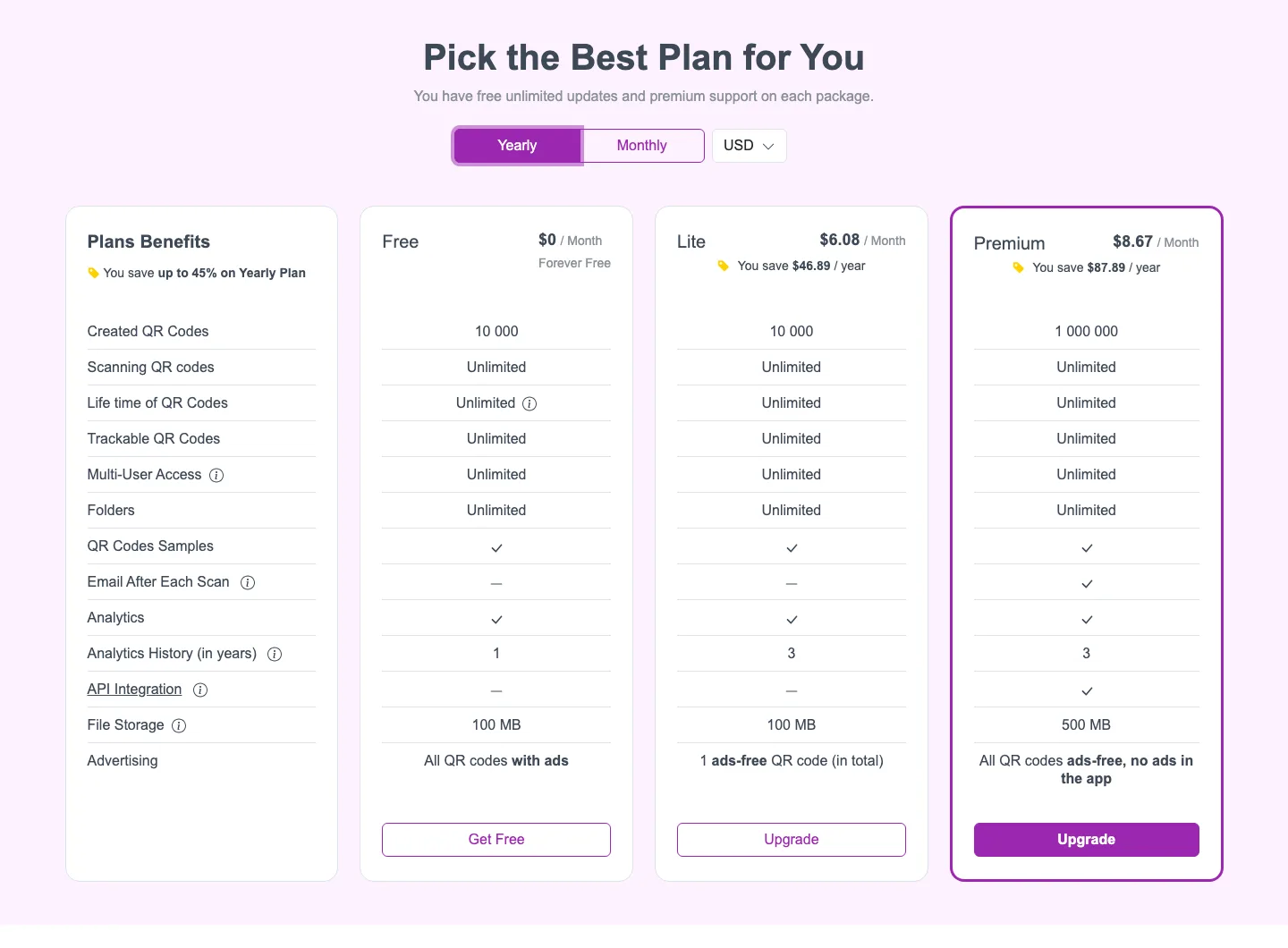
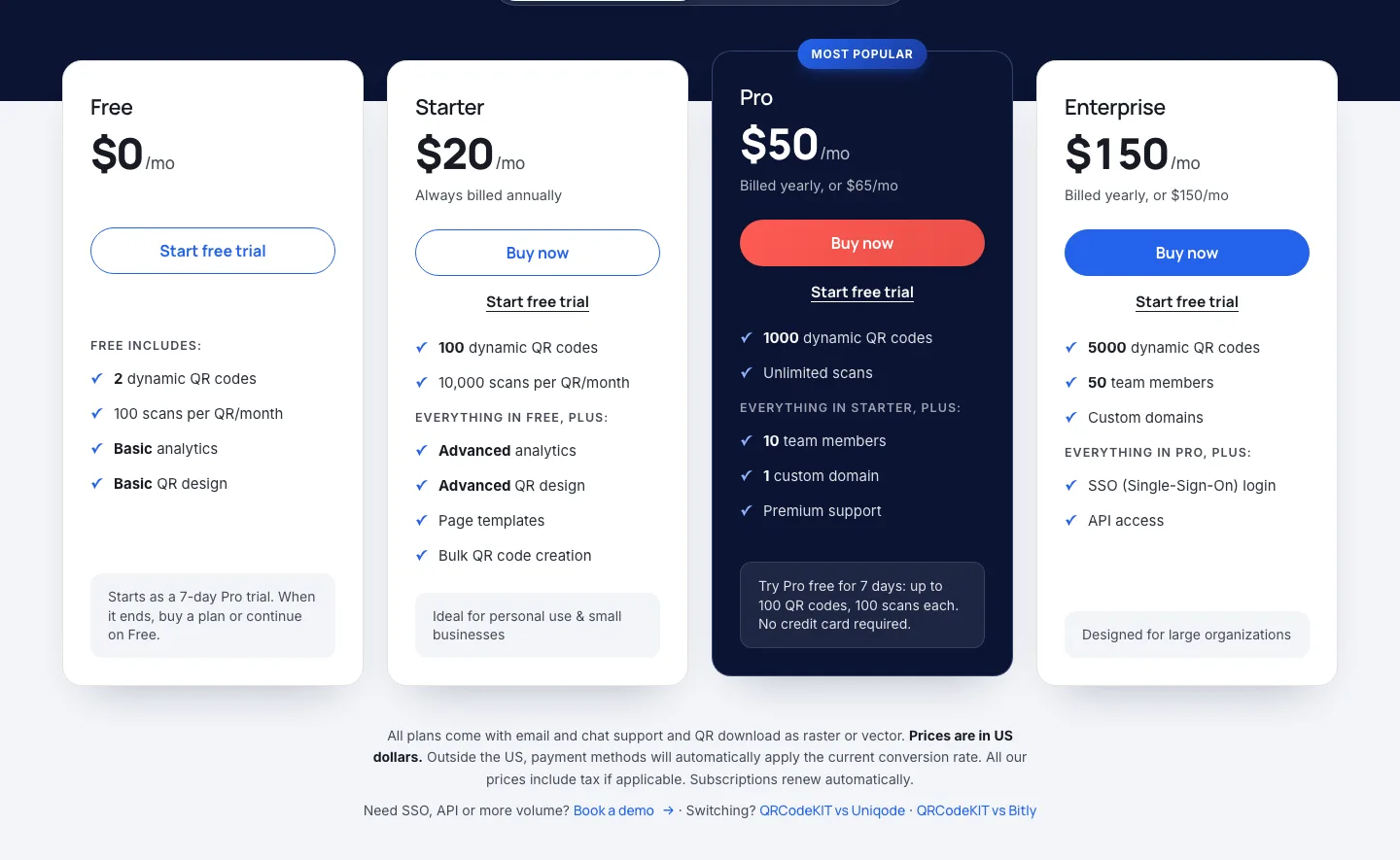
Prices and limits were read on each vendor's public pricing page on 2 October 2026 and match the plan grids shown below, captured on 5 October and 22 September. Where a vendor's site states two different figures, both are given. Re-verified quarterly. How we compare QR platforms explains the method.
Who the two platforms are
QRCodeKIT built the first dynamic QR code in 2009 and has run them continuously since. It was first to launch the digital business card QR and the menu QR, and first to put an AI agent inside a code. Its redirect infrastructure has resolved more than 1.2 billion scans and has been stress-tested at the Oscars, the Super Bowl and MotoGP. It is used by teams at Apple, Amazon, Netflix, Nike, Coca-Cola, Unilever, Nestlé, Tetra Pak, Philips and NASA, with published case studies from Qatar Airways, Karl Lagerfeld, Boca Juniors, PortAventura World and the University of Bologna. It has been certified to ISO 9001, 27001 and 14001, is GDPR compliant, and hosts the platform on AWS EU regions.
ME-QR is a QR code generator and scanner app. Its about page describes it as a product of ME TEAM LTD, a company founded in 2021 with an address in London, and reports 14 million monthly users and more than 40 content types. Its current terms of use name a different contracting party, ME Team L.L.C-FZ, incorporated in the United Arab Emirates, with the UK company processing older payments as its reseller. Its business model is stated plainly on the about page: codes are free, and "the only limitation is the presence of advertising shown to scanning ones."
This is a comparison between a free generator funded by advertising to your audience and a platform that has spent seventeen years making the code itself do more.
What QRCodeKIT does that ME-QR does not
- No third-party ads, on any plan. QRCodeKIT's two free codes open a short QRCodeKIT-branded page before your content, and every paid code goes straight to it. ME-QR shows ads on every free code, lifts them from one code in total on Lite, and from all codes only on Premium; its terms say the ads come from third-party advertisers, may link to external websites, and that advertisers "may collect data" from the interaction.
- Cleo, an AI agent at the scan. Trained on the owner's content, answering whoever scans in more than 40 languages. Nothing on ME-QR answers the person who scanned.
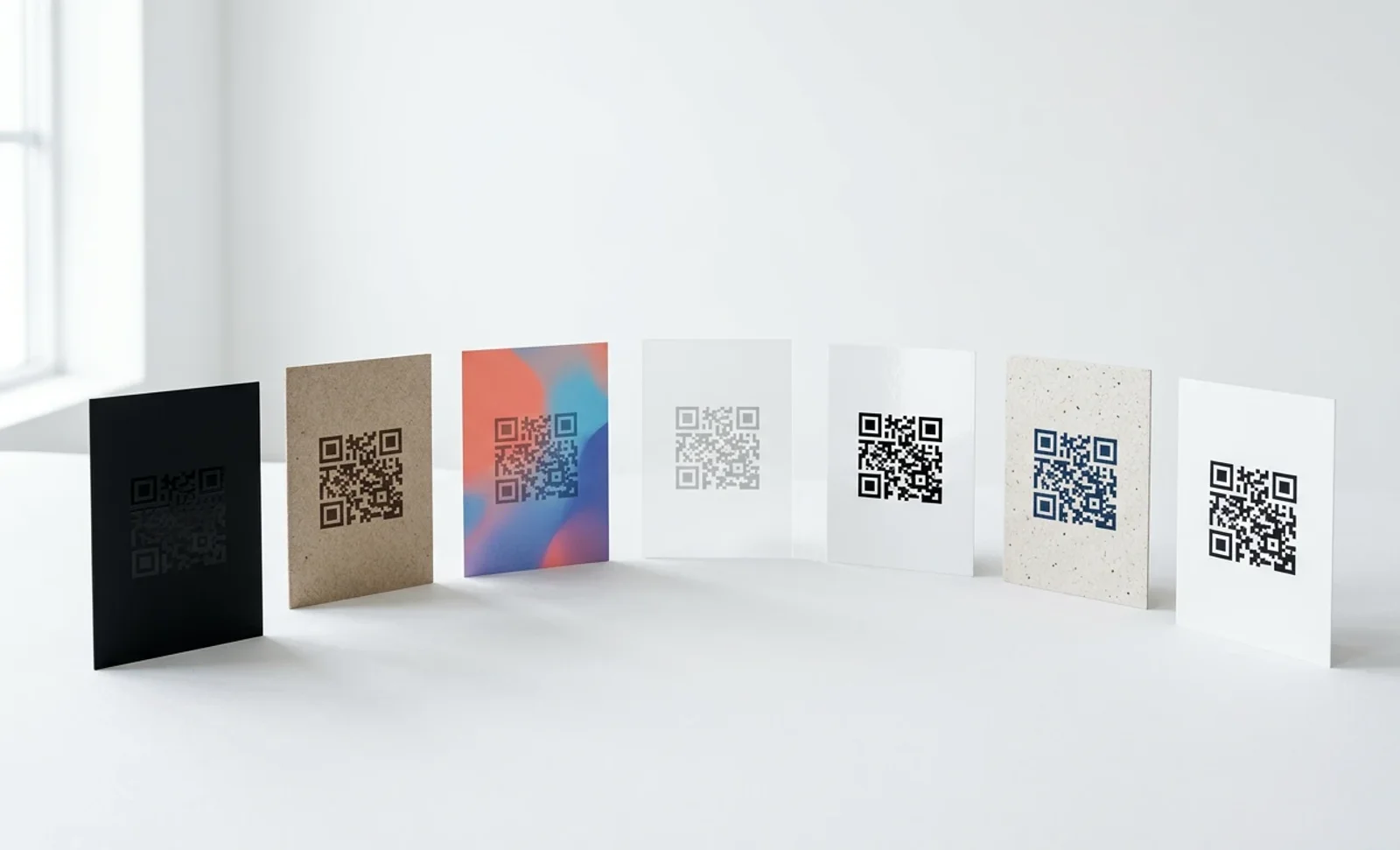
- Invisible QR codes. A design mode that removes the solid background and lets the code sit inside artwork with only the corner markers firm, exported as background-free PNG or SVG for Figma, Illustrator, InDesign and Canva.
- Google Reviews codes with AI-drafted reviews. A star, three questions, a drafted review, with a threshold that routes low scores to private feedback.
- A money-back policy. Seven days. ME-QR's terms operate "a no-refund policy", with no refunds "under any circumstances" once a plan is paid.
- Seventeen years of resolving scans, since the first dynamic QR code in 2009, and more than 1.2 billion of them.
What ME-QR does that QRCodeKIT does not
- Volume on every plan. 10,000 codes on free, 100,000 on Lite by its plan cards (10,000 in its comparison table) and a million on Premium, with unlimited scans, users and folders on every plan. QRCodeKIT's free plan has two codes with 100 scans each a month, Starter 100 codes, Pro 1,000.
- A low price for ad-free codes. Premium is $8.67 a month billed yearly, or $15.99 monthly, with the API included. QRCodeKIT's first paid plan is Starter at $20 a month billed yearly, and the API is on Enterprise.
- More content types: more than 40, against QRCodeKIT's 22.
- A custom domain on the free plan. ME-QR lists changing the QR code domain among its free features; QRCodeKIT includes a custom domain you own from Pro at $50.
- More app integrations, including HubSpot, Shopify, Gmail, Monday.com, ClickUp, Zoho and Trello, alongside Canva and Zapier.
- Scan analytics through its MCP server. ME-QR's assistant connection can return scan statistics; QRCodeKIT's MCP connector creates, lists, downloads and deletes codes, with analytics in the dashboard.
Plans, pricing and billing
| QRCodeKIT | ME-QR | |
|---|---|---|
| Free | 7-day Pro trial with no card (up to 100 codes), then 2 dynamic codes for life, 100 scans per code per month renewing, editable destinations, analytics included; scans open a QRCodeKIT-branded page before the destination, no third-party ads | 10,000 codes, unlimited scans, unlimited lifetime for codes scanned at least once a year, unlimited users and folders, 1 year of analytics history, 100 MB of files; ads on every code |
| Entry | Starter $20/mo billed yearly: 100 codes, 10,000 scans per code per month, advanced analytics and design, page templates, bulk creation | Lite $6.08/mo billed yearly or $9.99 monthly: 100,000 codes per its plan cards (10,000 in its table), 3 years of history and 1 ad-free code in total (one per month, per its plans article) |
| Middle | Pro $50/mo billed yearly or $65 monthly: 1,000 codes, unlimited scans, 10 seats, 1 custom domain, premium support | Premium $8.67/mo billed yearly or $15.99 monthly: 1,000,000 codes, all ad-free, API, email after each scan, 500 MB of files |
| Upper | Enterprise $150/mo, yearly or monthly: 5,000 codes, 50 seats, several custom domains, SSO through Okta or ADFS, API | None published |
| Ads on your codes | No third-party ads; a QRCodeKIT-branded page on Free scans, none on paid plans | All codes on free; all but one on Lite; none on Premium |
| Monthly billing | Pro and Enterprise; Starter yearly | Lite and Premium |
| Refunds | 7-day money-back | None "under any circumstances" |
On sticker price ME-QR is cheaper, and on volume it is not close. What the free and Lite plans cost is paid by the people who scan: every scan of a free ME-QR code passes through a third-party advertisement before it reaches your content, on your packaging, your menu or your sign. QRCodeKIT puts no third-party advertising between your code and your customer: free-plan scans pass a short QRCodeKIT-branded page, and paid plans go straight to your content. Full detail on the QRCodeKIT pricing page.
Put it into practice
Change where your code leads whenever you like, without reprinting it.
Start free trialPro free for 7 days. No credit card required.
What happens to printed codes over time
A QR code is a promise that a piece of print will keep working, and both platforms keep the first half of it: codes do not expire when a plan ends. They differ on what the person scanning sees.
ME-QR's codes have an unlimited lifetime on every plan, and its FAQ confirms they keep working after a subscription ends. The same FAQ sets a condition: a code not scanned for 365 days is blocked for a month and then permanently deleted. The ads come back with it: "you can use QR codes without ads only with a Premium subscription." A code printed while you paid for Premium will start showing advertising the day the subscription stops.
QRCodeKIT's two free codes stay editable and tracked for life on the Free plan, with a monthly allowance that renews; their scans pass a short QRCodeKIT-branded page, never a third-party ad, and paid codes go straight to your content. Every account starts with a 7-day trial of Pro, no card required; when it ends, a paid plan keeps every code as it is and the Free plan keeps two live, and until a plan is chosen the trial's codes are paused. Codes on a lapsed paid plan are deactivated and return when the plan is renewed, with the account and its data kept.
A code printed on either platform's default domain resolves through that platform only, so if you plan to move one day, print on a domain you own: on QRCodeKIT from Pro at $50. ME-QR lists changing the QR code domain among the features of its free plan, so a code can go on your own domain from the start.
Analytics, integrations and team controls
| QRCodeKIT | ME-QR | |
|---|---|---|
| Scan analytics | Total and unique visits, OS, country, city, time series; PDF and XLS export per code and per project; history not capped by plan | Scans with device type, country and time; 1 year of history on free, 3 on Lite and Premium; an email after each scan on Premium |
| Integrations | Google Analytics 4 and UTM; automations to Zapier, Make, n8n and Canva; webhooks on scan, form and payment events; retargeting as an add-on on higher plans | Canva, Shopify, ChatGPT, Zapier, HubSpot, Gmail, Monday.com, ClickUp, Zoho and Trello; Google Analytics UTM tags |
| API | Enterprise: REST, full CRUD on every type, analytics endpoints | Premium |
| AI assistants | MCP connector on every plan, including free | MCP server and a ChatGPT app |
| Team and governance | 10 seats on Pro, 50 on Enterprise; Admin, Editor and billing roles; SSO through Okta and ADFS on Enterprise | Unlimited multi-user access and shared folders on every plan |
ME-QR's integration list is long and its team access is open on every plan. QRCodeKIT's analytics keep their history for as long as the campaign lives, its automations fire on scans, form submissions and payments, and its roles and SSO give an organisation control over who can change a code that is already in print.
AI and assistants
Both platforms let an AI assistant work on the account. QRCodeKIT's MCP connector, included on every plan including free, lets Claude, ChatGPT, Cursor, VS Code or Windsurf create, list, download and delete codes in plain language. ME-QR runs an MCP server for ChatGPT, Claude and other assistants that also returns scan analytics, and a ChatGPT app that turns a description into a code.
The difference is where the AI sits. ME-QR's helps the owner create codes. QRCodeKIT's Cleo talks to the person who scanned the code, in their language, about the owner's own content; QRCodeKIT's AI also generates imagery into the code itself (artistic codes, more than 90 percent fully scannable) and writes for the customer (Google Reviews). QRCodeKIT was the first QR platform to put an agent inside the code, and ME-QR has no equivalent at the scan.
Compliance, hosting and trust
QRCodeKIT has been certified to ISO 9001, ISO 27001 and ISO 14001, complies with ISO/IEC 18004, is GDPR compliant, and has run a security operation with 24/7 monitoring and above 99 percent uptime for seventeen years, through the biggest live broadcasts a QR code has appeared in. It hosts the platform on AWS EU regions, with international transfer terms in its privacy policy.
On hosting the two are level: both serve from the EU. ME-QR stores data on Hetzner servers in Germany, says personal data may be transferred and stored outside the European Economic Area under Standard Contractual Clauses, publishes a GDPR page and a separate privacy policy for scans, and states no ISO or SOC 2 certification. Its privacy policy still describes Google as certified under the EU-US Privacy Shield, the framework the EU Court of Justice invalidated in 2020.
For a brand, the question is less the paperwork than the scan itself: on ME-QR's free and Lite plans, a third party's advertising and its data collection sit between your printed code and your customer.
Verdict: which should you choose?
Choose ME-QR if you need a very large number of codes for very little, if the codes are for personal or short-lived use where an ad before the content does not matter, or if you will pay for Premium to remove the ads and want its API and long integration list at that price.
Choose QRCodeKIT if the code carries your brand: if it goes on packaging, a menu, a poster, a ticket or a label, and the person scanning must reach your content and nothing else; if the code has to sit invisibly inside artwork, answer customers through Cleo or draft their Google reviews; if you want a money-back policy, and EU hosting on a platform that has been certified to ISO 9001, 27001 and 14001; and if you want seventeen years and more than a billion scans behind your print.
If you are leaving ME-QR, the ME-QR alternatives piece scores six platforms against the same criteria.
Ready to move? How to move your QR codes to QRCodeKIT covers what to export, what to keep running and how to recreate your codes, vendor by vendor.
Frequently asked questions
Which platform has been around longer?
QRCodeKIT: it built the first dynamic QR code in 2009 and has resolved more than 1.2 billion scans since, on infrastructure stress-tested at the Oscars, the Super Bowl and MotoGP. ME-QR's about page says its company was founded in 2021.
Does ME-QR show ads on my QR codes?
On the free plan, yes, on every code: people who scan see third-party advertising before your content. Lite removes ads from one code in total, and Premium from all codes. If a Premium subscription ends, the ads return. QRCodeKIT shows no third-party ads on any plan; its free-plan scans pass a short QRCodeKIT-branded page, and paid plans go straight to the content.
What can QRCodeKIT do that ME-QR cannot?
Keep every code free of third-party ads on every plan; put Cleo, an AI agent, at the scan; make codes invisible inside artwork; draft Google reviews with AI; refund within seven days; and show seventeen years of resolving scans, on a platform that has been certified to ISO 9001, 27001 and 14001.
What can ME-QR do that QRCodeKIT cannot?
Offer 10,000 codes on its free plan and a million on Premium, unlimited scans, users and folders on every plan, more than 40 content types, a custom domain on the free plan, the API from $8.67 a month, a longer list of app integrations, and scan analytics through its MCP server.
Is ME-QR cheaper than QRCodeKIT?
Yes, on price: Premium is $8.67 a month billed yearly for ad-free codes, against QRCodeKIT's Starter at $20. On ME-QR's free and Lite plans, the people who scan pay the difference by seeing advertising.
Does either offer AI?
Both do. Both have an MCP server, and ME-QR's can return scan analytics. QRCodeKIT also puts AI in the code itself: Cleo at the scan, artistic imagery, and AI-drafted Google reviews.
What happens to my ME-QR codes if I stop paying?
They keep working, and ME-QR says they have an unlimited lifetime, provided each is scanned at least once every 365 days. Ads return on every code, since only Premium is ad-free. Payments already made are not refunded under ME-QR's terms.
Related articles
QRCodeKIT vs QR.io: the 2026 comparison on stated criteria
QRCodeKIT vs QR.io compared: track record, free codes and trials, what the code itself can do, plans and seats, what happens to printed codes over time,…
QRCodeKIT vs Uniqode (formerly Beaconstac): the 2026 comparison on stated criteria
QRCodeKIT vs Uniqode compared on track record, advanced QR features, plans and billing, what happens to printed codes over time, analytics, compliance, hosting…
QRCodeKIT vs Bitly for QR codes: the 2026 comparison on stated criteria
QRCodeKIT vs Bitly compared for QR codes: track record, what the code itself can do, plans and quotas, what happens to printed codes over time, analytics,…
Try QRCodeKIT Pro free for 7 days.
No credit card required. The original dynamic QR code platform since 2009.