QRCodeKIT vs QR.io: the 2026 comparison on stated criteria
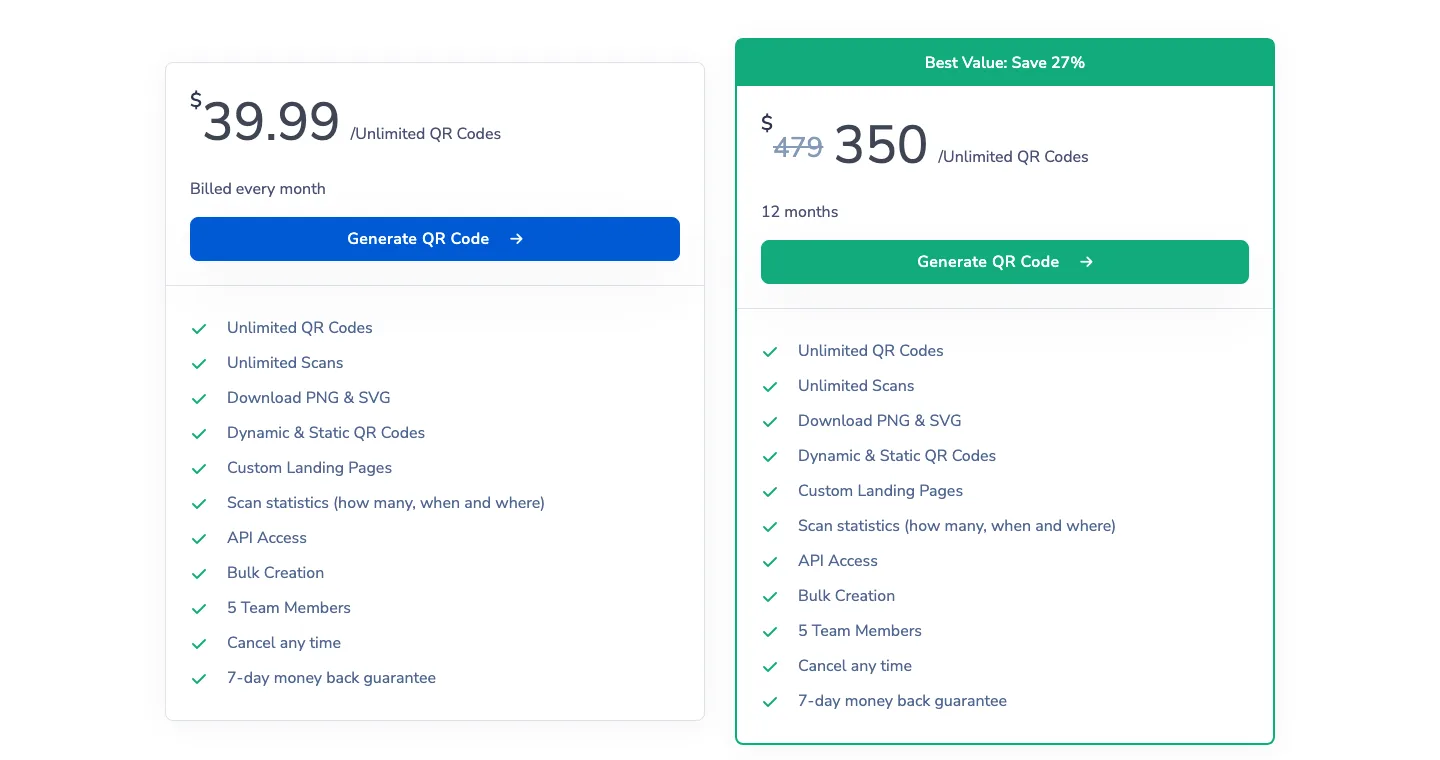
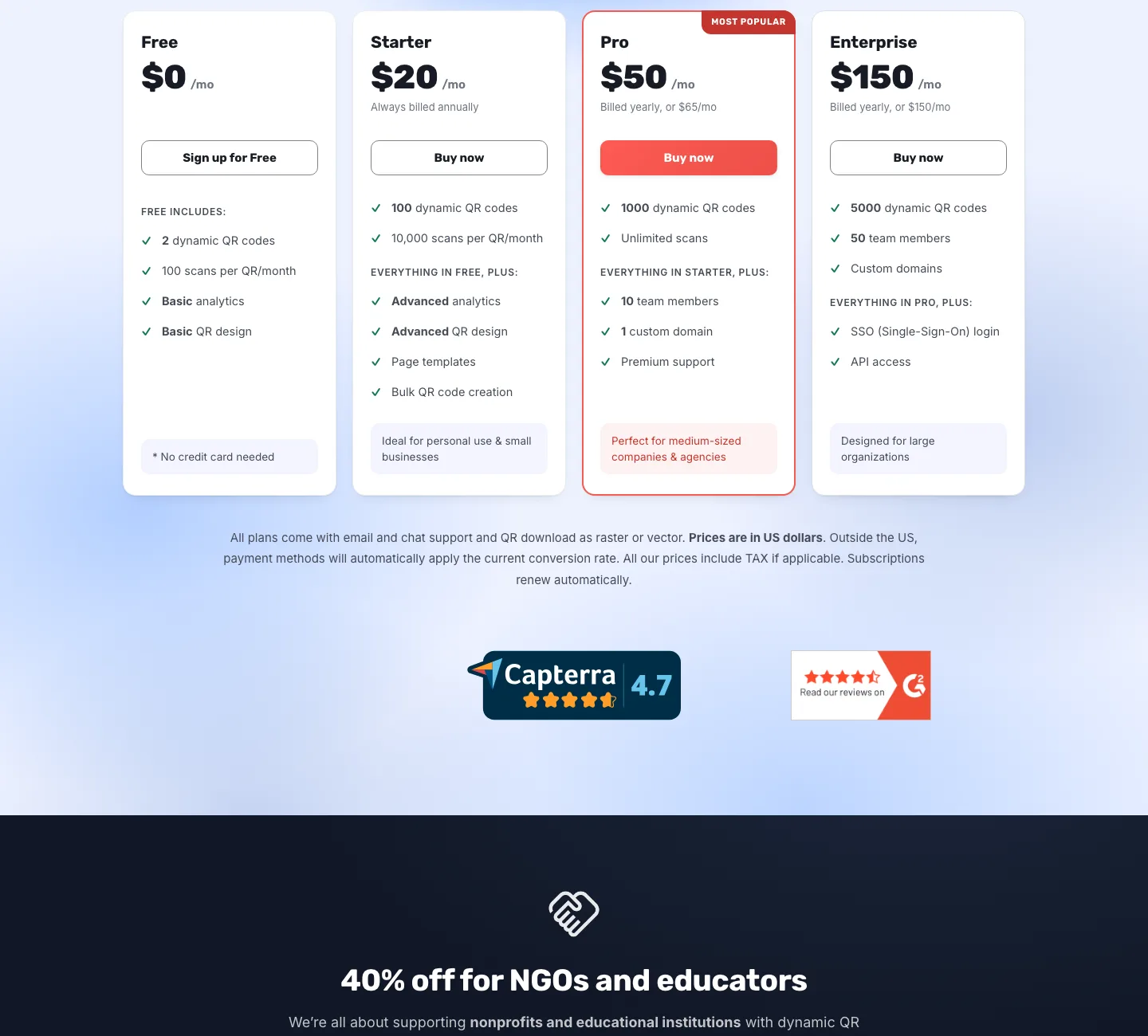
Prices and limits were read on each vendor's public pricing page on 5 October 2026 and match the plan grids shown below, captured on 7 October and 22 September. Where a vendor's site states two different figures, both are given. Re-verified quarterly. How we compare QR platforms explains the method.
Who the two platforms are
QRCodeKIT built the first dynamic QR code in 2009 and has run them continuously since. It was first to launch the digital business card QR and the menu QR, and first to put an AI agent inside a code. Its redirect infrastructure has resolved more than 1.2 billion scans and has been stress-tested at the Oscars, the Super Bowl and MotoGP. It is used by teams at Apple, Amazon, Netflix, Nike, Coca-Cola, Unilever, Nestlé, Tetra Pak, Philips, Walmart, LEGO and NASA, with published case studies from Qatar Airways, Karl Lagerfeld, Boca Juniors, PortAventura World and the University of Bologna. It has been certified to ISO 9001, 27001 and 14001, is GDPR compliant, and hosts the platform on AWS EU regions.
QR.io is a QR code generator its founders launched "right when the covid pandemic started", building version 1 in 30 days. It sells one plan, monthly or yearly, with unlimited codes and scans, landing pages, the API, bulk creation and five team members, after a 7-day free trial. Its terms, privacy policy and disclaimer refer to the company only as "QR.io", without a legal name, address or jurisdiction.
This is a comparison between a simple, single-price generator and a platform that has spent seventeen years making the code itself do more.
What QRCodeKIT does that QR.io does not
- Free dynamic codes that never stop. Two dynamic codes free for life, editable and tracked, with 100 scans per code each month, renewing, and no ads. QR.io's free trial lasts 7 days, and its FAQ says static codes are the ones that "will continue to work after the free trial expires".
- Cleo, an AI agent at the scan. Trained on the owner's content, answering whoever scans in more than 40 languages. QR.io publishes no AI features.
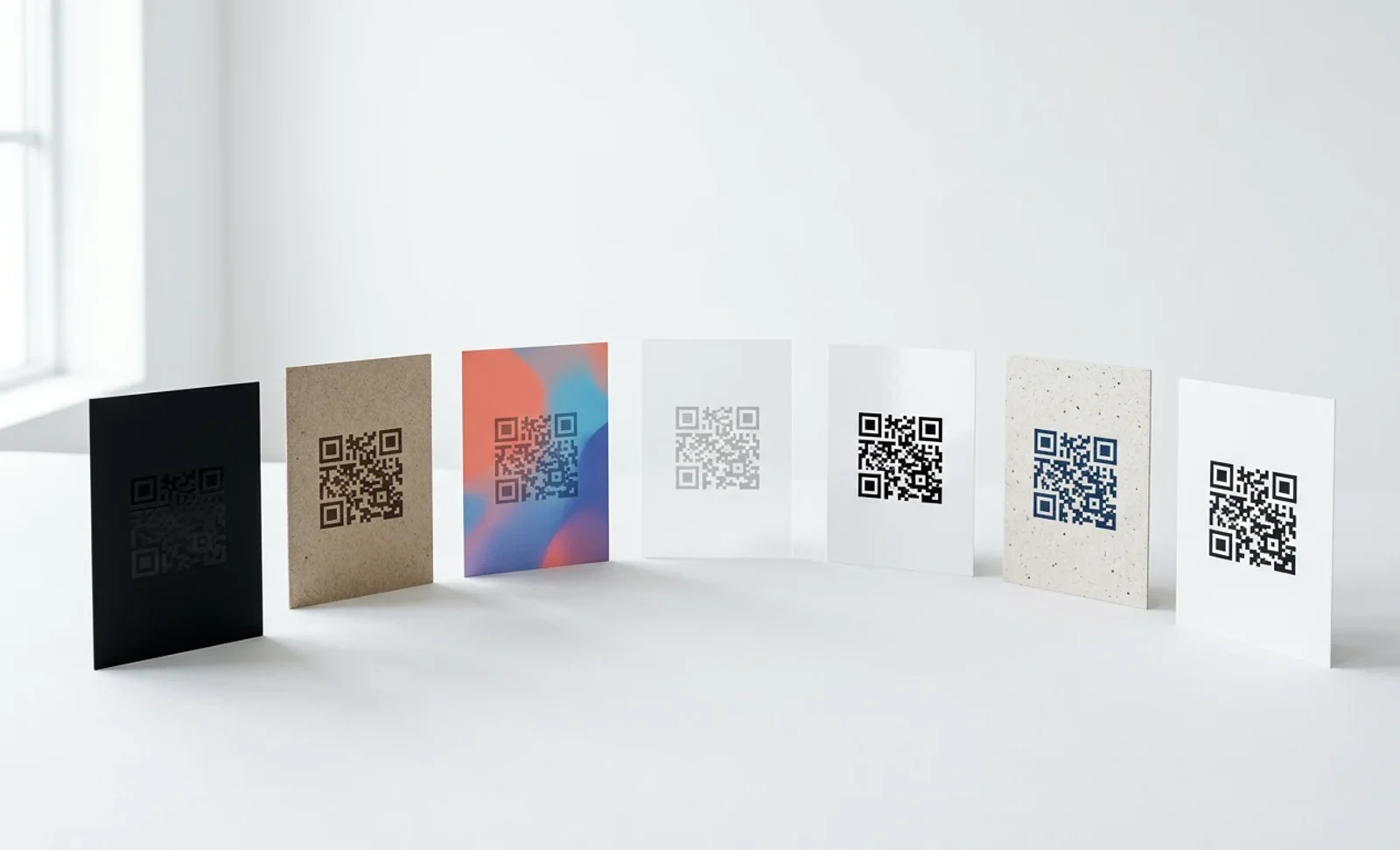
- Invisible QR codes. A design mode that removes the solid background and lets the code sit inside artwork with only the corner markers firm, exported as background-free PNG or SVG for Figma, Illustrator, InDesign and Canva.
- Google Reviews codes with AI-drafted reviews. A star, three questions, a drafted review, with a threshold that routes low scores to private feedback.
- 22 native code types, including payment through Stripe or PayPal, menu, multilingual, form, digital business card and GS1 Digital Link. QR.io does not publish a list of its types.
- Automations and integrations. Zapier, Make, n8n and Canva, plus webhooks on scan, form and payment events, and Google Analytics 4. QR.io publishes its API and no integrations.
- An MCP connector on every plan, including free, for Claude, ChatGPT, Cursor, VS Code and Windsurf.
- Seats and a custom domain on Pro. Ten seats and a domain you own at $50, fifty seats, several domains and SSO on Enterprise. QR.io includes five team members and lists no custom domain.
- Stated EU hosting and GDPR compliance. AWS EU regions, with transfer terms in the privacy policy. QR.io's privacy policy names no hosting location and makes no GDPR statement.
What QR.io does that QRCodeKIT does not
- Unlimited codes and scans at a single price. $39.99 a month, or $350 a year, for as many codes as you need. QRCodeKIT counts codes by plan: 100 on Starter, 1,000 on Pro, 5,000 on Enterprise.
- The API and bulk creation on its only plan. QRCodeKIT includes bulk creation from Starter and reserves the API for Enterprise.
- One plan, no tiers to choose between.
Plans, pricing and billing
| QRCodeKIT | QR.io | |
|---|---|---|
| Free | 2 dynamic codes for life, 100 scans per code per month renewing, editable destinations, no ads, analytics included | 7-day free trial; afterwards static codes keep working |
| Paid plans | Starter $20/mo billed yearly: 100 codes, 10,000 scans per code per month. Pro $50/mo billed yearly or $65 monthly: 1,000 codes, unlimited scans, 10 seats, 1 custom domain. Enterprise $150/mo, yearly or monthly: 5,000 codes, 50 seats, several custom domains, SSO, API | One plan, $39.99 billed monthly or $350 for 12 months: unlimited codes and scans, landing pages, scan statistics, API, bulk creation, 5 team members |
| Custom domain | From Pro at $50 | Not listed |
| Monthly billing | Pro and Enterprise; Starter yearly | Yes |
| Refunds | 7-day money-back | 7 days in full; renewals not refunded; may be declined for "excessive usage" in the refund period |
QR.io is the simpler buy: one plan, no tiers, unlimited codes. Up to 100 codes QRCodeKIT costs less, $240 a year on Starter against QR.io's $350, and it is the only one of the two with a free plan that keeps dynamic codes working. Beyond 100 codes QR.io's unlimited plan costs less than Pro at $600 a year; what Pro adds is a custom domain you own and ten seats, which QR.io does not list at any price. Full detail on the QRCodeKIT pricing page.
Put it into practice
Create a dynamic QR code free and see it work. No credit card required.
Get started freeWhat happens to printed codes over time
A QR code is a promise that a piece of print will keep working, and the two platforms keep it on different terms at the start and similar ones afterwards.
At the start, QR.io's dynamic codes depend on the trial and then on a subscription; its FAQ says static codes are what keep working after the 7-day trial. QRCodeKIT's two free codes stay editable and tracked for life, so a code printed today works in five years whether or not you ever subscribe.
After a subscription, both behave the same way: QR.io's refund policy says that after you cancel, "your QR Codes will go into paused mode" and come back when you resubscribe; on QRCodeKIT, codes on a lapsed paid plan are deactivated and return on renewal, with the account and its data kept.
A code printed on either platform's default domain resolves through that platform only. QRCodeKIT lets you print on a domain you own from Pro, which makes codes portable; QR.io does not list a custom domain.
Analytics, integrations and team controls
| QRCodeKIT | QR.io | |
|---|---|---|
| Scan analytics | Total and unique visits, OS, country, city, time series; PDF and XLS export per code and per project; history not capped by plan | Scan statistics: how many, when and where |
| Integrations | Google Analytics 4 and UTM; automations to Zapier, Make, n8n and Canva; webhooks on scan, form and payment events; retargeting as an add-on on higher plans | API |
| API | Enterprise: REST, full CRUD on every type, analytics endpoints | Included |
| AI assistants | MCP connector on every plan, including free | None published |
| Team and governance | 10 seats on Pro, 50 on Enterprise; Admin, Editor and billing roles; SSO through Okta and ADFS on Enterprise | 5 team members |
If you want the API without an enterprise contract, QR.io includes it. If your codes need to feed Zapier, Make or n8n, fire webhooks on scans, forms and payments, be managed from an AI assistant, or report more than counts by time and place, QRCodeKIT does that from its first plans.
AI and assistants
QR.io publishes no AI features and no MCP server. QRCodeKIT's MCP connector, included on every plan including free, lets Claude, ChatGPT, Cursor, VS Code or Windsurf create, list, download and delete codes in plain language.
QRCodeKIT's AI also sits in the code itself. Cleo talks to the person who scanned the code, in their language, about the owner's own content; the AI generates imagery into the code (artistic codes, more than 90 percent fully scannable) and writes for the customer (Google Reviews). QRCodeKIT was the first QR platform to put an agent inside the code.
Compliance, hosting and trust
QRCodeKIT has been certified to ISO 9001, ISO 27001 and ISO 14001, complies with ISO/IEC 18004, is GDPR compliant, and has run a security operation with 24/7 monitoring and above 99 percent uptime for seventeen years, through the biggest live broadcasts a QR code has appeared in. It hosts the platform on AWS EU regions, with international transfer terms in its privacy policy.
QR.io's privacy policy describes its security measures in general terms, refers to the US Fair Information Practice Principles, and names no hosting location, no GDPR position and no certification. Its legal pages do not name the company behind it. For a buyer with a procurement questionnaire or a data-residency requirement, those are the questions to put to QR.io in writing.
Verdict: which should you choose?
Choose QR.io if you want one plan with unlimited codes and the API included, you are comfortable paying from the first week, and your codes do not need integrations, AI, a custom domain or more than five people on the account.
Choose QRCodeKIT if the code carries your brand: if a free code must still work in five years; if it needs to be a payment, a menu, a multilingual page or a GS1 Digital Link; if it has to sit invisibly inside artwork, answer customers through Cleo or draft their Google reviews; if it feeds automations or an AI assistant; if you want ten seats and a domain you own at $50; and if you want stated EU hosting and seventeen years of resolving scans behind your print, on a platform that has been certified to ISO 9001, 27001 and 14001.
Frequently asked questions
Which platform has been around longer?
QRCodeKIT: it built the first dynamic QR code in 2009 and has resolved more than 1.2 billion scans since, on infrastructure stress-tested at the Oscars, the Super Bowl and MotoGP. QR.io's about page says it launched at the start of the covid pandemic, in 2020.
Does QR.io have a free plan?
No. It offers a 7-day free trial, and its FAQ says static codes keep working after the trial expires; dynamic codes need a subscription. QRCodeKIT's two free dynamic codes stay editable and tracked for life.
What can QRCodeKIT do that QR.io cannot?
Keep two dynamic codes free for life; put Cleo, an AI agent, at the scan; make codes invisible inside artwork; draft Google reviews with AI; offer 22 native types including payment, menu, multilingual and GS1 Digital Link; run automations to Zapier, Make and n8n with webhooks; connect AI assistants through MCP; include ten seats and a custom domain on Pro; and state EU hosting.
What can QR.io do that QRCodeKIT cannot?
Sell unlimited codes and scans on a single plan, with the API and bulk creation included, at $39.99 a month or $350 a year.
Is QR.io cheaper than QRCodeKIT?
It depends on volume. Up to 100 codes QRCodeKIT is cheaper: Starter is $240 a year against QR.io's $350, and QRCodeKIT also has a free plan. Beyond 100 codes QR.io's unlimited plan costs less than QRCodeKIT's Pro at $600 a year, which adds ten seats and a custom domain you own.
Do both have a money-back guarantee?
Yes, both give a full refund within 7 days of purchase. QR.io's policy excludes renewals and lets it decline a refund for "excessive usage" during that period.
What happens to my QR.io codes if I cancel?
QR.io says they go into "paused mode" and come back when you resubscribe. Codes on its default domain resolve through QR.io only, and it lists no custom domain, so moving them means reprinting.
Related articles

QRCodeKIT vs Uniqode: the 2026 comparison
QRCodeKIT vs Uniqode compared on track record, advanced QR features, plans and billing, what happens to printed codes over time, analytics, compliance, hosting…
QRCodeKIT vs Bitly: the 2026 comparison for QR codes
QRCodeKIT vs Bitly compared for QR codes: track record, what the code itself can do, plans and quotas, what happens to printed codes over time, analytics,…
QRCodeKIT vs QR TIGER: the 2026 comparison
QRCodeKIT vs QR TIGER compared: track record, what the code itself can do, plans and billing, what happens to printed codes over time, analytics, compliance,…
Two free dynamic QR codes. Yours forever.
No credit card. No expiry. The original dynamic QR platform since 2009.